'Zoomable' map of poplar proteins offers new view of bioenergy crop
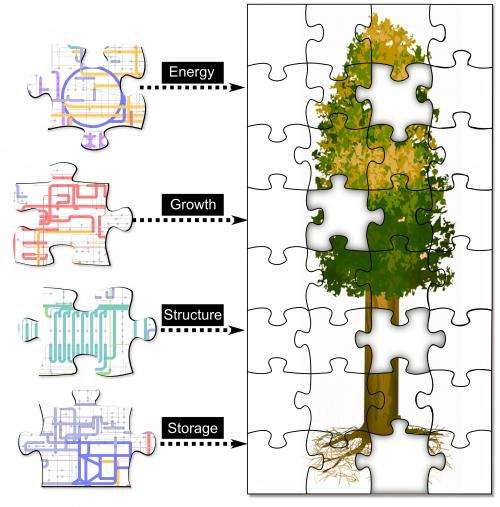
(Phys.org)—Researchers seeking to improve production of ethanol from woody crops have a new resource in the form of an extensive molecular map of poplar tree proteins, published by a team from the Department of Energy's Oak Ridge National Laboratory.
Populus, a fast-growing perennial tree, holds potential as a bioenergy crop due to its ability to produce large amounts of biomass on non-agricultural land. Now, a study by ORNL scientists with the Department of Energy's BioEnergy Science Center has provided the most comprehensive look to date at poplar's proteome, the suite of proteins produced by a plant's cells. The study is featured on the cover of January's Molecular and Cellular Proteomics.
"The ability to comprehensively measure genes and proteins helps us understand the range of molecular machinery that a plant uses to do its life functions," said ORNL's Robert Hettich. "This can provide the information necessary to modify a metabolic process to do something specific, such as altering the lignin content of a tree to make it better suited for biofuel production. "
The ORNL research team measured more than 11,000 proteins in different parts of poplar, including mature leaves, young leaves, roots and stems. This systematic approach yielded a so-called proteome atlas, which maps out the proteins present in the various tissue types at a given point in time. Lead coauthors Paul Abraham and Richard Giannone describe how the atlas offers a broad overview of the poplar proteome and also the ability to zoom in on specific biological features, such as pathways and individual proteins.
"We tried to provide a zoomable view, like Google maps, so you can look at the system from various perspectives," Abraham said. "By having these different viewpoints, it makes it easier to mine out the relevant biological information."
Obtaining and analyzing information about plant proteomes is especially tricky, considering a plant such as poplar can potentially manufacture more than 40,000 different proteins. Unlike an organism's genome, which is the same for every cell and remains constant, the proteome varies from cell to cell and changes over time as the plant adapts to different environmental conditions.
"The analytical techniques we've demonstrated allow us to measure the range of proteins very deeply and specifically, so we can start to figure out, for instance, how the protein machinery in a leaf differs from the ones in the trunk," Hettich said. "Or we can look at a tree that's very young versus one that's very old, thus enabling us to understand how all these proteins are changing as a function of the tree growing older."
Knowing how plants change and adapt to environmental surroundings by altering their proteins could help bioenergy researchers develop poplar trees better suited to biofuel production.
"It's the proteins that directly alter the morphology, anatomy, and function of a plant cell," Abraham said. "If we can identify the proteins that create a favorable trait such as fast growth, then we can incorporate that protein or modify it to develop a superior plant with all favorable traits through transgenics."
Journal information: Molecular and Cellular Proteomics
Provided by Oak Ridge National Laboratory


