Improved performance for solar cells: Highly efficient p-type dye-sensitized solar cell with cobalt-based electrolyte
Dec 04, 2012

(Phys.org)—Photovoltaics continues to be an expensive technology. Dye-based solar cells may represent a more cost-effective alternative to traditional solar cells. In these cells, a dye is used in place of a semiconductor to trap the light. Tandem cells consisting of both a conventional n-type and an "inverse" p-type dye-sensitized solar cell seem to be especially promising. In the journal Angewandte Chemie, a team of Australian and German scientists has now reported a significant increase in the degree of efficiency of p-type dye-sensitized solar cells through use of an electrolyte based on a cobalt complex.

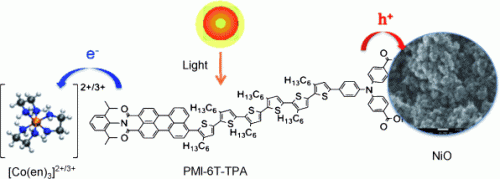
Conventional n-type dye-sensitized solar cells use a photoanode, a positive electrode coated with an n-type semiconductor, such as , and a dye. When light strikes the electrode, the become excited and release electrons—negative charges, hence the n in n-type—and "inject" them into the n-type semiconductor. The redox mediator, a component of the electrolyte that can move freely between the electrodes, regenerates the dye by resupplying it with electrons from the counter electrode. In a p-type cell, the process is reversed: a special dye and a p-type semiconductor are located on a photocathode. The light-activated dye "sucks" electrons out of the valence band of a p-type semiconductor such as . This effectively transfers "electron holes"—positive charges, hence the p in p-type—from the dye. The redox mediator takes the electrons from the dye and hands them over to the counter electrode.

A very promising approach for increasing the performance of is to combine both an n-type and a p-type dye-sensitized solar cell to make a tandem cell. However, despite some progress, the performance of the p-type cells still significantly lags behind that of their n-type counterparts. An international team of researchers from Monash University and the Commonwealth Scientific and Industrial Research Organization (Australia), as well as the University of Ulm (Germany), have now achieved a considerable improvement in the efficiency of p-type cells by choosing a different redox mediator.

Researchers working with Udo Bach and Leone Spiccia replaced the previous, commonly used iodide and triiodide system with a well-known cobalt complex, tris(ethylenediamine)cobalt(II)/(III), in which the cobalt can switch between the +2 and +3 oxidation states. The advantage of this system is that the redox potential is significantly lower. As a result, the open-circuit voltage, a critical parameter for , is doubled and there is still a high enough driving force to ensure rapid and efficient regeneration of the spent dye. These devices achieve an energy-conversion efficiency of 1.3 %, while previous systems attained a maximum of only 0.41 %. The p-type dye-sensitized solar cell with the cobalt-based redox mediator even gave promising performance data under diffuse sunlight experienced on cloudy days.

Explore further: Graetzel cells are implanted in an iPad keyboard

More information: Bach, U. Highly Efficient p-Type Dye-Sensitized Solar Cells based on Tris(1,2-diaminoethane)Cobalt(II)/(III) Electrolytes, Angewandte Chemie International Edition, dx.doi.org/10.1002/anie.201206219.

Related Stories

Dye-sensitized solar cells break a new record

Nov 14, 2011

(PhysOrg.com) -- Dye-sensitized Grätzel solar cells have just set a new efficiency benchmark. By changing the composition and color of the cells, an EPFL team has increased their efficiency to more than ...

Substantial improvement in essential cheap solar cell process

Mar 20, 2008

A cheap alternative to silicon solar cells can be found in dye-sensitised solar cells. This type of cell imitates the natural conversion of sunlight into energy by, for instance, plants and light-sensitive bacteria. Annemarie ...

Recommended for you

Beautiful 'flowers' self-assemble in a beaker

May 16, 2013

By simply manipulating chemical gradients in a beaker of fluid, materials scientists at Harvard have found that they can control the growth behavior of crystals to create precisely tailored structures—such ...

User comments : 3

Adjust slider to filter visible comments by rank

Display comments: newest first

Sonhouse
5 / 5 (1) Dec 04, 2012
If they really really work at it they may get all the way to two percent!
natello
not rated yet Dec 04, 2012
The photochemical solar cells with aqueous solutions will never replace the solid-state solar cells from apparent reason: it's way more convenient to connect the solar cells to electrolyzer in the basement, than to install some water filled construction and pipes at the roof. In addition, the separation of photolysis into two separate processes enables to optimize them separately and as such more easily. But the main problem here is, the stability of organic molecules in water solutions exposed to sunlight is generally very low and they degrade fast. This is how every poster appears at sunlight after few months...
natello
not rated yet Dec 04, 2012
BTW The titanium dioxide covered surfaces were proposed as a self-cleaning surfaces just with respect to the fact, they do absorb UV light and they degrade most of organic matter fast. The above solar cell just utilizes the ability of titanium dioxide particles to inject holes into molecules of the dye. Only few organic dyes can survive such a treatment for prolonged time. And ethylenediamine complexes are particularly prone to oxidation like most of organic amines.

More news stories

Attacking MRSA with metals from antibacterial clays

In the race to protect society from infectious microbes, the bugs are outrunning us. The need for new therapeutic agents is acute, given the emergence of novel pathogens as well as old foes bearing heightened antibiotic resistance.

Beautiful 'flowers' self-assemble in a beaker

By simply manipulating chemical gradients in a beaker of fluid, materials scientists at Harvard have found that they can control the growth behavior of crystals to create precisely tailored structures—such ...

Making gold green: New non-toxic method for mining gold

Northwestern University scientists have struck gold in the laboratory. They have discovered an inexpensive and environmentally benign method that uses simple cornstarch—instead of cyanide—to isolate gold from raw materials ...

US seizes Bitcoin operator accounts

US authorities seized the accounts of a Bitcoin digital currency exchange operator, claiming it was functioning as an "unlicensed money service business," court documents showed Friday.

Alaska volcano shoots ash 15,000 feet into the air

(AP)—One of Alaska's most restless volcanoes has shot an ash cloud 15,000 feet into the air in an ongoing eruption that has drawn attention from a nearby community but isn't expected to threaten air traffic.

Chinese, Indian airlines face EU pollution fines

Eight Chinese and two Indian airlines face fines of up to several million euros for not paying for their greenhouse gas emissions during flights within the bloc, the European Commission said on Friday.