Scientists develop indium-free organic light-emitting diodes
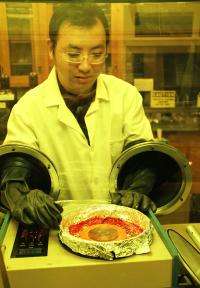
(Phys.org)—Scientists at the U.S. Department of Energy's (DOE) Ames Laboratory have discovered new ways of using a well-known polymer in organic light emitting diodes (OLEDs), which could eliminate the need for an increasingly problematic and breakable metal-oxide used in screen displays in computers, televisions, and cell phones.
The metal-oxide, indium tin oxide (ITO), is a transparent conductor used as the anode for flat screen displays, and has been the standard for decades. Due to indium's limited supply, increasing cost and the increasing demand for its use in screen and lighting technologies, the U.S. Department of Energy has designated indium as "near-critical" in its assessment of materials vital to clean energy technology. Scientists have been working to find an energy efficient, cost effective substitute.
"There are not many materials that are both transparent and electrically conductive," said Joseph Shinar, an Ames Laboratory Senior Scientist. "One hundred percent of commercial display devices in the world use ITO as the transparent conducting electrode. There's been a big push for many years to find alternatives."
"Everybody is trying to find a replacement for ITO, many working with zinc oxide, another metal oxide. But here we are working towards something different, developing ways to use a conducting polymer," said Min Cai, a post-doctoral research scientist in the Ames Laboratory and the Dept. of Physics and Astronomy at Iowa State University.
The polymer's name is a mouthful of a word: poly (3,4-ethylene dioxythiophene):poly(styrene sulfonate), known as PEDOT:PSS for short, and has been around for about 15 years. Until recently, the material wasn't sufficiently conductive or transparent enough to be a viable ITO substitute, Shinar said. But by using a multi-layering technique and special treatments, Cai and his fellow scientists were able to fabricate PEDOT:PSS OLEDs with vastly improved properties.
"Compared to an ITO anode device, the PEDOT:PSS device is at least 44 percent more efficient," said Cai. According to Joe Shinar, that gain in efficiency over ITO-based technology is the highest yet recorded.
The researchers used computer simulations to show that the enhanced performance is largely an effect of the difference in the optical properties between the polymer- and ITO-based devices.
Another key property of PEDOT:PSS is flexibility; using ITO in OLEDs defeats one of OLED's big pluses compared to conventional LED technology.
"OLEDs can be made on a flexible substrate, which is one of their principal advantages over LEDs. But ITO is ceramic in nature; it is brittle rather than flexible," said Ruth Shinar, a Senior Scientist at Iowa State University's Microelectronics Research Center.
The findings, co-authored by Joseph Shinar and Ruth Shinar along with Min Cai, Zhuo Ye, Teng Xiao, Rui Liu, Ying Chen, Robert W. Mayer, Rana Biswas, and Kai-Ming Ho, were recently published in Advanced Materials.
The research builds on continuing work to find more affordable and efficient manufacturing materials and processes for OLED manufacturing. An earlier paper published in Advanced Materials by Joseph Shinar and Ruth Shinar along with Min Cai, Teng Xiao, Emily Hellerich, and Ying Chen demonstrated the use of solution processing for small molecule-based OLEDs, which are typically constructed using a more expensive thermal evaporation deposition process.
The scientists' ongoing investigations into better materials and processes pave the way to more cost-efficient manufacturing and making OLED technology more widely available to consumers.
Joseph Shinar said that OLED televisions were already available to a limited high-end consumer, and that prices would come down as major manufacturers perfected their production processes. Both Samsung and LG exhibited a 55-inch OLED TV as a highlight feature of the 2012 Consumer Electronics Show in Las Vegas in January.
"We are already getting there with OLED televisions. Consumers will see them getting more affordable and more widely available in the very near future," said Joseph Shinar.
Shinar said the technology was also beginning to be used in lighting, in applications where diffuse light is preferred instead of point source lighting, and in architectural and art design.
Journal information: Advanced Materials
Provided by Ames Laboratory


