Disappearing light: Precision measurement of an atomic transition
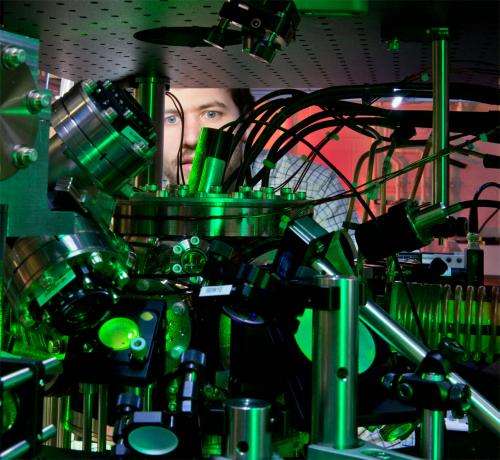
(Phys.org)—Modern precision measurements are spectacular feats of engineering. An excellent example is determining the passage of time. Before John Harrison's marine chronometer in the mid 18th century, ship clocks lost so much time that the sailors themselves often became lost as well. Today's global positioning system (GPS) relies on rubidium and cesium atomic clocks aboard satellites. These clocks, precise to about one second per 30,000 years are far better than those used in the early days of navigation. Currently, the most accurate clock in the world is located at NIST in the lab of 2012 Nobel Prize recipient David Wineland. He uses quantum logic and an atomic ion to make a clock that is off by only one second over about 4 billion years. While not every application requires a clock of this caliber, scientists are continually looking to improve time-keeping, whether it is for defining the second* or for GPS. One essential ingredient for improvement is a better understanding of the properties of the atoms used in these types of clocks.
In a recently accepted Physical Review Letter, JQI researchers present a novel method to measure the strength of two of rubidium's atomic transitions with unprecedented accuracy. Lead author and graduate student Creston Herold explains, "While our measurement only has a slight impact on the precision of rubidium atomic clocks, this proof-of-principle experiment could be extended to improve next generation clocks built from other elements of the periodic table."
Unlike Harrison's spring-and-gear based clocks, the "ticks" of today's atomic clocks are based on the energy levels that arise from the interactions of the swirling electrons and nucleus within an atom. Scientists can measure an atom's ticking rate by adjusting the frequency of electromagnetic radiation, from an outside source, to precisely match the separation between energy levels. When matched, the radiation causes electrons to undergo transitions.
Similar to Harrison's mechanical clocks, an atom's ticking rate depends on environmental factors, such as temperature. For instance, the blackbody radiation shift (BBR) happens because everything, including atomic clocks, is bathed in infrared radiation emitted from the environment due to its temperature. The presence of this light can slightly shift the energy separation between the levels. Accounting for these shifts is currently one of the most important limitations on precision clocks. While physicists can estimate the atomic transition amplitudes that determine the sensitivity to spurious radiation, experimental atomic spectroscopy is necessary to constrain and provide a benchmark for theoretical calculations.
BBR falls under the umbrella of radiation-induced changes in energy levels—or light shifts. In this experiment, lasers are the primary source of radiation. In order to measure transition amplitudes, or how strongly an atom interacts with the laser light, scientists must apply a probe. The problem is that the probes for atoms are also electromagnetic fields themselves, influencing the measurement. Such a circular solution can sometimes limit the measurement accuracy.
To circumvent this, the JQI scientists apply laser beams in such a way that cumulatively the light shifts due to the probe cancel. Only when the light has a certain wavelength will the contributions from different transitions exactly cancel – a "magic" wavelength where the atoms no longer feel the presence of the light.
In the experiment, a cloud of rubidium atoms is cooled close to absolute zero where it forms a state of matter called a Bose-Einstein condensate (BEC). Then, the atoms are diffracted by a standing wave of laser light. Because the atoms in a BEC act like waves, much like ripples on a pond encountering an obstacle, they form an interference pattern with peaks and valleys. The height of these peaks and valleys depends on the wavelength of the laser light. Interference patterns only occur when the atoms experience a light shift.
The scientists can use an instrument called a wavemeter to determine the color of the standing wave precisely. This tells them not only exactly what shade of blue the light is (~420 nanometers), but also that the uncertainty is 50 femtometers (10-15 m). To give a sense of scale, this would be like knowing the weight of a 150 lb person to 0.0003 ounces, which is about the weight of a strand of hair.
As the scientists tune the wavelength of light close to the point where the light shift disappears, the diffraction signal necessarily diminishes because the laser light becomes invisible to the rubidium atoms. So how can they achieve such precision when the atoms barely feel the light? They use a trick of applying the standing wave repeatedly such that the interference effects add up. In this way, tiny light shifts can be detected (see animation). With this method, the team determines the transition strength to an accuracy of 0.3 %. Using the weight analogy, this is about half a pound, or the resolution of your bathroom scale. This seems like a lot compared to the wavemeter, but it is in fact 10 times better than previous theoretical calculations of this atomic transition.
Current methods for determining transition strengths involves measuring an excited state's lifetime, which is the length of time an excited electron can stay this way before it decays. This method is limited because of uncertainty in the different decay pathways. Other methods that involve laser illumination are inherently uncertain because measuring optical intensity independently of the atom, say with a detector, is limited by the detector itself. In other words, counting photons is hard (see this article on single photon detection).
One of the ultimate goals of this research is to mix ultracold ytterbium and rubidium together in such a way that the ytterbium "sees" the laser light and the rubidium is "blind." For this reason, they were motivated to make the precision measurement presented here. Due to technical nature of these kinds of experiments, using multiple types of atoms is quite difficult, requiring many more lasers of different colors. This team is one of a handful of groups that will study these types of mixtures. Some of the questions they will attempt to answer are related to dissipation, where energy from the ytterbium atoms can be removed and absorbed by a rubidium bath.
More information: Herold, C.D., et al., Precision Measurement of Transition Matrix Elements via Light Shift Cancellation, Physical Review Letters early December, 2012.
Journal information: Physical Review Letters
Provided by University of Maryland


