New metamaterial lens focuses radio waves: Device could improve satellite and molecular imaging
Nov 14, 2012 by Jennifer Chu
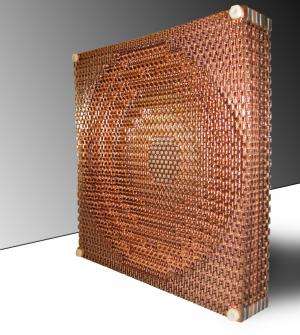
The orientation of 4,000 S-shaped units forms a metamaterial lens that focuses radio waves with extreme precision, and very little energy lost. Credit: Dylan Erb

In many respects, metamaterials are supernatural. These manmade materials, with their intricately designed structures, bend electromagnetic waves in ways that are impossible for materials found in nature. Scientists are investigating metamaterials for their potential to engineer invisibility cloaks—materials that refract light to hide an object in plain sight—and "super lenses," which focus light beyond the range of optical microscopes to image objects at nanoscale detail.

Researchers at MIT have now fabricated a three-dimensional, lightweight metamaterial that focuses with . The concave lens exhibits a property called negative , bending electromagnetic waves—in this case, radio waves—in exactly the opposite sense from which a normal concave lens would work.

Concave lenses typically radiate radio waves like spokes from a wheel. In this new metamaterial lens, however, radio waves converge, focusing on a single, precise point—a property impossible to replicate in .

For Isaac Ehrenberg, an MIT graduate student in mechanical engineering, the device evokes an image from the movie "Star Wars": the Death Star, a space station that shoots from a concave dish, the lasers converging to a point to destroy nearby planets. While the researchers' fabricated lens won't be blasting any in the near future, Ehrenberg says there are other potential applications for the device, such as molecular and deep-space imaging.

"There's no solid block of any material in the periodic table which will generate this effect," Ehrenberg says. "This device refracts radio waves like no other material found in nature."

Ehrenberg published the results of his research in the . His co-authors on the paper are Sanjay Sarma, the Fred Fort Flowers and Daniel Fort Flowers Professor of Mechanical Engineering at MIT, and Bae-Ian Wu, a researcher at the Air Force Research Laboratory.

Shaping a cell

A metamaterial's extraordinary properties are determined largely by its structure—similar to how a diamond's crystals impart strength. A material can refract light differently depending on the shape of individual units within a material, and the arrangement of those units as a whole.

Prior to this recent paper, Wu and others have studied how certain shapes of metamaterials can affect the propagation of . The team came up with a blocky, S-shaped "unit cell" whose shape refracts radio waves in particular directions. Ehrenberg used the unit shape as the basis for his concave lens, creating the rough shape from more than 4,000 unit cells, each only a few millimeters wide.

To fabricate his design, Ehrenberg utilized 3-D printing, building a lens layer by intricate layer from a polymer solution. He then washed away any residue with a high-pressure water jet and coated each layer with a fine mist of copper to give the lens a conductive surface.

To test the lens, the researchers placed the device between two radio antennae and measured the energy transmitted through it. Ehrenberg found that most of the energy was able to travel through the lens, with very little lost within the metamaterial—a significant improvement in energy efficiency when compared with past negative-refraction designs. The team also found that radio waves converged in front of the lens at a very specific point, creating a tight, focused beam.

Imaging space and beyond

Sarma says the combination of the device's "low loss" and tight focus is a promising step toward engineering practical metamaterial lenses.

"There are a lot of phenomena in the world that you can demonstrate, but whether you can achieve it at scale is the issue," Sarma says. "We've taken the negative refraction concept from the realm of proof-of-concept to the realm of practicality."

The device, which weighs less than a pound, may be used to focus radio waves precisely on molecules to create high-resolution images—images that are currently produced using bulky, heavy and expensive lenses. Ehrenberg says that such a lightweight device could also be mounted on satellites to image stars and other celestial bodies in space, "where you don't want to bring up a hefty lens."

Cheng Sun, an assistant professor of mechanical engineering at Northwestern University, says the metamaterial design is a promising demonstration that may lead to stronger, faster telecommunications.

"The low-loss design can be considered a significant step forward toward practical applications at microwave or radio-frequencies ranges," Sun says.

Beyond the lens' applications, Ehrenberg says its fabrication is simple and easily replicated, allowing other scientists to investigate 3-D metamaterial designs.

"You can really fully explore the space of metamaterials," Ehrenberg says. "There's a whole other dimension that now people will be able to look into."

Explore further: New metamaterials device focuses sound waves like a camera lens

More information: Paper: "A three-dimensional self-supporting low loss microwave lens with a negative refractive index" jap.aip.org/resource/1/japiau/v112/i7/p073114_s1

Related Stories

Novel man-made material could facilitate wireless power

May 23, 2011

Electrical engineers at Duke University have determined that unique man-made materials should theoretically make it possible to improve the power transfer to small devices, such as laptops or cell phones, or ultimately to ...

Next generation lens promises more control

Dec 20, 2009

(PhysOrg.com) -- Duke University engineers have created a new generation of lens that could greatly improve the capabilities of telecommunications or radar systems to provide a wide field of view and greater ...

Recommended for you

Promising doped zirconia

May 17, 2013

Materials belonging to the family of dilute magnetic oxides (DMOs)—an oxide-based variant of the dilute magnetic semiconductors—are good candidates for spintronics applications. This is the object of ...

Bringing life into focus

May 17, 2013

Spinning-disk confocal microscopy is an optical imaging technique that can be used to generate detailed three-dimensional fluorescence images of living cells and their contents. Although a powerful tool for ...

Nanocrystals grow from liquid interface

May 17, 2013

An international collaboration of scientists has discovered a unique crystalizing behavior at the interface between two immiscible liquids that could aid in sustainable energy development.

User comments : 11

Adjust slider to filter visible comments by rank

Display comments: newest first

natello
5 / 5 (2) Nov 14, 2012
..In many respects, metamaterials are supernatural...
Metamaterials are widespread in nature - they're forming photonic mirrors and waveguides for invertebrates (beetles, moths) and many birds. And their principle is actually quite simple and nothing miraculous is about it. There is an animation, which illustrates how this focusing appears at the microscopic scale of evanescent waves, which are spreading along surfaces of metamaterial foam. Note that these waves are seemingly "moving" faster than the original waves, they're doing strange "quantum movements" during this and they even tend to move backward during certain time/space intervals, so they're violating causality heavily. Analogous process occurs during spreading of light waves through optical metamaterials inside of insect wings etc.
drhoo
not rated yet Nov 14, 2012
Curious about the bandwidth over which the effect occurs. Surely they do not mean it works independent of frequency.
natello
not rated yet Nov 14, 2012
Curious about the bandwidth over which the effect occurs. Surely they do not mean it works independent of frequency.

It's evident from abstract: 10 - 12 GHz. It's not very much, but most of imagining devices working at microwave spectrum are essentially working with monochromatic radiation too. Even the microwave oven does generate the monochromatic radiation.
Sonhouse
not rated yet Nov 14, 2012
I wonder what it would look like for lower frequencies, say 10 mhz to 1 Ghz? That covers most of our amateur radio bands. We have a few below that frequency but I imagine the device for those lower frequencies, like 2 Mhz would be very cumbersome. The article says 'a few mm' for 10 ghz, so each one would be a few meters for 10 mhz or so it seems. And you would need a lot of them, sounds impractical for low frequencies.
indio007
not rated yet Nov 14, 2012
Why does it say radio waves when the paper is titled microwave.

I also don't think the amount of gain is very impressive.
Sonhouse
5 / 5 (2) Nov 14, 2012
Where did you read the gain figures? I don't see them in the printed piece here. In the abstract? Anyway, microwaves ARE radio waves. I guess you are stuck thinking radio means something below 300 mhz or thereabouts. Even Terahertz waves are radio waves, or long wave Infra red if you like, light is too for that matter. They are all electromagnetic waves.

I expect there will be thoughts about weaponizing this technology also. If it focuses better than a dish of the same diameter at a distance.....
indio007
not rated yet Nov 14, 2012
indio007
not rated yet Nov 14, 2012
Where did you read the gain figures? I don't see them in the printed piece here. In the abstract? Anyway, microwaves ARE radio waves. I guess you are stuck thinking radio means something below 300 mhz or thereabouts. Even Terahertz waves are radio waves, or long wave Infra red if you like, light is too for that matter. They are all electromagnetic waves.

I expect there will be thoughts about weaponizing this technology also. If it focuses better than a dish of the same diameter at a distance.....


I know they are all EM waves. I've never heard 10-12 GHZ referred to as radiowave. Even 2.4 ghz is referred to as microwave.
natello
1 / 5 (1) Nov 14, 2012
I wonder what it would look like for lower frequencies, say 10 mhz to 1 Ghz?
Of course. Actually the construction of modern high gain TV antennae is already based on well known principles of evanescent wave spreading along surfaces of 1D/2D metamaterials - just more sparse.
Jeffhans1
1 / 5 (1) Nov 14, 2012
Would this be applicable for lithography as well? Take the same concept and use it to get another few microns closer when making CPU's or memory.
vacuum-mechanics
1 / 5 (3) Nov 15, 2012
… Wu and others have studied how certain shapes of metamaterials can affect the propagation of electromagnetic waves. The team came up with a blocky, S-shaped "unit cell" whose shape refracts radio waves in particular directions.
The device, which weighs less than a pound, may be used to focus radio waves … on satellites to image stars and other celestial bodies in space…


This is interesting, but what which is more interesting is that nowadays we still do not know how electromagnetic waves could propagate without any medium as the carrier! Conventionally it was told that electromagnetic waves could be travel by themselves via mutual creation between electric and magnetic field, but the problem is that both the fields are created at the same time, then how could they do that…
http://www.vacuum...20〈=en

More news stories

New principle may help explain why nature is quantum

Like small children, scientists are always asking the question 'why?'. One question they've yet to answer is why nature picked quantum physics, in all its weird glory, as a sensible way to behave. Researchers ...

Heat-related deaths in Manhattan projected to rise

Residents of Manhattan will not just sweat harder from rising temperatures in the future, says a new study; many may die. Researchers say deaths linked to warming climate may rise some 20 percent by the 2020s, ...

Kinks and curves at the nanoscale

One of the basic principles of nanotechnology is that when you make things extremely small—one nanometer is about five atoms wide, 100,000 times smaller than the diameter of a human hair—they are going ...