Hagfish slime as a model for tomorrow's natural fabrics
Nov 28, 2012
Hagfish slime as a model for tomorrow's natural fabrics

Nylon, Kevlar and other synthetic fabrics: Step aside. If new scientific research pans out, people may be sporting shirts, blouses and other garments made from fibers modeled after those in the icky, super-strong slime from a creature called the hagfish. The study appears in ACS' journal Biomacromolecules.

Lead author Atsuko Negishi, her supervisor Douglas S. Fudge and colleagues explain that petroleum is the raw material for making modern synthetics. Rising prices and the quest for more sustainable alternatives have led scientists to consider the possibilities of using protein-based raw materials, such as spider silk. Another candidate comes from the hagfish, an eel-like fish that produces a thick slime to protect itself against predators. A single Atlantic Hagfish can produce quarts of slime in seconds. It clogs the gills and may suffocate other fish. The slime consists of tens of thousands of remarkably strong threads, each 100 times thinner than a human hair. The scientists set out to investigate spinning spider-silk-like fibers from the proteins of these slime threads.

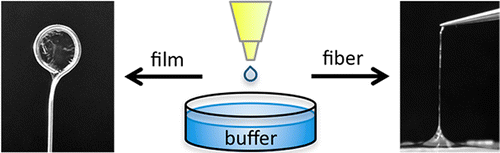
They developed a method for drawing hagfish slime thread proteins into fibers comparable to lab-made . It involved casting a thin self-supporting film of thread proteins on the surface of a salt solution, then grabbing it with forceps and lifting it upwards so it collapses into a single strand. The threads in hagfish slime, they indicate, might be models for made from renewable, naturally occurring proteins.

Explore further: The future of biomaterial manufacturing: Spider silk production from bacteria

More information: "The Production of Fibers and Films from Solubilized Hagfish Slime Thread Proteins" Biomacromolecules, 2012, 13 (11), pp 3475–3482. DOI: 10.1021/bm3011837

Abstract
Hagfish slime threads, which make up the fibrous component of the defensive slime of hagfishes, consist primarily of proteins from the intermediate filament family of proteins and possess impressive mechanical properties that make them attractive biomimetic models. To investigate whether solubilized intermediate filament proteins can be used to make high-performance, environmentally sustainable materials, we cast thin films on the surface of electrolyte buffers using solubilized hagfish slime thread proteins. The films were drawn into fibers, and the tensile properties were measured. Fiber mechanics depended on casting conditions and postspinning processing. Postsecondary drawing resulted in fibers with improved material properties similar to those of regenerated silk fibers. Structural analyses of the fibers revealed increased molecular alignment resulting from the second draw, but no increase in crystallinity. Our findings show promise for intermediate filament proteins as an alternative source for the design and production of high performance protein-based fibers.

add to favorites email to friend print save as pdf

Related Stories

Silkworms spinning spider webs

Jan 03, 2012

(PhysOrg.com) -- A spiders silk is strong and more elastic and has a large range of possible medical applications. However, spiders have a history of being territorial and prone to cannibalism, so the idea ...

Scientists film hagfish anti-shark slime weapon

Oct 28, 2011

(PhysOrg.com) -- The hagfish found in New Zealand’s deepest waters is grotesque enough, thanks to its scary protruding teeth straight from a horror film.  Now, scientists have witnessed the full ...

Hagfish found to eat through its skin

Mar 03, 2011

(PhysOrg.com) -- A new study in Canada has shown that the primitive fish called the Hagfish, which has the habit of burrowing into dead or dying creatures on the sea bed, eats by absorption through its skin ...

Why spiders don't drop off of their threads

Aug 17, 2011

It has five times the tensile strength of steel and is stronger then even the best currently available synthetic fibers: Spider thread. German scientists of the Technische Universitaet Muenchen and the Universitaet Bayreuth ...

Fascinating Spider Silk

Apr 04, 2007

Stronger than steel and more elastic than rubber: spider silk is unsurpassed in its expandability, resistance to tearing, and toughness. Spider silk would be an ideal material for a large variety of medical and technical ...

Recommended for you

New method for producing clean hydrogen

6 hours ago

Duke University engineers have developed a novel method for producing clean hydrogen, which could prove essential to weaning society off of fossil fuels and their environmental implications.

Non-wetting fabric drains sweat

May 20, 2013

(Phys.org) —Waterproof fabrics that whisk away sweat could be the latest application of microfluidic technology developed by bioengineers at the University of California, Davis.

Beautiful 'flowers' self-assemble in a beaker

May 16, 2013

By simply manipulating chemical gradients in a beaker of fluid, materials scientists at Harvard have found that they can control the growth behavior of crystals to create precisely tailored structures—such ...

User comments : 2

Adjust slider to filter visible comments by rank

Display comments: newest first

VendicarD
5 / 5 (1) Nov 28, 2012
Odd isn't it, that just shy of 50 percent of Americans think that Republican slime represents the future.
Jeddy_Mctedder
1 / 5 (2) Nov 28, 2012
Silky smooth or slimy smooth¿

More news stories

New method for producing clean hydrogen

Duke University engineers have developed a novel method for producing clean hydrogen, which could prove essential to weaning society off of fossil fuels and their environmental implications.

Protein study suggests drug side effects are inevitable

A new study of both computer-created and natural proteins suggests that the number of unique pockets – sites where small molecule pharmaceutical compounds can bind to proteins – is surprisingly small, meaning drug side ...

Beautiful 'flowers' self-assemble in a beaker

By simply manipulating chemical gradients in a beaker of fluid, materials scientists at Harvard have found that they can control the growth behavior of crystals to create precisely tailored structures—such ...

Attacking MRSA with metals from antibacterial clays

In the race to protect society from infectious microbes, the bugs are outrunning us. The need for new therapeutic agents is acute, given the emergence of novel pathogens as well as old foes bearing heightened antibiotic resistance.

If you can remember it, you can remember it wrong

(Medical Xpress)—Native peoples in regions where cameras are uncommon sometimes react with caution when their picture is taken. The fear that something must have been stolen from them to create the photo ...

B vitamins could delay dementia

(Medical Xpress)—Despite spending billions of dollars on research and development, drug companies have been unable to come up with effective treatments for dementia and Alzheimer's Disease (AD). Now, A. ...

Reducing caloric intake delays nerve cell loss

Activating an enzyme known to play a role in the anti-aging benefits of calorie restriction delays the loss of brain cells and preserves cognitive function in mice, according to a study published in the May ...