Capping ligands as selectivity switches in hydrogenation reactions
Nov 19, 2012
Capping ligands as selectivity switches in hydrogenation reactions
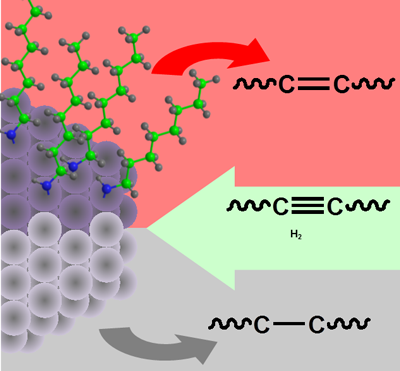
Alkyne hydrogenation on platinum nanoparticles with amine-coated (upper, red) and bare surfaces (lower, grey) produces alkene and alkane, respectively.

The role of surface modification of nanoparticle catalysts in alkyne hydrogenation reactions was systematically investigated by the Center for Nanoscale Materials' NanoBio Interfaces Group working with researchers in Argonne's Chemical Sciences & Engineering and X-Ray Science divisions. The team explains the effect of surface ligands on the selectivity and activity of platinum and Co/Pt nanoparticles using experimental and computational approaches.

A tunable balance between the energetics of alkenes at the of bare and capped nanoparticles defines the selectivity of the nanocatalyst for alkene in alkyne hydrogenation reaction. Addition of primary alkylamines to platinum and CoPt3 nanoparticle catalysts can drastically increase selectivity for alkene from 0 to more than 90% with about 99.9% conversion. Increasing the primary alkylamine coverage on the nanoparticle surface leads to a decrease in the binding energy of octenes and eventual competition between octene and primary alkylamines for adsorption sites. At sufficiently high coverage with primary alkylamine, the alkylamines dominate, which prevents further hydrogenation of alkenes into alkanes. Primary amines with different lengths of carbon chains have similar adsorption energies at the surface of catalysts and, consequently, the same effect on selectivity. When the adsorption energy of capping ligands at the catalytic surface is lower than adsorption energy of alkenes, the ligands do not affect the selectivity of hydrogenation of alkyne to alkene. On the other hand, capping ligands with adsorption energies at the catalytic surface higher than that of alkyne reduce its activity resulting in low conversion of alkynes.

The significance of this work is that catalysts with improved selectivity can profoundly reduce the amount of generated chemical waste. A clear understanding of the role of capping ligands on chemically synthesized nanoparticles while undergoing catalytic reactions has until now been far from complete. This systematic investigation reveals the role of nanocatalyst surface modification in alkyne hydrogenation.

Explore further: Gold nanoparticle catalyst that learns from enzyme in nature

More information: S.G. Kwon et al., Capping Ligands as Selectivity Switches in Hydrogenation Reactions. Nano Lett.. 12, 5382 (2012).

add to favorites email to friend print save as pdf

Related Stories

Improving catalysis

Jun 14, 2011

(PhysOrg.com) -- Cardiff University research may help to improve the way that metal nanoparticles are used in catalysis – the process of making chemical reactions go faster.

Discovery of new catalyst promises cheaper, greener drugs

Mar 27, 2012

A chemistry team at the University of Toronto has discovered environmentally-friendly iron-based nanoparticle catalysts that work as well as the expensive, toxic, metal-based catalysts that are currently in wide use by the ...

Platinum nanocatalyst could aid drugmakers

Aug 31, 2009

(PhysOrg.com) -- Nanoparticles combining platinum and gold act as superefficient catalysts, but chemists have struggled to create them in an industrially useful form. Rice University chemists have answered the call this week ...

Recommended for you

Hybrid material as gold-leaf substitute

Jun 18, 2013

(Phys.org) —A team of researchers headed by Professor Raffaele Mezzenga has created a hybrid material out of gold and milk proteins that looks like a wafer-thin gold leaf. Thanks to its properties, it could ...

Antioxidant with a long shelf life

Jun 17, 2013

(Phys.org) —Scientists from ETH Zurich have developed a nanomaterial that protects other molecules from oxidation. Unlike many such active substances in the past, the ETH-Zurich researchers' antioxidant ...

Fast pollutant degradation by nanosheets

Jun 17, 2013

(Phys.org) —Waste from textile and paint industries often contains organic dyes such as methylene blue as pollutants. Photocatalysis is an efficient means of reducing such pollution, and molybdenum trioxide ...

Unzipped nanotubes unlock potential for batteries

Jun 13, 2013

(Phys.org) —Researchers at Rice University have come up with a new way to boost the efficiency of the ubiquitous lithium ion (LI) battery by employing ribbons of graphene that start as carbon nanotubes.

Nanoparticle opens the door to clean-energy alternatives

Jun 13, 2013

(Phys.org) —Cheaper clean-energy technologies could be made possible thanks to a new discovery. Research team members led by Raymond Schaak, a professor of chemistry at Penn State University, have found ...

User comments : 0

More news stories

Sound waves precisely position nanowires

(Phys.org) —The smaller components become, the more difficult it is to create patterns in an economical and reproducible way, according to an interdisciplinary team of Penn State researchers who, using ...

An environmentally friendly battery made from wood

Taking inspiration from trees, scientists have developed a battery made from a sliver of wood coated with tin that shows promise for becoming a tiny, long-lasting, efficient and environmentally friendly energy ...

3D printing tiny batteries

(Phys.org) —3D printing can now be used to print lithium-ion microbatteries the size of a grain of sand. The printed microbatteries could supply electricity to tiny devices in fields from medicine to communications, ...

Hybrid nanostructures: Getting to the core

Material scientists expect the new multifunctional properties of hybrid nanostructures will transform the development of high-performance devices, including batteries, high-sensitivity sensors and solar cells. ...

Pearly perfection

The mystery of how pearls form into the most perfectly spherical large objects in nature may have an unlikely explanation, scientists are proposing in a new study. It appears in ACS' journal Langmuir, named ...