The brief but violent life of monogenetic volcanoes
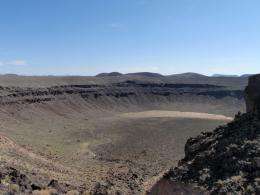
A new study in the journal Geology is shedding light on the brief but violent lives of maar-diatreme volcanoes, which erupt when magma and water meet in an explosive marriage below the surface of the earth.
Maar-diatremes belong to a family of volcanoes known as monogenetic volcanoes. These erupt just once before dying, though some eruptions last for years. Though not particularly famous, monogenetic volcanoes are actually the most common form of land-based volcano on the planet.
Despite their number, monogenetic volcanoes are poorly understood, said Greg A. Valentine, PhD, University at Buffalo geology professor.
He is lead author of the new Geology paper, which provides a novel model for describing what happens underground when maar-diatremes erupt. The research appeared online Sept. 18.
"The hazards that are associated with these volcanoes tend to be localized, but they're still significant," Valentine said. "These volcanoes can send ash deposits into populated areas. They could easily produce the same effects that the one in Iceland did when it disrupted air travel, so what we're trying to do is understand the way they behave."
Previously, scientists theorized that maar-diatreme eruptions consisted, underground, of a series of explosions that took place as magma reacted violently with water. With each explosion, the subterranean water table would fall, driving the next explosion even deeper.
Taking into account new geological evidence, Valentine and volcanologist James D.L. White of New Zealand's University of Otago revise this model.
In Geology, they propose that maar-diatreme eruptions consist not of ever-deepening explosions, but of explosions occurring simultaneously over a range of depths.
Under this new paradigm, deep explosions break up buried rock thousands of feet below ground and push it upward. Shallow explosions eject some of this debris from the volcano's depths, but expel far larger quantities of shallow rock.
This model fits well with recent field studies that have uncovered large deposits of shallow rock ringing maar-diatreme volcanoes, with only small amounts of deeper rock present. This was the case, for example, at two sites that Valentine examined at the San Francisco Volcanic Field in Arizona (see the Journal of Volcanology and Geothermal Research at tinyurl.com/9g4hoq5).
White and Valentine's description of the eruptive process also corresponds well with White's investigations into the "plumbing" of maar-diatreme volcanoes, the conduits that carry magma toward the surface. These conduits become visible over time as a landscape erodes away, and the main "pipe"—called a diatreme—often shows evidence of explosions, including zones of broken-up rock, at a range of depths.
Such findings contradict the older model that White and Valentine argue against.
According to the old model, Valentine explained, ever-deepening explosions should cause shallow rocks to be ejected from the mouth of the volcano first, followed by deposits of deeper and deeper rock fragments. But this isn't what scientists are finding when they analyze geological clues at volcanic sites.
The old model doesn't account for the fact that even when scientists find deep rock fragments at maar-diatreme sites, these bits of rock are mixed mostly with shallow fragments. The old model also doesn't match with White's observations indicating that explosions occur at essentially every depth.
The new model uses the strengths of the old model but accounts for new data. The results give scientists a better basis for estimating the hazards associated with maar-diatreme volcanoes, Valentine said.
Journal information: Geology
Provided by University at Buffalo


