Researchers simulate neutron stars' 'gigantic' magnetic fields
Oct 12, 2012
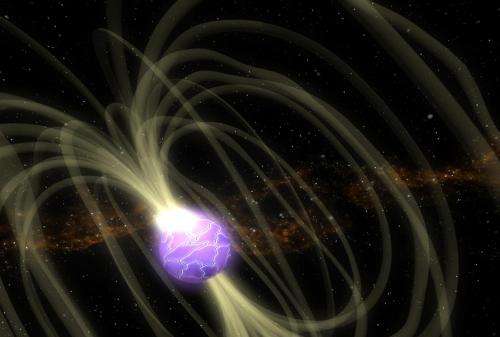
Conceptual image of a neutron star – crucial characteristics of such stars can now be simulated and studied on earth. Credit: NASA/Goddard Space Flight Center Conceptual Image Lab

Scientists from the universities of Kiel and Düsseldorf (both Germany) have developed a method to simulate gigantic magnetic fields that normally occur on neutron stars only. The physicists Professor Hartmut Löwen (Heinrich-Heine-Universität Düsseldorf) and Professor Michael Bonitz (Kiel University) have now published these results in the journal Physical Review Letters. In the article they show: when small particles in complex plasmas are set into rotation they behave as if they were exposed to a huge magnetic field.

Neutron stars belong to the most extreme objects in space: even though they are only 20 kilometers in diameter, they are up to three times heavier than the sun. At the same time, they have large magnetic fields up to 300 million times stronger than the earth's magnetic field.

The physicists from Düsseldorf and Kiel have come up with an idea how effects of such extreme conditions can be examined in laboratories on earth. They insert small particles of only a few micrometers into a complex plasma and cause them to rotate. According to theory and computer , the particles should – in this constellation – be exposed to similar forces as if they were located in a large magnetic field. It would not even be necessary to create a magnetic field at all.

The method has been already verified by experiments of Professor Alexander Piel (Kiel University) and can now be used to study the characteristics of ' magnetic fields. For physicists, this means that they can now for the first time study both extreme matter "conditions" and the behavior of particles therein on earth.

Explore further: Neutrons escaping to a parallel world?

More information: H. Kählert, J. Carstensen, M. Bonitz, H. Löwen, F. Greiner, and A. Piel (2012): "Magnetizing a complex plasma without a magnetic field", Phys. Rev. Lett. 109, 155003, prl.aps.org/abstract/PRL/v109/i15/e155003

add to favorites email to friend print save as pdf

Related Stories

Are pulsars giant permanent magnets?

Nov 22, 2011

Some of the most bizarre phenomenon in the universe are neutron stars. Very few things in our universe can rival the density in these remnants of supernova explosions. Neutron stars emit intense radiation ...

Neutrons escaping to a parallel world?

Jun 15, 2012

In a paper recently published in European Physical Journal C, researchers hypothesised the existence of mirror particles to explain the anomalous loss of neutrons observed experimentally. The existence of such mirror matter ...

Researchers make magnetic fields breakthrough

Aug 20, 2010

(PhysOrg.com) -- Researchers at the University of Dundee have made a breakthrough in the study of magnetic fields, which enhances our understanding of how stars, including the Sun, work.

Mysterious pulsar with hidden powers discovered

Oct 14, 2010

Dramatic flares and bursts of energy - activity previously thought reserved for only the strongest magnetized pulsars - has been observed emanating from a weakly magnetised, slowly rotating pulsar. The international ...

Recommended for you

Bringing life into focus

May 17, 2013

Spinning-disk confocal microscopy is an optical imaging technique that can be used to generate detailed three-dimensional fluorescence images of living cells and their contents. Although a powerful tool for ...

World's smallest droplet

May 17, 2013

(Phys.org) —Physicists may have created the smallest drops of liquid ever made in the lab. That possibility has been raised by the results of a recent experiment conducted by Vanderbilt physicist Julia Velkovska and her ...

User comments : 0

More news stories

New principle may help explain why nature is quantum

Like small children, scientists are always asking the question 'why?'. One question they've yet to answer is why nature picked quantum physics, in all its weird glory, as a sensible way to behave. Researchers ...

Heat-related deaths in Manhattan projected to rise

Residents of Manhattan will not just sweat harder from rising temperatures in the future, says a new study; many may die. Researchers say deaths linked to warming climate may rise some 20 percent by the 2020s, ...

Kinks and curves at the nanoscale

One of the basic principles of nanotechnology is that when you make things extremely small—one nanometer is about five atoms wide, 100,000 times smaller than the diameter of a human hair—they are going ...