October 3, 2012 report
MIT physicists suggest a means for creating an electron cloaking device
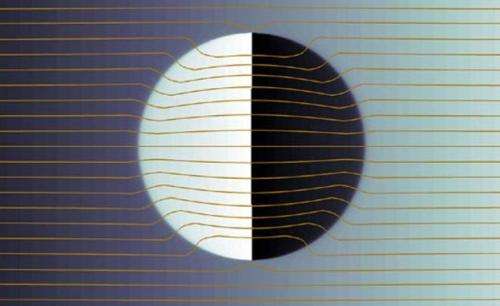
(Phys.org)—Physicists in the Department of Mechanical Engineering at MIT have developed a new theory derived from calculations that suggest it should be possible to construct an electron cloaking device, similar in principle to invisibility cloaks that other researchers have created using metamaterials. The team, whose study was recently published in Physical Review Letters, suggests that such a cloaking device could be useful in making semiconductors that optimize electron mobility.
In the latter method of creating an invisibility cloaking device, metamaterials are configured around an object, causing the light that strikes both to be bent around the object and then bent back toward its initial path, making the object invisible to the observer. Similar configurations have been constructed based on sound waves that cause a noise-emitting object impossible to hear. As delineated in the current study, researchers suggest something similar could be done with electrons as they too travel in waves, at least until they reach their coherent transport length and dissipate due to scattering.
In their paper, the team suggests that an electron cloak could be configured with core-shell nanoparticle structures with multiple interfaces around a semiconductor matrix host. This host could be tuned to redirect incoming electrons with the purpose of creating interference in the electrons' paths: in effect, canceling the total reflection. This would allow the electrons to travel through without being reflected, as if there were nothing in their path. For it to work, the nanoparticle structures would need to be of the same approximate size as the electron wavelength, i.e. about 10 nm.
The team suggests that such cloaks would be most useful in electronic devices requiring very high electron mobility, such as semiconductors. They also suggest that hybrid, energy harvesting, and/or conversion thermoelectric devices might be created with new types of switches that make use of the visible-not visible properties of the nanoparticle structures.
In an effort to reveal the practical applications of their theories, the researcher team hopes to develop a real-world electron cloak in the future.
More information: Cloaking Core-Shell Nanoparticles from Conducting Electrons in Solids, Phys. Rev. Lett. 109, 126806 (2012) DOI:10.1103/PhysRevLett.109.126806
Abstract
In this Letter, we aim at making nanoparticles embedded in a host semiconductor with a size comparable to electronic wavelengths "invisible" to the electron transport. Inspired by the recent progress made in optics and working within the framework of the expansion of partial waves, we demonstrate that the opposite effects imposed by potential barriers and wells of a core-shell nanoparticle on the phase shifts associated with the scattered electron wave could make the scattering cross section of the first two partial waves vanish simultaneously. We show that this is sufficient to cloak the nanoparticle from being detected by electrons with specific energy in the sense that a total scattering cross section smaller than 0.01% of the physical cross section can be obtained and a 4 orders of magnitude difference in the total scattering cross section can be presented within an energy range of only 40 meV, indicating possible applications of the "electron cloaks" as novel electronic switches and sensors, and in efficient energy harvesting and conversion technologies.
Journal information: Physical Review Letters
© 2012 Phys.org


