Physicists gain new insights into the remote control of quantum systems
Aug 06, 2012
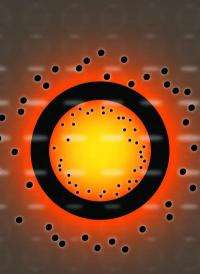
This is a graphic representation of remotely prepared quantum states. In their experiment, the researchers demonstrated that it is possible to prepare quantum states remotely by means of quantum discord (outside the circle) which might not always be possible to achieve by means of entanglement (inside the circle). Credit: Copyright: University of Vienna

An international collaboration led by physicists of the University of Vienna shines new light on the question of the resources required for achieving quantum information processing. The scientists demonstrate that less demanding resources, which are easier to prepare and to control, can be used for quantum-enhanced technologies. In the experiment, which is published in Nature Physics, the researchers achieve remote quantum state preparation without requiring entanglement as a resource.

A fundamental characteristic of quantum physics is the fact that two or more particles can exhibit correlations stronger than classically allowed. This unique characteristic applies particularly to : as soon as the quantum state of a particle is measured the state of its entangled partner changes accordingly, regardless of how far apart the two might be. This feature allows for the remote quantum state preparation, which is an essential ingredient for applications in quantum communication, , and quantum computation.

The degree of entanglement is often used as a figure of merit for determining its usefulness for . Strongly entangled systems, however, are very sensitive to extrinsic influence and difficult to prepare and to control. A team of researchers headed by the physicists Caslav Brukner (theory) and Philip Walther (experiment) at the University of Vienna have been able to show that in order to achieve successful remote state preparation entanglement is not the only way forward. Under certain circumstances, non-entangled states can outperform their entangled counterparts for such tasks - as long as they have a significant amount of so-called "quantum discord". This novel and not yet fully understood measure of quantifies the disturbance of correlated particles when being measured.

In their experiments, the researchers used a variety of two-photon states with different polarization correlations. "By measuring the polarization state of a certain photon we prepare the state of the respective partner photon remotely", explains Philip Walther. "In the experiment we observe how the quality of our remotely prepared is affected by changes in the quantum discord." This work provides an important and significant step towards future quantum information processing schemes that would rely on less demanding resources.

Explore further: Researchers forward quest for quantum computing

More information: "Quantum discord as resource for remote state preparation": Borivoje Dakic, Yannick-Ole Lipp, Xiaosong Ma, Martin Ringbauer, Sebastian Kropatschek, Stefanie Barz, Tomasz Paterek, Vlatko Vedral, Anton Zeilinger, Caslav Brukner, Philip Walther (Nature Physics 2012) DOI: 10.1038/NPHYS2377

Related Stories

Quantum physics mimics spooky action into the past

Apr 23, 2012

Physicists of the group of Prof. Anton Zeilinger at the Institute for Quantum Optics and Quantum Information (IQOQI), the University of Vienna, and the Vienna Center for Quantum Science and Technology (VCQ) ...

Quantum correlations -- without entanglement

Aug 24, 2011

(PhysOrg.com) -- Few people doubt the "quantumness" of entanglement. Quantifying the quantum correlation of entanglement is something that is relatively regular right now. However, things change a bit when it comes to quantum ...

Recommended for you

A quantum simulator for magnetic materials

14 hours ago

Physicists understand perfectly well why a fridge magnet sticks to certain metallic surfaces. But there are more exotic forms of magnetism whose properties remain unclear, despite decades of intense research. ...

Researchers forward quest for quantum computing

19 hours ago

Research teams from UW-Milwaukee and the University of York investigating the properties of ultra-thin films of new materials are helping bring quantum computing one step closer to reality.

Hydrogen atoms under the magnifying glass

May 22, 2013

To describe the microscopic properties of matter and its interaction with the external world, quantum mechanics uses wave functions, whose structure and time dependence is governed by the Schrödinger equation. ...

Making quantum encryption practical

May 21, 2013

One of the many promising applications of quantum mechanics in the information sciences is quantum key distribution (QKD), in which the counterintuitive behavior of quantum particles guarantees that no one can eavesdrop on ...

Lab sets a new record for creating heralded photons

May 20, 2013

(Phys.org) —Entanglement, by general consensus of physicists, is the weirdest part of quantum science. To say that two particles, A and B, are entangled means that they are actually two parts of an inseparable ...

Competition in the quantum world

May 20, 2013

Innsbruck physicists led by Rainer Blatt and Peter Zoller experimentally gained a deep insight into the nature of quantum mechanical phase transitions. They are the first scientists that simulated the competition ...

User comments : 0

More news stories

A quantum simulator for magnetic materials

Physicists understand perfectly well why a fridge magnet sticks to certain metallic surfaces. But there are more exotic forms of magnetism whose properties remain unclear, despite decades of intense research. ...

Engineers pioneer flat spray-on optical lens

A University of British Columbia engineer and a team of U.S. researchers have made a breakthrough utilizing spray-on technology that could revolutionize the way optical lenses are made and used.

Researchers forward quest for quantum computing

Research teams from UW-Milwaukee and the University of York investigating the properties of ultra-thin films of new materials are helping bring quantum computing one step closer to reality.

How do cold ions slide

Things not always run smoothly. It may happen, actually, that when an object slides on another, the advancement may occur through a 'stop and go' series in the characteristic manner which scientists call ...

Controlling mood through the motions of mitochondria

(Medical Xpress)—Regulating the distribution of power in neurons is done by a system that makes the national electric grid look simple by comparison. Each neuron has several thousand mitochondria confined ...

A hidden population of exotic neutron stars

(Phys.org) —Magnetars – the dense remains of dead stars that erupt sporadically with bursts of high-energy radiation - are some of the most extreme objects known in the Universe. A major campaign using ...