Nature-inspired systems give 'soft robots' ability to camouflage themselves (w/ Video)
Aug 16, 2012
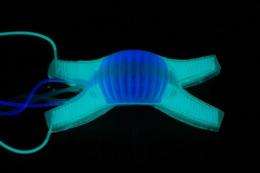
Handout picture shows a flexible robot that can change colors to blend in or stand out in its environment, this one glows in the dark using chemiluminescence. Scientists in the United States said they had devised a rubbery robot, inspired by the squid and octopus, which can crawl, camouflage itself and hide from infrared cameras.

(Phys.org) -- A team of researchers led by George Whitesides, the Woodford L. and Ann A. Flowers University Professor, has already broken new engineering ground with the development of soft, silicone-based robots inspired by creatures like starfish and squid. Now, they're working to give those robots the ability to disguise themselves.

As demonstrated in an August 16 paper published in Science, researchers have developed a system – again, inspired by nature – that allows the soft robots to either camouflage themselves against a background, or to make bold color displays. Such a "dynamic coloration" system could one day have a host of uses, ranging from helping doctors plan complex surgeries to acting as a visual marker to help search crews following a disaster, said Stephen Morin, a Post-Doctoral Fellow in Chemistry and Chemical Biology and first author of the paper.

This video is not supported by your browser at this time.
Harvard University researchers working under DARPA's Maximum Mobility and Manipulation (M3) program recently demonstrated the ability to manufacture low-cost silicone robots with microfluidic channels that allow for air and fluids to be pumped in to control movement, color and temperature. In this video, a soft robot walks onto a bed of rocks and is filled with fluid to match the color of the rocks and break up the robot's shape. The robot moves at a speed of approximately 40 meters per hour; absent the colored fluid, it can move at approximately 67 meters per hour. Future research will be directed at smoothing the movements; however, speed is less important than the robot's flexibility. Soft robots are useful because they are resilient and can maneuver through very constrained spaces. For this demonstration, the researchers used tethers to attach the control system and to pump pressurized gases and liquids into the robot. Tethered operation reduces the size and weight of such robots by leaving power sources and pumps off-board, but future prototypes could incorporate that equipment in a self-contained system. At a pumping rate of 2.25 mL per minute, color change in the robot required 30 seconds. Once filled, the color layers require no power to sustain the color.

"When we began working on soft robots, we were inspired by soft organisms, including octopi and ," Morin said. "One of the fascinating characteristics of these animals is their ability to control their appearance, and that inspired us to take this idea further and explore dynamic coloration. I think the important thing we've shown in this paper is that even when using simple systems – in this case we have simple, open-ended micro-channels – you can achieve a great deal in terms of your ability to camouflage an object, or to display where an object is."

"One of the most interesting questions in science is 'Why do animals have the shape, and color, and capabilities that they do?'" said Whitesides. "Evolution might lead to a particular form, but why? One function of our work on robotics is to give us, and others interested in this kind of question, systems that we can use to test ideas. Here the question might be: 'How does a small crawling organism most efficiently disguise (or advertise) itself in leaves?' These robots are test-beds for ideas about form and color and movement."

Just as with the soft robots, the "color layers" used in the camouflage start as molds created using 3D printers. Silicone is then poured into the molds to create micro-channels, which are topped with another layer of . The layers can be created as a separate sheet that sits atop the soft robots, or incorporated directly into their structure. Once created, researchers can pump colored liquids into the channels, causing the robot to mimic the colors and patterns of its environment.

The system's camouflage capabilities aren't limited to visible colors though.

By pumping heated or cooled liquids into the channels, researchers can camouflage the robots thermally (infrared color). Other tests described in the Science paper used fluorescent liquids that allowed the color layers to literally glow in the dark.

The uses for the color-layer technology, however, don't end at camouflage.

Just as animals use color change to communicate, Morin envisions robots using the system as a way to signal their position, both to other robots, and to the public. As an example, he cited the possible use of the soft machines during search and rescue operations following a disaster. In dimly lit conditions, he said, a that stands out from its surroundings (or even glows in the dark) could be useful in leading rescue crews trying to locate survivors.

"What we hope is that this work can inspire other researchers to think about these problems and approach them from different angles," he continued. "There are many biologists who are studying animal behavior as it relates to camouflage, and they use different models to do that. We think something like this might enable them to explore new questions, and that will be valuable."

Explore further: Robots learn to take a proper handoff by following digitized human examples

More information: "Camouflage and Display for Soft Machines," by S.A. Morin et al., Science, 2012.

Related Stories

Tests check out rescue robots' life-saving vision

Jun 12, 2008

To save lives, search and rescue robots crawling through the rubble of a collapsed building or surveying a chemical spill area must be capable of beaming back clear, easily interpretable images of what they "see" to operators ...

Recommended for you

The new consoles from Microsoft, Nintendo and Sony

5 hours ago

Microsoft is the last of the three big video game console makers to unveil its latest gaming system. Tuesday's unveiling comes nearly eight years after the Xbox 360 went on sale. It follows last fall's de ...

Microsoft readies new Xbox as entertainment hub

18 hours ago

Microsoft offers a glimpse Tuesday at a new-generation Xbox as videogame consoles evolve into home entertainment centers and adapt to competition from smartphones and tablets.

Finnish start-up launches smartphone to rival giants

May 20, 2013

A group of ex-Nokia employees who quit over the company's decision to abandon the planned MeeGo operating system in favour of Windows presented their own smartphone on Monday, hoping to rival the sector's ...

User comments : 0

More news stories

The new consoles from Microsoft, Nintendo and Sony

Microsoft is the last of the three big video game console makers to unveil its latest gaming system. Tuesday's unveiling comes nearly eight years after the Xbox 360 went on sale. It follows last fall's de ...

Expectations high for next Xbox

It's almost time for a new Xbox. Eight years have passed since Microsoft unveiled the Xbox 360, double the amount of time between the original Xbox debut in 2001 and its high-definition successor's launch ...

If you can remember it, you can remember it wrong

(Medical Xpress)—Native peoples in regions where cameras are uncommon sometimes react with caution when their picture is taken. The fear that something must have been stolen from them to create the photo ...

B vitamins could delay dementia

(Medical Xpress)—Despite spending billions of dollars on research and development, drug companies have been unable to come up with effective treatments for dementia and Alzheimer's Disease (AD). Now, A. ...

New method for producing clean hydrogen

Duke University engineers have developed a novel method for producing clean hydrogen, which could prove essential to weaning society off of fossil fuels and their environmental implications.