Gumby-like flexible robot crawls in tight spaces (w/ video)
November 28, 2011

Gumby-like flexible robot crawls in tight spaces (w/ video)

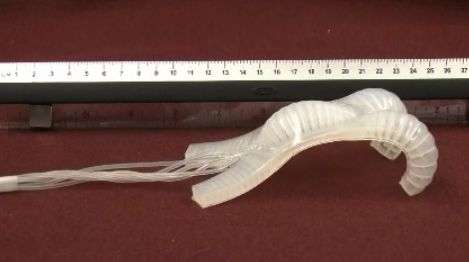
Harvard scientists have built a new type of flexible robot that is limber enough to wiggle and worm through tight spaces.

It's the latest prototype in the growing field of soft-bodied robots. Researchers are increasingly drawing inspiration from nature to create machines that are more bendable and versatile than those made of metal.

The Harvard team, led by chemist George M. Whitesides, borrowed from squids, starfish and other animals without hard skeletons to fashion a small, four-legged rubber robot that calls to mind the clay animation character Gumby.

In recent years, scientists have been tinkering with squishy — sometimes odd-looking — robots designed to squeeze through hard-to-reach cracks after a disaster like an earthquake or navigate rough terrain in the battlefield.

This video is not supported by your browser at this time.

"The unique ability for soft robots to deform allows them to go places that traditional rigid-body robots cannot," Matthew Walter, a roboticist at the Massachusetts Institute of Technology, said in an email.

A team from Tufts University earlier this year showed off a 4-inch caterpillar-shaped robot made of silicone rubber that can curl into a ball and propel itself forward.

The Harvard project, funded by the Pentagon's research arm, was described online Monday in the journal Proceedings of the National Academy of Sciences.

The new robot, which took two months to construct, is 5 inches long. Its four legs can be separately controlled by pumping air into the limbs, either manually or via computer. This gives the robot a range of motions including crawling and slithering.

This video is not supported by your browser at this time.

The researchers tested the robot's flexibility by having it squirm underneath a pane of glass just three-quarters of an inch from the surface.

Scientists maneuvered the robot through the tiny gap 15 times using a combination of movements. In most cases, it took less than a minute to get from side to side.

Researchers eventually want to improve the robot's speed, but were pleased that it did not break from constant inflation and deflation.

"It was tough enough to survive," said Harvard postdoctoral fellow Robert Shepherd, adding that the robot can traverse on a variety of surfaces including felt cloth, gravel, mud and even Jell-O.

There were drawbacks. The robot is tethered to an external power source and scientists need to find a way to integrate the source before it can be deployed in the real world.

"There are many challenges to actively moving soft robots and no easy solutions," Tufts neurobiologist Barry Trimmer, who worked on the caterpillar robot, said in an email.

Robotics researcher Carmel Majidi, who heads the Soft Machines Lab at Carnegie Mellon University, said the latest is innovative even as it builds on previous work.

"It's a simple concept, but they're getting lifelike biological motions," he said.

More information: Multigait soft robot: Published online before print November 28, 2011, doi: 10.1073/pnas.1116564108

Abstract
This manuscript describes a unique class of locomotive robot: A soft robot, composed exclusively of soft materials (elastomeric polymers), which is inspired by animals (e.g., squid, starfish, worms) that do not have hard internal skeletons. Soft lithography was used to fabricate a pneumatically actuated robot capable of sophisticated locomotion (e.g., fluid movement of limbs and multiple gaits). This robot is quadrupedal; it uses no sensors, only five actuators, and a simple pneumatic valving system that operates at low pressures (< 10 psi). A combination of crawling and undulation gaits allowed this robot to navigate a difficult obstacle. This demonstration illustrates an advantage of soft robotics: They are systems in which simple types of actuation produce complex motion.

©2011 The Associated Press. All rights reserved. This material may not be published, broadcast, rewritten or redistributed.

Filter


Move the slider to adjust rank threshold, so that you can hide some of the comments.


Display comments: newest first

hyongx
Nov 28, 2011

Rank: 5 / 5 (4)
Really cool engineering,
but still totally creepy.
Pirouette
Nov 28, 2011

Rank: 1 / 5 (5)
I like it. . . .now if the researchers could bring it down to the size of a grain of pepper or smaller, it might be useful in delicate brain surgery where a steady hand might not be steady enough to extract a tumor. AND it could get into those parts of the brain which would be deemed inoperable ordinarily to remove all of the tumor. Great piece of research.
antialias_physorg
Nov 29, 2011

Rank: 5 / 5 (2)
now if the researchers could bring it down to the size of a grain of pepper or smaller, it might be useful in delicate brain surgery where a steady hand might not be steady enough to extract a tumor.


For that kind of thing we already have robot assisted surgery where the robotic hand is (passively) guided by the operator and an algorithm automatically smoothes out any tremors.

What they should so is combine the gas filled chambers with liquid filled ones (like in living organisms). Would give added strength to the structure.
Isaacsname
Nov 29, 2011

Rank: not rated yet
Interesting concept. Like a robotic amoeba. Starfish would be neat too.

Anybody working on artificial muscles based on cross-linked polymers ?
antialias_physorg
Nov 29, 2011

Rank: 5 / 5 (1)
Anybody working on artificial muscles based on cross-linked polymers ?


These guys are:
http://www.youtub...vyw5tUko

Electroactive polymers:
http://en.wikiped...polymers
Isaacsname
Nov 29, 2011

Rank: not rated yet
....hmmm.....seen those. Seen anything nifty with IPMC's ?

I recently started fooling around with CL polymers, somehow managed to make one that eerily resembles muscle tissue, got me to thinking about what other materials I could play around with this winter ....o,O
SmartK8
Nov 29, 2011

Rank: 5 / 5 (1)
I love how he, after the walk, splat himself where he stands. Reminds me of.. well.. me. :D
Pirouette
Nov 29, 2011

Rank: 1 / 5 (1)
@antialias. . .thanks for the heads-up on the robot assisted surgery, but I was referring to very tight corners where even a steady robotic hand may not be able to enter without touching sensitive areas. Evidently, the movement of these gumbys are by the utilization of hydraulics. Whether by gas or liquid hydraulics, the results of movement are the same. It's only the speed at which the gas or liquid can flow to move each limb would be crucial to its rapidity of travel, plus the length of the hydraulic tubing. They should try a radio-controlled sealed unit that has its hydraulics self- contained along with a pumping network that reacts to radio commands.
Something like that could also clean out blockages in blood vessels without the need for a stint.
Pirouette
Nov 29, 2011

Rank: 1 / 5 (1)
Many people with malignant brain tumors have died anyway, even though the brain surgery had removed the tumor, but not ALL of the malignant cells. If the surgeons had a small enough unit to remove the rest of the malignant cells, the patients might still be alive.
A tiny unit would have both the steadiness (radio-controlled) and the right size to do the job completely, IMO. It could have a cutting and suction tool to remove the cells and examine the site.
antialias_physorg
Nov 29, 2011

Rank: 5 / 5 (2)
If the surgeons had a small enough unit to remove the rest of the malignant cells,

That's not really an issue in brain surgery. The problem lies more in the fact that you can't readily distinguish malignant from benign cells. Tumor surgeries usually try to take out a bit more - just to be safe. In brain surgery that line has to be drawn somewhat tighter as just 'taking out an extra scoop' is not really an option. tumors often also frazzle out out the edges - making the delineation doubly difficult (these outliers often don't even show up on scans).

Then you have to consider that removing a tumor does not neccessarily remove the cause of the tumor (which may be genetic, trophic, or the tumor you removed my simply be a secondary one that was spawned by a tumor somewhere else). So reappearance of a tumor is not always caused by suboptimal removal of the first one.
FrankHerbert
Nov 29, 2011

Rank: 3 / 5 (107)
Pirouette, you looking at this and claiming it would be useful for brain surgery is about as logical as someone claiming the same for an automobile. Sure if an automobile were small enough we could drive it around someone's arteries... jeez. How can you not see that creating something of such a small size, not the form, is the problem. Uggggggggggggggggg.

Maybe if we can get you to realize your nuttiness on an issue you aren't so involved in maybe you'll be capable of some self reflection.
Pirouette
Nov 29, 2011

Rank: 1.1 / 5 (35)
http://www.physor...ery.html

OK. . .found the info I think you were referring to. . .it doesn't seem to be completely operative at this time and is still in experiment mode. The hand is 10X steadier, but would still be too large, IMO, to fit inside small crevices within the brain, And it is within those small crevices where stray cancer cells tend to settle when separated from the main tumor. It's such an insidious and overwhelming and patient killer, and most people don't want their loved ones going through a second operation to clean out the remaining cancer cells that have grown into another tumor. It would be so helpful to have this gumby robot miniaturized and perfected. It would save countless lives.
FrankHerbert
Nov 29, 2011

Rank: 3.1 / 5 (106)
Yeah, and a nano-Humvee with roof-mounted ablative lasers would also save countless lives.
Pirouette
Nov 29, 2011

Rank: 3 / 5 (4)
I will not respond directly to FrankHerb$hit, who has proven himself in most threads to follow the people around whom he wishes to victimize and drive away from commenting on Physorg. And there are many of them, including myself, whom he tries to drown out with his stupidity in order to get praise and adulation for himself. He also is a race-baiter and has been known to tell lies about people being racists or bigots so that his shills can pretend to believe the racist and bigot accusations and threaten their victims with physical harm. He has done that to me in another thread and his shill has threatened me because FrankHerbert said that I called him the N word in a PM. . .which is a big lie. I have never PMed FrankHerb$hithead and Physorg will back me up on that.
Vendicar_Decarian
Nov 29, 2011

Rank: 3 / 5 (4)
Gumby appears to be quite ill.

This must be polycystic gumby. A commercial flop last X-mas.

Isaacsname
Nov 30, 2011

Rank: not rated yet
Rank 4 /5 (4 votes)
Relevant PhysicsForums posts

More news stories

Nvidia trumpets Tegra 3 phone design wins for 2012

(Phys.org) -- Nvidia’s competitive war paint has a name, Tegra 3. On the heels of Nvidia announcements about lowering costs of its Tegra 3 processors and Nvidia-enabled tablets running Android Ice Cream ...

Electronics / Hardware

created 14 hours ago | popularity 5 / 5 (2) | comments 1 | with audio podcast report

Dell tablet leak: 10.1-inch display, two-battery choice

(Phys.org) -- Headline after headline talks about vendors’ tablets in the wings as likely number-one contenders for the iPad. Such claims have justifiably been taken with a grain of salt, considering ...

Electronics / Consumer & Gadgets

created May 26, 2012 | popularity 4 / 5 (4) | comments 11 | with audio podcast report

Nvidia says Kai platform will turn price tide for tablets

(Phys.org) -- In March, Nvidia gave some signs that they were working to lower the cost of their Tegra 3 processors and they suggested consumers might see prices for Android tablets as low as $199. Connect ...

Electronics / Hardware

created May 24, 2012 | popularity 4.3 / 5 (4) | comments 3 | with audio podcast report

OmniVision tops up sensors for cameras, phones

(Phys.org) -- OmniVision has announced two high-resolution image sensors for the digital still and digital video camera market (DS/DVC) and higher end smartphones. In end-user language, it is a claim for superior ...

Electronics / Hardware

created May 25, 2012 | popularity 5 / 5 (6) | comments 3 | with audio podcast report

MIT researchers devise new means to synchronize a group of robots (w/ Video)

(Phys.org) -- For several years, roboticists have been working out ways to get a group of robots to perform synchronized activities as demonstrated most often in dance routines. It’s not just about trying ...

Electronics / Robotics

created May 25, 2012 | popularity 5 / 5 (1) | comments 1 | with audio podcast report


Stunning image of smallest possible five-ringed structure

Scientists have created and imaged the smallest possible five-ringed structure – about 100,000 times thinner than a human hair – and you'll probably recognise its shape.

'Unzipped' carbon nanotubes could help energize fuel cells, batteries

Multi-walled carbon nanotubes riddled with defects and impurities on the outside could replace some of the expensive platinum catalysts used in fuel cells and metal-air batteries, according to scientists at ...

Change in developmental timing was crucial in the evolutionary shift from dinosaurs to birds: study

At first glance, it's hard to see how a common house sparrow and a Tyrannosaurus Rex might have anything in common. After all, one is a bird that weighs less than an ounce, and the other is a dinosaur that ...

Computer model used to pinpoint prime materials for efficient carbon capture

When power plants begin capturing their carbon emissions to reduce greenhouse gases – and to most in the electric power industry, it's a question of when, not if – it will be an expensive undertaking.

T cells 'hunt' parasites like animal predators seek prey, study shows

By pairing an intimate knowledge of immune-system function with a deep understanding of statistical physics, a cross-disciplinary team at the University of Pennsylvania has arrived at a surprising finding: T cells use a movement ...

Land and sea species differ in climate change response: study

(Phys.org) -- Marine and terrestrial species will likely differ in their responses to climate warming, new research by Simon Fraser University and Australia’s University of Tasmania has found.