Holy bat detector! Ecologists develop first Europe-wide bat ID tool
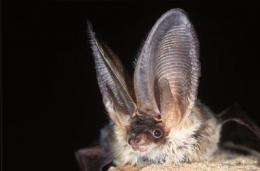
Just as differences in song can be used to distinguish one bird species from another, the pips and squeaks bats use to find prey can be used to identify different species of bat. Now, for the first time, ecologists have developed a Europe-wide tool capable of identifying bats from their echolocation calls.
The new free online tool – iBatsID – will be a major boost to conserving bats, whose numbers have declined significantly across Europe over the past 50 years. Details are published today in the British Ecological Society's Journal of Applied Ecology.
Working with an international team of ecologists, lead author and PhD student Charlotte Walters from the Zoological Society of London (ZSL) selected 1,350 calls of 34 different European bat species from EchoBank, a global echolocation library of more than 200,000 bat calls.
The calls were then analysed to find out which characteristics were most useful in distinguishing different bat species. According to Walters: "Lots of different measurements can be taken from an echolocation call, such as its maximum and minimum frequency, how quickly the frequency changes during the call, and how long the call lasts, but we didn't know which of these measurements are most useful for telling different species' calls apart."
The 12 most useful call parameters were then used to train artificial neural networks to produce the new identification tool, iBatsID, which can identify 34 different bat species across the whole of Europe. Most species can be identified correctly more than 80% of the time, although accuracy varies because some species are much harder to identify than others.
"iBatsID can identify 83-98% of calls from pipistrelle species correctly, but some species such as those in the Myotis genus are really hard to tell apart and even with iBatsID we can still only identify 49-81% of Myotis calls correctly," she explains.
iBatsID should have a major impact on European bat conservation, which until now has been hampered by the absence of a standardised, objective and continent-scale identification tool.
According to Professor Kate Jones, another of the paper's authors and chair of the Bat Conservation Trust: "Acoustic methods are really useful for surveying and monitoring bats, but without using the same identification methods everywhere, we can't form reliable conclusions about how bat populations are doing and whether their distributions are changing. Because many bats migrate between different European countries, we need to monitor bats at a European, as well as at country, scale. In iBatsID, we now have a free, online tool that works anywhere in Europe." Bat populations have declined significantly across Europe since the middle of the 20th century. As a result, all bats are now protected through the EU Habitats Directive. Bats face many pressures, including loss of roosting sites in trees and buildings; loss of feeding habitats in woodlands, meadows, parks and gardens; falling insect numbers; and habitat fragmentation resulting in the loss of green corridors such as hedges that provide connectivity in the landscape.
As well as providing vital ecosystem services, such as pollinating plants and controlling insect pests, bats are important indicators of biodiversity. "Bats are very sensitive to changes in their environment, so if bat populations are declining, we know that something bad is going on in their environment. Monitoring bats can therefore give us a good idea of what is going on with biodiversity in general," Walters adds.
More information: iBatsID is available free online at sites.google.com/site/ibatsresources/iBatsID
Charlotte L Walters et al (2012). 'A continental-scale tool for acoustic identification of European bats', doi: 10.1111/j.1365-2664.2012.02182.x , is published in the Journal of Applied Ecology on Tuesday 7 August 2012.
Journal information: Journal of Applied Ecology
Provided by Wiley


