Driving an electron spin vortex "Skyrmion" with a microcurrent
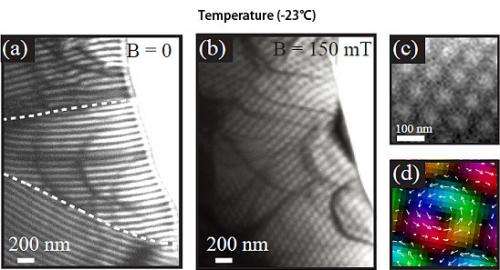
RIKEN and the National Institute for Materials Science (NIMS) have succeeded in forming a skyrmion crystal in which electron spin is aligned in a vortex shape in a microdevice using the helimagnet FeGe. The skyrmion crystal is driven with an ultra-low current density less than 1/100,000 that of the current necessary to drive magnetic domain walls in ferromagnets. This research lays the groudwork for technology that manipulates the states of magnetic information media with extremely low power consumption.
Magnetic memory devices that use the direction of electron spin—the source of magnetism—as digital information have attracted attention because of their high speed and non-volatility, etc. In recent years, numerous attempts have been made to manipulate that magnetic information electrically without utilizing a magnetic field. If a current is passed through a ferromagnet, it is possible to move the magnetic domain walls. These walls are the boundaries between those domains with upward-oriented magnetization and those with downward orientation (at domain walls, the direction of magnetic spin gradually changes). Therefore, reversal of magnetization becomes possible and information can be written. However, in order to drive the domain walls in this manner, a large current density of at least approximately 105 A/cm2 was necessary. Because this causes large energy loss—in other words, large energy consumption—a method of manipulating magnetic information media with a smaller current density is advantageous.
The research team investigated various functional magnetic materials, and in 2010, succeeded in forming and observing a skyrmion crystal by applying a weak magnetic field of less than 200 millitesla (mT) to a thin slice of the helimagnet FeGe at near room temperature. In the present research, the team fabricated microdevices with a length of 165μm, width of 100μm, and thicknesses of 100nm to 30μm using the same FeGe. When a magnetic field of approximately 150mT at temperatures from -23°C to near-room temperature (-3°C) was applied, skymrion crystals in which a stable skyrmion with a diameter of about 70nm was aligned in a triangular lattice shape were observed. The team succeeded in driving the skymrion crystal with an ultra-low current density (the minimum density is approximately 5A/cm2), which is less than 1/100,000th that required to drive magnetic domain walls in conventional ferromagnets. The fact that the skymrion can be driven with this extremely low current density represents the first step toward the development of low power consumption magnetic memory devices using skymrions as an information medium. Various applications can also be expected in the field of spintronics, which is currently an area of active research as a next-generation electronic technology.
More information: This research was published in the online edition of the British science journal Nature Communications on August 7 (August 8 Japan time).
Journal information: Nature Communications
Provided by National Institute for Materials Science


