NASA sees withering post-tropical storm Fabio moving toward coast
Jul 18, 2012
NASA sees withering post-tropical storm Fabio moving toward coast
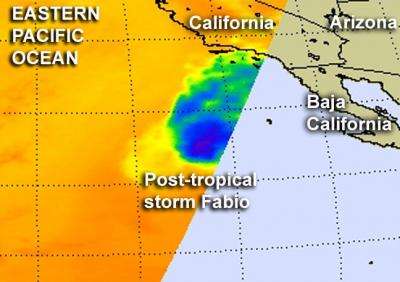
When NASA's Aqua satellite passed over post-tropical storm Fabio on July 18 at 1023 UTC (6:23 a.m. EDT) it detected very little strong convection and heavy rainfall (blue area). Sea surface temperature dropped below 22 Celsius (71.6 Fahrenheit) and can't support a tropical cyclone. Credit: Credit: NASA JPL, Ed Olsen

Infrared satellite data from NASA's Aqua satellite showed a very small area of strong thunderstorms north of the center of what is now post-tropical storm Fabio as it moves toward the southern California coast.

When NASA's Aqua satellite passed over post-tropical storm Fabio on July 18 at 1023 UTC (6:23 a.m. EDT), the Atmospheric Infrared Sounder (AIRS) instrument captured temperatures of and the sea surface. AIRS data showed very little strong convection and heavy rainfall occurring in the post-tropical storm and it was north of the center of circulation. from the south is pushing the showers north of the center.

are not warm enough to support a tropical cyclone because they are colder than 22 Celsius (71.6 Fahrenheit) in the area Fabio is moving through.

At 11 a.m. EDT on July 18, the National Hurricane Center issued their final advisory on post-tropical storm Fabio. At that time, Fabio was about 535 miles (855 km) south-southwest of San Diego, California, near latitude 25.7 north and longitude 120.8 west. Fabio's were near 30 mph (45 kmh) and weakening. It was still moving to the north at 9 mph (15 kmh) but is expected to turn to the north-northeast.

Doppler radar images from San Diego, Calif. showed some shower activity from Fabio approaching the area at 11 a.m. EDT on July 18.

The National Hurricane Center expects Fabio to dissipate in a couple of days. Meanwhile, large ocean swells, rip tides and dangerous surf conditions continue to affect the coasts of Baja California, Mexico and southern California.

Explore further: NASA watching Tropical Storm Fabio head to southern California

add to favorites email to friend print save as pdf

Related Stories

NASA sees hot towers as Tropical Storm Fabio's trigger

Jul 12, 2012

NASA research has indicated whenever "Hot Towering" thunderstorms are spotted within a tropical cyclone, it is more likely to strengthen. NASA's TRMM satellite saw hot towers within newborn Tropical Depression ...

Frigid cloud top temperatures show Hurricane Dora's power

Jul 20, 2011

Extremely cold cloud top temperatures in thunderstorms are an indication of the strength they possess, and infrared satellite data from NASA revealed a large area of very cold and powerful thunderstorms around ...

Recommended for you

Volcanoes cause climate gas concentrations to vary

12 minutes ago

Trace gases and aerosols are major factors influencing the climate. With the help of highly complex installations, such as MIPAS on board of the ENVISAT satellite, researchers try to better understand the ...

Explainer: Why are tornadoes so destructive?

58 minutes ago

Tornadoes are a part of life for people living in the Great Plains of the United States. In Oklahoma, a state that averages 62 tornadoes a year, people are prepared as best as they can be and are well warned.

NASA's BARREL mission launches 20 balloons

14 hours ago

(Phys.org) —In Antarctica in January, 2013 – the summer at the South Pole – scientists released 20 balloons, each eight stories tall, into the air to help answer an enduring space weather question: ...

Power of US tornado dwarfs Hiroshima bomb

15 hours ago

Wind, humidity and rainfall combined precisely to create Monday's massive killer tornado in Oklahoma. The awesome amount of energy released dwarfed the power of the atomic bomb that leveled Hiroshima.

User comments : 0

More news stories

Volcanoes cause climate gas concentrations to vary

Trace gases and aerosols are major factors influencing the climate. With the help of highly complex installations, such as MIPAS on board of the ENVISAT satellite, researchers try to better understand the ...

Explainer: Why are tornadoes so destructive?

Tornadoes are a part of life for people living in the Great Plains of the United States. In Oklahoma, a state that averages 62 tornadoes a year, people are prepared as best as they can be and are well warned.

Could pond waste be the 'new' fertiliser?

The University of Stirling is to lead a new project to develop a strategy for using nutrient-rich aquatic biomass waste – from ponds, wetlands and other water-bodies – in farming, as an environmentally ...

Theorists weigh in on where to hunt dark matter

(Phys.org) —Now that it looks like the hunt for the Higgs boson is over, particles of dark matter are at the top of the physics "Most Wanted" list. Dozens of experiments have been searching for them, but ...

DNA damage: The dark side of respiration

(Phys.org) —Adventitious changes in cellular DNA can endanger the whole organism, as they may lead to life-threatening illnesses like cancer. Researchers at LMU now report how byproducts of respiration cause mispairing ...