From microns to centimetres: Researchers invent new tissue engineering tool
(Phys.org) -- Imagine a machine that makes layered, substantial patches of engineered tissue—tissue that could be used as grafts for burn victims or vascular patches. Sounds like science fiction? According to researchers at the University of Toronto, it's a growing possibility.
Along with graduate students from their labs—Lian Leng, Boyang Zhang, and Arianna McAllister— Associate Professor Axel Guenther of the Department of Mechanical and Industrial Engineering, cross-appointed to the Institute of Biomaterials and Biomedical Engineering (IBBME), and Associate Professor Milica Radisic, core professor at IBBME and the Department of Chemical Engineering and Applied Chemistry, have invented a new device that may allow for the uniform, large-scale engineering of tissue.
"There's a lot of interest in soft materials, particularly biomaterials," explains Guenther of the materials that help create functional tissue cultures, "but until now no one has demonstrated a simple and scalable one-step process to go from microns to centimeters."
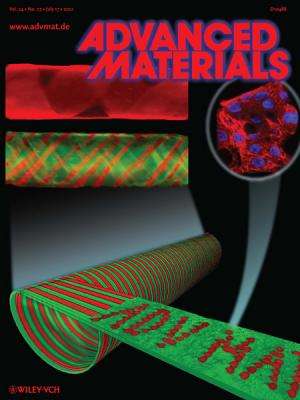
The invention, presented in a cover article for the journal Advanced Materials this month, is currently being commercialized by MaRS Innovations in collaboration with the Innovations and Partnerships Office (IPO) of the University of Toronto, where Radisic and Guenther's labs have filed two patents on the device.
But how exactly does a machine grow a large patch of functional tissue?
Scientists manipulate biomaterials into the micro-device through several channels. The biomaterials are then mixed, causing a chemical reaction that forms a "mosaic hydrogel"—a sheet-like substance compatible with the growth of cells into living tissues, into which different types of cells can be seeded in very precise and controlled placements.
Unique to this new approach to tissue engineering, however, and unlike more typical methods (for instance, scaffolding: the seeding of cells onto an artificial structure capable of supporting three-dimensional tissue formation), cells planted onto the mosaic hydrogel sheets are precisely incorporated into the mosaic hydrogel sheet just at the time it's being created—generating the perfect conditions for cells to grow.
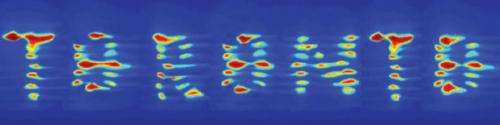
The placement of the cells is so precise, in fact, that scientists can spell words (such as "Toronto," shown here) and can precisely mimic the natural placement of cells in living tissues. And by collecting these sheets around a drum, the machine is able to collect layers of cells in thicknesses made to measure: in essence, three dimensional, functional tissues.
The resulting tissues, cites Lian Leng, lead author on the project and a 3rd year PhD Candidate in the Department of Mechanical and Industrial Engineering, are remarkably stable. "In this case, when we put the cells in the right places we create cellular organization quite naturally."
So what's the next step?
"My laboratory is currently pursuing different applications of the technology—different tissues," says Guenther. The device may provide the means to create three-dimensional cell cultures for the development of therapeutic drugs, for instance. The technology may provide the means to create three-dimensional cell cultures for the development of therapeutic drugs, for instance. Currently, the two UofT labs are also collaborating their research with a burn unit at Sunnybrook Hospital. "At some point [the machine] could allow dermal [skin] grafts to be prepared that perhaps will be less expensive, and more efficient," says Guenther.
More information: Read more on the incredible research coming out of IBBME.
Journal information: Advanced Materials
Provided by University of Toronto


