Lipid helps cells find their way by keeping their 'antennae' up
Jul 09, 2012
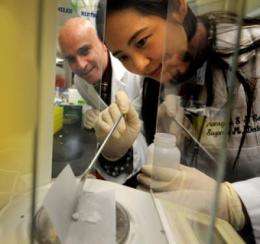
A lipid that helps lotion soften the skin also helps cells find and stay in the right location in the body by ensuring they keep their “antennae” up, scientists report. Credit: Phil Jones

A lipid that helps lotion soften the skin also helps cells find and stay in the right location in the body by ensuring they keep their "antennae" up, scientists report.

Each cell has an antenna, or cilium, that senses the environment then determines where to go and what to do when it arrives, said Dr. Erhard Bieberich, biochemist at the Medical College of Georgia at Georgia Health Sciences University.

"A cell is blind; it does not see, it does not feel; it doesn't know where it is," Bieberich said. "It needs to have an organelle that senses where it is in space in order to go where it wants and needs to go."

That kind of direction helps keep , for example, from wandering off to the feet and vice versa. It's enabled by on the antennae that are attracted to growth factors secreted by cells that already have found their way. Once cells are situated, the antennae help them respond to nearby signals, such as helping sense when to void, said Bieberich, corresponding author of the study in Molecular Biology of the Cell.

His team has shown that the lipid ceramide helps cells keep this organelle or antenna from retracting by inhibiting the enzyme, histone deacetylase 6 or HDAC6.

Antennae must retract for cells to divide and activating HDAC6 enables that occasional necessity, such as during development or when more skin or gastrointestinal cells are needed to replace normal turnover. Interestingly, some of the most rapidly dividing cells, , "abuse" HDAC for their purposes; they also suppress ceramide, which is known to induce , Bieberich said.

Ceramide is really quite the multi-tasker. Bieberich's team reported in 2007 in the that in the earliest days of development, it helps orient stem cells to which way is up and find their place in a lineup that is important for the genesis of an embryo. Three years earlier the scientists showed the lipid teams up with the protein PAR-4 to eliminate useless cells in developing brains.

Explore further: Researcher admits mistakes in stem cell study

Related Stories

Recommended for you

Researcher admits mistakes in stem cell study

May 23, 2013

A blockbuster study in which US researchers reported that they had turned human skin cells into embryonic stem cells contained errors, its lead author has acknowledged. ...

Scientists discover how rapamycin slows cell growth

May 23, 2013

University of Montreal researchers have discovered a novel molecular mechanism that can potentially slow the progression of some cancers and other diseases of abnormal growth. In the May 23 edition of the prestigious journal ...

Unlocking secrets of cell reproduction

May 23, 2013

Research published in Open Biology today identifies, for the first time, nearly all the genes required for reproduction of a cell in a living organism.

What the smallest infectious agents reveal about evolution

May 22, 2013

Radically different viruses share genes and are likely to share ancestry, according to research published in BioMed Central's open access journal Virology Journal this week. The comprehensive phylogenomic analysis compar ...

User comments : 1

Adjust slider to filter visible comments by rank

Display comments: newest first

irjsiq
3 / 5 (1) Jul 10, 2012
quote: " ... "A cell is blind; it does not see, it does not feel; it doesn't know where it is, . . . "
We Humans have a need to re-write the term 'Intelligence' for All of the above suggest 'thought processes' to me. We have for far too long attributed our comprehension of mental processes, as we are aware of them, may not be uniquely Our Domain!
I have observed 'strategic thinking' and preference 'decision-making' in dogs and pigeons. Not a lot of facial expression with the pigeons, but Very distinct 'facial expressions' with dogs!

It has not been many years, 'the discovery of life forms and 'Black Smokers' which turned biology on it's head. Then the discovery of Bacteria, living far below the Earth's surface!
Fascinated me! perhaps 'thought' is extensively 'ubiquitous/' as well; we just have to learn new terms of/and observation/interpretation skills! Dolphins don't write, nor do they read books or have libraries, but they know how to think and learn!

Roy J Stewart,
Phoenix A

More news stories

EU bans three pesticides harmful to bees

The European Commission said Friday that it will ban for two years beginning in December pesticides blamed for killing the bees that pollinate food and fruit crops.

Galaxies fed by funnels of fuel

(Phys.org) —Computer simulations of galaxies growing over billions of years have revealed a likely scenario for how they feed: a cosmic version of swirly straws.

Google eyes emerging markets networks

Google has become deeply involved in a series of projects to build and operate wireless networks in emerging markets including sub-Saharan Africa and Southeast Asia, a report said Friday.