Japan reactor back to full power after shutdown
Jul 09, 2012
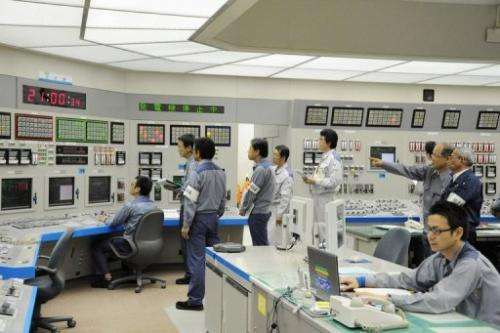
Kansai Electric Power Co. (KEPCO) engineers reactivate its nuclear reactor at the company's Oi nuclear power plant at Oi town in Fukui on July 1. The reactor began full operations on Monday, the first restart since the country shut down its atomic stations in the wake of last year's crisis at the Fukushima Daiichi plant.

A nuclear reactor in western Japan began full operations on Monday, the first restart since the country shut down its atomic stations in the wake of last year's crisis at the Fukushima Daiichi plant.

Kansai Electric Power Co. (KEPCO), operator of the Oi power plant in the nation's industrial heartland, said its Unit No. 3 had come back to full capacity early Monday after the was switched on earlier this month.

"The reactor has already shifted to a stable output mode without any trouble," a KEPCO spokesman said, adding that the utility plans to resume operations at another reactor in the same plant later this month.

The return to full operations ended a nearly two-month hiatus in the aftermath of the atomic crisis, but comes amid strong anti-nuclear sentiment in Japan which has seen protesters come out in their tens of thousands.
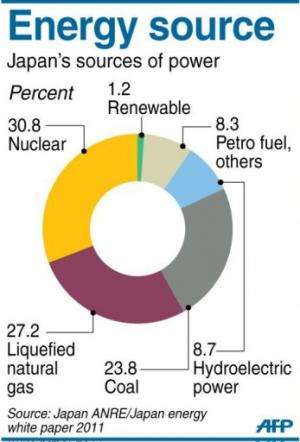
Chart on Japan's energy sources, showing nuclear power generating 30% in 2010. A reactor in western Japan resumed full operation on Monday, the first to restart since the country shut down its atomic power plants following the Fukushima disaster last year.

It also comes less than a week after a damning parliamentary report said the accident was a man-made disaster, marked by a lack of oversight and collusion between plant operator Power, the government and regulators.

On Sunday, the governor of southern Kagoshima prefecture, who supports the restart, handily won a new term even as the issue divides Japan with strong voices of opposition hanging over the controversial move.

Nuclear restarts were put on hold as the government mulled its options following the 9.0-magnitude earthquake and tsunami last year that crippled reactor cooling systems at Fukushima.

But in mid-June, Japan's Prime Minister Yoshihiko Noda gave the green light to restart two reactors at the Oi plant in Fukui prefecture, amid concerns about looming power shortages this summer.

Japan had been operating without nuclear power since early May when the last of its 50 working reactors was shut down for a scheduled safety check.

The nation turned to pricey fossil-fuel alternatives to fill the gap left by the shutdown of atomic plants which had supplied about one-third of resource-poor Japan's energy.

The government has asked business and households to cut back on their power usage by as much as 15 percent from summer levels two years ago, with the Oi restart expected to ease KEPCO's shortfall.

Explore further: Japan PM renews plea for nuclear restart

add to favorites email to friend print save as pdf

Related Stories

Japan to go nuclear-free for first time since 1970

May 04, 2012

Japan is set to go without nuclear energy for the first time since 1970 from Saturday, when the last operating reactor shuts down for maintenance, heightening fears of a looming power crunch this summer.

Japan approves nuclear reactor restart

Aug 17, 2011

Japan on Wednesday approved the full resumption of commercial operations of an atomic reactor for the first time since the March 11 quake and tsunami sparked the Fukushima nuclear accident.

Japan PM renews plea for nuclear restart

Jun 08, 2012

Prime Minister Yoshihiko Noda on Friday renewed his call for the re-firing of idle nuclear reactors, saying Japan could not do without atomic energy, but stopped short of ordering a restart.

Japan's Hamaoka atomic plant to build huge seawall

Jul 22, 2011

Chubu Electric said Friday it will build an 18-metre (60 foot) anti-tsunami seawall to protect its ageing Hamaoka nuclear plant located near a faultline in a region seen as vulnerable to earthquakes.

Recommended for you

Green conversion of heat to electricity

13 hours ago

Soon, it will be possible to produce electricity from heat over 30 degrees emitted from a waste incinerator, refinery, or data processor. The start-up Osmoblue has just confirmed the feasibility of this new ...

Space drives e-mobility

13 hours ago

An ESA business incubation start-up company is helping major car manufacturers to develop electric vehicle concepts and improve safety systems by turning ideas quickly into virtual prototypes.

User comments : 1

Adjust slider to filter visible comments by rank

Display comments: newest first

COCO
1 / 5 (1) Jul 10, 2012
thank goodness the crisis is over and all can return to normal - been hearing a lot of conspiracy nuts waxing about increased radiation counts on our West Coast - nice to see that will be ending.

More news stories

Game system castAR debuts at Maker Faire

(Phys.org) —Two tech talents, formerly employees at video game publisher Valve, have been working on their own vision in the form of game-ready glasses. Their company, Technical Illusions, will seek to ...

Green conversion of heat to electricity

Soon, it will be possible to produce electricity from heat over 30 degrees emitted from a waste incinerator, refinery, or data processor. The start-up Osmoblue has just confirmed the feasibility of this new ...

If you can remember it, you can remember it wrong

(Medical Xpress)—Native peoples in regions where cameras are uncommon sometimes react with caution when their picture is taken. The fear that something must have been stolen from them to create the photo ...

B vitamins could delay dementia

(Medical Xpress)—Despite spending billions of dollars on research and development, drug companies have been unable to come up with effective treatments for dementia and Alzheimer's Disease (AD). Now, A. ...

New method for producing clean hydrogen

Duke University engineers have developed a novel method for producing clean hydrogen, which could prove essential to weaning society off of fossil fuels and their environmental implications.