Fused polymer-based multi-component fibers provide well-defined domains for cell co-culture in tissue engineering
Jul 04, 2012
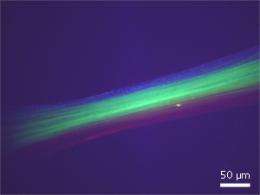
Multicomponent fibers obtained from multiple polyelectrolyte interfaces. © IBN

(Phys.org) -- Polymer fibers play a central role in the production of biomaterials for tissue engineering applications. Generated from self-assembling polyelectrolytes, these materials provide matrices for cells to grow and differentiate. Unfortunately, polymer fibers cannot encapsulate different cell types in a spatially defined manner for culture, thereby hindering their implementation in native tissue mimics.

To overcome these limitations, Andrew Wan and Jackie Y. Ying at the A*STAR Institute of Bioengineering and Nanotechnology and co-workers have developed a method that fuses several fibers from multiple polyelectrolyte interfaces. This method creates matrices composed of well-defined, spatially patterned domains at the scale, facilitating cell co-culture within the same fiber.

Ying explains that polyelectrolyte-based fibers have previously yielded three-dimensional scaffolds for , inspiring the team to fuse these materials to achieve co-culture.

The team’s goal is to exploit the patterning ability of their method to give structures that emulate native tissues such as the liver. “Many cell types are involved in the liver, and they are spatially patterned with respect to each other to achieve liver function,” adds Wan.

Unlike typical techniques deployed to manufacture multi-component fibers, the interfacial polyelectrolyte complexation adopted by Wan and Ying’s team is a gentle, water-based chemical process. “When two oppositely charged polyelectrolytes come into contact with each other, a complex forms at their interface,” explains Wan. “Upward drawing of this complex leads to the formation of a fiber.”

The researchers flanked a droplet of polyelectrolyte solution with two droplets of the oppositely charged polyelectrolyte, creating two interfaces from which two fibers were drawn and fused. Upon contact, the wet fibers zipped together, forming a Y-shape pattern over the droplets and producing a two-component fiber. By increasing the number of interfaces to three and four, the team obtained three- and four-component fibers.

Assessments of the ability of the fibers to enable co-culture in distinct domains showed that bone-forming cells encased in the outer layers of four-component fibers exclusively propagated and accumulated in those layers. Further experiments were carried out on fibers that consisted of a central core containing endothelial cells surrounded by outer layers filled with liver cells. The liver cells closely aggregated along the fiber without spreading to the core, where the endothelial cells had formed blood vessel-like structures.

The researchers are currently investigating ways to design better mimics of native tissue using their process. They are also planning on using the multi-component to study the influence of cellular microenvironment on cancer cell behavior.

Explore further: New method for producing clean hydrogen

More information: Wan, A. C. A., Leong, M. F., Toh, J. K. C., Zheng, Y. & Ying, J. Y. Multicomponent fibers by multi-interfacial polyelectrolyte complexation. Advanced Healthcare Materials 1, 101–105 (2012). dx.doi.org/10.1002/adhm.201100020

add to favorites email to friend print save as pdf

Related Stories

New process converts polyethylene into carbon fiber

Mar 27, 2012

(PhysOrg.com) -- Common material such as polyethylene used in plastic bags could be turned into something far more valuable through a process being developed at the Department of Energy's Oak Ridge National ...

Tube-shaped solar cells could be woven into clothing

Mar 01, 2012

(PhysOrg.com) -- Titania semiconducting nanorods grown on the surface of carbon fibers look more like bristles on a tiny hairbrush than a solar cell, but the novel configuration could have several advantages ...

Spinning a new yarn: silicone fibers with living organisms

Nov 20, 2006

In a feat once as unlikely as the miller's daughter of fairytale fame spinning straw into gold, scientists in the United Kingdom have spun fine threads of biocompatible silicone that contain living human brain cells. The ...

Recommended for you

New method for producing clean hydrogen

3 hours ago

Duke University engineers have developed a novel method for producing clean hydrogen, which could prove essential to weaning society off of fossil fuels and their environmental implications.

Non-wetting fabric drains sweat

May 20, 2013

(Phys.org) —Waterproof fabrics that whisk away sweat could be the latest application of microfluidic technology developed by bioengineers at the University of California, Davis.

Beautiful 'flowers' self-assemble in a beaker

May 16, 2013

By simply manipulating chemical gradients in a beaker of fluid, materials scientists at Harvard have found that they can control the growth behavior of crystals to create precisely tailored structures—such ...

User comments : 0

More news stories

New method for producing clean hydrogen

Duke University engineers have developed a novel method for producing clean hydrogen, which could prove essential to weaning society off of fossil fuels and their environmental implications.

Protein study suggests drug side effects are inevitable

A new study of both computer-created and natural proteins suggests that the number of unique pockets – sites where small molecule pharmaceutical compounds can bind to proteins – is surprisingly small, meaning drug side ...

Beautiful 'flowers' self-assemble in a beaker

By simply manipulating chemical gradients in a beaker of fluid, materials scientists at Harvard have found that they can control the growth behavior of crystals to create precisely tailored structures—such ...

Attacking MRSA with metals from antibacterial clays

In the race to protect society from infectious microbes, the bugs are outrunning us. The need for new therapeutic agents is acute, given the emergence of novel pathogens as well as old foes bearing heightened antibiotic resistance.

Power of US tornado dwarfs Hiroshima bomb

Wind, humidity and rainfall combined precisely to create Monday's massive killer tornado in Oklahoma. The awesome amount of energy released dwarfed the power of the atomic bomb that leveled Hiroshima.

NASA's BARREL mission launches 20 balloons

(Phys.org) —In Antarctica in January, 2013 – the summer at the South Pole – scientists released 20 balloons, each eight stories tall, into the air to help answer an enduring space weather question: ...

Amazon plans greenhouse-style headquarters

US online giant Amazon has unveiled plans for a futuristic greenhouse style headquarters "where employees can work and socialize in a more natural, park-like setting."