Ultrasensitive biosensor promising for medical diagnostics
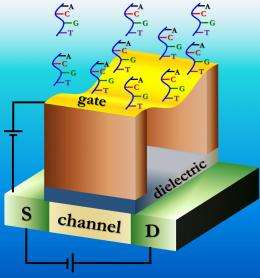
(Phys.org) -- Researchers have created an ultrasensitive biosensor that could open up new opportunities for early detection of cancer and "personalized medicine" tailored to the specific biochemistry of individual patients.
The device, which could be several hundred times more sensitive than other biosensors, combines the attributes of two distinctly different types of sensors, said Muhammad A. Alam, a Purdue University professor of electrical and computer engineering.
"Individually, both of these types of biosensors have limited sensitivity, but when you combine the two you get something that is better than either," he said.
Findings are detailed in a paper appearing Monday (May 14) in the Proceedings of the National Academy of Sciences. The paper was written by Purdue graduate student Ankit Jain, Alam and Pradeep R. Nair, a former Purdue doctoral student who is now a faculty member at the Indian Institute of Technology, Bombay.
The device ╨ called a Flexure-FET biosensor - combines a mechanical sensor, which identifies a biomolecule based on its mass or size, with an electrical sensor that identifies molecules based on their electrical charge. The new sensor detects both charged and uncharged biomolecules, allowing a broader range of applications than either type of sensor alone.
The sensor has two potential applications: personalized medicine, in which an inventory of proteins and DNA is recorded for individual patients to make more precise diagnostics and treatment decisions; and the early detection of cancer and other diseases.
In early cancer diagnostics, the sensor makes possible the detection of small quantities of DNA fragments and proteins deformed by cancer long before the disease is visible through imaging or other methods, Alam said.
The sensor's mechanical part is a vibrating cantilever, a sliver of silicon that resembles a tiny diving board. Located under the cantilever is a transistor, which is the sensor's electrical part.
In other mechanical biosensors, a laser measures the vibrating frequency or deflection of the cantilever, which changes depending on what type of biomolecule lands on the cantilever. Instead of using a laser, the new sensor uses the transistor to measure the vibration or deflection.
The sensor maximizes sensitivity by putting both the cantilever and transistor in a "bias." The cantilever is biased using an electric field to pull it downward as though with an invisible string.
"This pre-bending increases the sensitivity significantly," Jain said.
The transistor is biased by applying a voltage, maximizing its performance as well.
"You can make the device sensitive to almost any molecule as long as you configure the sensor properly," Alam said.
A key innovation is the elimination of a component called a "reference electrode," which is required for conventional electrical biosensors but cannot be miniaturized, limiting practical applications.
"Eliminating the need for a reference electrode enables miniaturization and makes it feasible for low-cost, point-of-care applications in doctors' offices," Alam said.
A U.S. patent application has been filed for the concept.
More information: Flexure-FET Biosensor to Break the Fundamental Sensitivity Limits of Nanobiosensors Using Nonlinear Electro-Mechanical Coupling, Proceedings of the National Academy of Sciences.
ABSTRACT
In this letter, we propose a Flexure-FET (Flexure sensitive Field Effect Transistor) ultrasensitive biosensor that utilizes the nonlinear electro-mechanical coupling to overcome the fundamental sensitivity limits of classical electrical or mechanical nanoscale biosensors. The stiffness of the suspended gate of Flexure-FET changes with the capture of the target bio-molecules, and the corresponding change in the gate shape or deflection is reflected in the drain current of FET. The Flexure-FET is configured to operate such that the gate is biased near pull-in instability, and the FET-channel is biased in the sub-threshold regime. In this coupled nonlinear operating mode, the sensitivity (S) of Flexure-FET with respect to the captured molecule density (Ns) is shown to be exponentially higher than that of any other electrical or mechanical biosensor. In addition, the proposed sensor can detect both charged and charge-neutral bio-molecules, without requiring a reference electrode or any sophisticated instrumentation, making it a potential candidate for various low-cost, point-of-care applications.
Journal information: Proceedings of the National Academy of Sciences
Provided by Purdue University


