Power storage buffers fluctuating solar power
May 11, 2012

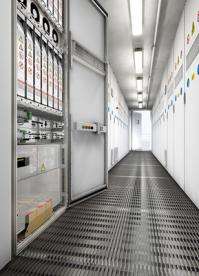
Siemens has developed an energy-storage system that can act as a buffer in electrical power grids. The aim is to provide a buffer against short-term fluctuations in output from renewable energy sources. Such fluctuations can last for seconds or several minutes long. The modular designed Siestorage battery is based on lithium-ion rechargeable battery technology and fits into a normal shipping container. In its big layout it stores 500 kilowatt-hours of electricity. That's about the average daily power consumption of 50 households. The Italian power company Enel recently switched on the first Siestorage installation, which has a capacity of one megawatt. Enel is using the installation, which is connected to its primary distribution network, to study how voltage can be stabilized.

The electrical output of photovoltaic arrays doesn't only fluctuate with the seasons or between night and day. It's also affected by . For example, power production sags for a few seconds (or even minutes) if clouds drift over the modules. Consequently, the grid experiences brief drops in voltage. deal with these fluctuations within milliseconds in the power grid itself. As a result, there's no need to adjust controls at power stations - a procedure that reduces efficiency and increases costs. 

During development, Siemens worked together with one of the world's largest manufacturers of lithium-ion batteries. Thanks to the system's modular design, its capacity can be expanded to two megawatt hours at an output of 8 megawatts. The complete solution with the inverter module and the controller that connect the system to the grid are from Siemens. 

Enel will also study how well the system can handle a controlled restart of a grid after a complete blackout. To achieve this feat, the system's inverter has to regulate the right voltage and frequency so that the grid can be powered up in a controlled manner. Such a solution would be very interesting for small independent power grids on islands or in remote areas, which would otherwise have to be connected to neighboring grids. 

Energy storage systems form part of Siemens solutions for tomorrow's smart grid. They are part of Siemens' environmental portfolio, with which the company generated about €30 billion in sales in 2011.

Explore further: Energy-positive with natural ventilation

add to favorites email to friend print save as pdf

Related Stories

Smart software for self-regulating smart grid

May 24, 2011

Siemens and the utility company Allgauer Uberlandwerk (AUW) in the city of Kempten, Germany, are testing the smart grids of the future. The tests focus on optimized power distribution and the use of a self-organizing ...

Virtual power plants for renewable energies

Apr 27, 2012

Siemens recently put two virtual power plants into operation. Virtual power plants are networks of several small power stations that are run like a single system. One of the new virtual power plants enables ...

Siemens makes US acquisition in smart grid sector

Dec 05, 2011

German engineering giant Siemens said Monday it has agreed to buy eMeter, a US-based data management specialist, in a bid to enhance its position in the field of so-called smart grids.

A world record in direct current transmission

May 03, 2011

Siemens is building power converter stations for a high-voltage direct current (HVDC) transmission system with a record capacity of 2 x 1,000 megawatts. Beginning in 2013 the new HVDC PLUS technology will ...

Sony develops 1.2kWh-class energy storage module

Jun 23, 2010

Sony today announced the development of an energy storage module using lithium-ion rechargeable batteries made with olivine-type lithium iron phosphate as the cathode material. Key features of olivine-type ...

Recommended for you

Morocco to harness the wind in energy hunt

2 hours ago

Morocco is ploughing ahead with a programme to boost wind energy production, particularly in the southern Tarfaya region, where Africa's largest wind farm is set to open in 2014.

Energy-positive with natural ventilation

May 17, 2013

Buildings can be air-conditioned using entirely natural means, without mechanical ventilation systems. This is the claim made by 78-year-old Benjamin Bronsema, who will be awarded his PhD for his thesis on the subject at ...

CTRL+P: Printing Australia's largest solar cells

May 16, 2013

(Phys.org) —The printer has allowed researchers from the Victorian Organic Solar Cell Consortium (VICOSC) – a collaboration between CSIRO, The University of Melbourne, Monash University and industry partners ...

User comments : 0

More news stories

Morocco to harness the wind in energy hunt

Morocco is ploughing ahead with a programme to boost wind energy production, particularly in the southern Tarfaya region, where Africa's largest wind farm is set to open in 2014.

Galaxy's Ring of Fire

Johnny Cash may have preferred this galaxy's burning ring of fire to the one he sang about falling into in his popular song. The "starburst ring" seen at center in red and yellow hues is not the product of ...

US psychiatry gets makeover in new manual

The latest makeover to a massive psychiatric tome honored by some, reviled by others and even called the "Bible" of mental disorders is being released Saturday with a host of new changes.

New case of SARS-like virus in Saudi: ministry

A new case of the deadly coronavirus has been detected in Saudi Arabia where 15 people have already died after contracting it, the health ministry announced on Saturday on its Internet website.