A physicist and an inventor
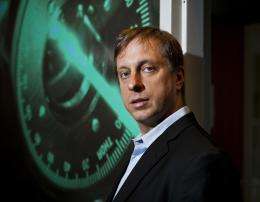
As a boy growing up in Croatia, Marin Soljacic wanted to be an inventor. But he wasn’t interested only in designing new products; he wanted to discover physical phenomena that would enable completely new technologies.
In that, Soljacic has succeeded remarkably. With others at MIT, he developed a way to transmit power wirelessly — a technology that might soon allow people to charge their cellphones, computers and even electric cars without ever having to plug them in. His work on photonic crystals, which can alter the behavior of light, could lead to a variety of novel applications, including more efficient ways to capture solar and thermal energy, faster optical communications and novel light sources.
“As a child I always dreamed about inventing machines. But when I started taking computer science classes, physics classes and engineering classes, I realized that what I found most exciting was when new physics enables new applications,” says Soljacic, who in 2008 won a MacArthur Fellowship, commonly known as the “genius grant.”
Soljacic, a physics professor who earned tenure last summer, had a serendipitous route to MIT. He was a high school junior in 1991 when Croatia declared its independence from Yugoslavia. Soljacic had been planning to attend the University of Zagreb, but the prospect of war prompted him to consider other possibilities more seriously. A friend who was a year older had gained acceptance to MIT, and encouraged him to apply.
“I had heard of MIT, but I didn’t know that much about it,” Soljacic recalls. He thought it would be too expensive to attend, but applied for scholarship money at his friend’s suggestion.
“I didn’t really have very high hopes that I would get in and get the money,” he recalls. “On the other hand, I thought I might as well apply.”
Soljacic spent much of the first half of his senior year of high school in bomb shelters, fearing the war might go on for many years. But in January 1992, the international community recognized Croatia’s independence and a ceasefire was declared.
After that, “motivation to study outside of Croatia was weaker,” Soljacic says. “I wouldn’t say I forgot about it, but it was less urgent. Then two months later I got a letter from MIT saying that not only would they admit me, but they would pay for everything. Then I was like, I might as well go and see — what’s the worst thing that could happen?”
As an undergraduate, Soljacic majored in physics and electrical engineering. “I couldn’t make up my mind,” he laughs. His undergraduate thesis resulted in a paper on inflationary cosmology, written with physics professors Alan Guth and Lisa Randall (now at Harvard University).
However, Soljacic, who graduated from MIT in 1996, wanted to focus more on experimental research. As a graduate student at Princeton University, he first worked with Frank Wilczek (now at MIT) on soft condensed matter theory, a field that examines the physical behavior of materials such as liquids, glasses, polymers, foams and gels.
For his PhD thesis, Soljacic turned his attention to the field of photonics — the study of the physics of light. “I really liked that because it’s still a fairly small field, so not only is it possible but it’s still desirable to do both theory and experiments,” he says. “Many fields are larger, more mature, and once fields become more mature it is often difficult to do things like that. Typically, one needs to become more specialized.”
Practical applications
After finishing his PhD, Soljacic came to MIT as a Pappalardo Postdoctoral Fellow. After that, he was a principal research scientist at MIT’s Research Laboratory for Electronics (RLE) for two years, then joined the faculty of the physics department in 2005.
Soljacic, who is still a member of RLE, came up with the idea for wireless energy transfer after growing tired of hearing his cellphone emit warning beeps in the middle of the night because its battery was dying.
Such systems could make forgetting to charge your cellphone a thing of the past, and make electric cars more practical, Soljacic says. “Let’s say you have an electric car and your neighbor has a conventional car, running on gasoline. The only difference you will notice is you never have to go to a gas station again,” he says. “You’ll just park it in your garage and it will charge itself, so you won’t have to remember to plug it in every night.”
Soljacic is also working on more efficient solar energy conversion using photonic crystals — materials whose nanoscale structures make light behave in ways it ordinarily can’t. Specifically, the crystals are made of a lattice of one kind of material alternating with either a different material or open space. Depending on the structure and the spacing of the blocks that make up the lattice, certain wavelengths can get through while others are reflected or absorbed.
“By tailoring the nanostructure, we can tailor the laws of physics as far as light is concerned, almost at will,” Soljacic says. “We can create materials, called metamaterials, which have physical properties dramatically different than any naturally existing materials.”
For example, such materials can be designed to absorb substantially more energy from the sun than traditional ones, while thermal radiation losses are minimized. Photonic crystals can also be used for applications in lasers, LEDs and optical fibers. Soljacic’s lab is also working on creating materials that change color depending on the spacing of materials in the nanostructure.
Provided by Massachusetts Institute of Technology
This story is republished courtesy of MIT News (web.mit.edu/newsoffice/), a popular site that covers news about MIT research, innovation and teaching.


