Cracking idea for egg shell recycling gets Food and Drink iNet support at Easter
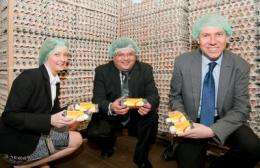
Scientists and food industry experts are hatching a plan this Easter to turn egg shells into plastics that could be used to manufacture anything from food packaging to construction materials.
They also hope to extract material from egg shells that may prove valuable in the pharmaceutical industry.
As Easter approaches, The Food and Drink iNet is revealing that it is funding a research project at the University of Leicester which is looking at eggs and egg shells in a new light.
The project aims to find useful ways of recycling egg shells which are currently regarded as waste by food producers and which they have to pay to dispose of in landfill.
This is why the Food and Drink iNet is supporting the project with the university to discover innovative ways of using egg shells practically in a number of different areas to be seen as income generating by egg producers, rather than a financial drain on their business.
Scientists in the Department of Chemistry at the University of Leicester, specialising in 'green chemistry' and sustainable materials are looking at how to extract glycosaminoglycans, proteins which are found in egg shells. GAGs are used in numerous biomedical applications and could prove useful in the pharmaceutical industry.
They are also hoping to identify ways to use the egg shells as fillers which could be used to 'bulk up' different grades of plastic, with all sorts of applications from ready meal food trays to shop fittings.
The ultimate goal is to use the egg shells in packaging to protect egg products – giving a second lease of life to the egg shell in the very role it was created for …. a true case of recycling.
"Egg shell is classified as a waste material by the food industry but is in fact a highly sophisticated composite," said Food and Drink iNet director Richard Worrall. "The scientists at the University of Leicester have identified a number of uses for egg shell waste and the Food and Drink iNet is very pleased to support a 'Collaborate to Innovate' research project to examine egg shell recycling solutions.
"This could have potential benefit on many levels, both for food manufacturers and a much wider industry."
The research team led by Professor Andy Abbott, professor of physical chemistry and head of the Chemistry Department at the University of Leicester, is working in conjunction with Philip Chatfield, director of Ashby de la Zouch project management company Integrated Food Projects. The project plans to involve a number of small and medium-sized egg-related companies in the East Midlands region.
Leicester hard-boiled egg and mayonnaise manufacturer Just Egg uses around 1.3 million eggs every week, creating around 10 tonnes of egg shells. Currently the firm spends approximately £30,000 a year sending about 480 tonnes of shells to landfill for disposal.
Managing director Pankaj Pancholi said the research could bring big benefits to the food and drink sector.
"If I wasn't spending the £30,000 a year on landfill costs I could employ another worker or two part-time workers, or invest that money in R&D and innovation," he said. "It would be great if the egg shells could ultimately be recycled to be used in the plastic packaging that we use for egg products, like our new hard boiled eggs in packs. This is a really exciting project."
Part-funded by the European Regional Development Fund (ERDF), the Food and Drink iNet has awarded almost £20,000 towards the project under its Collaborate to Innovate programme, which will include the sharing of the results with food manufacturers across the East Midlands and beyond. Interested companies are invited to get in touch.
Professor Andy Abbott, from The University of Leicester, said: "We specialise in researching and developing innovative manufacturing solutions around recycling technology. This project is focused on researching novel methodologies for recovering and re using a waste stream into a sustainable financially viable material supply locally. The R&D funding from the Food and Drink iNet is very timely and very gratefully received."
The iNet-funded project aims to develop and validate the pre-treatment process of the eggshell needed to make it sterile; develop a method for the extraction of glycosaminoglycans from eggshell and analyse the products obtained; develop a post-treatment process to convert the eggshell into a starch-based plastic; test the mechanical properties, including the strength of the new material and make a variety of materials to optimise the eggshell loading and particle size.
Provided by University of Leicester


