Compounds shared by all worms may lead to parasite treatment
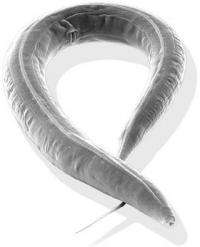
(Phys.org) -- Worms are important decomposers in soil and are great for fishing, but in humans, the slimy wrigglers spell trouble. Hookworms, whipworms, Ascaris, Guinea worms and trichina worms are just a few parasitic nematodes that infect some 2 billion people.
Now, researchers have discovered a class of small molecules that all nematodes use to signal such processes as growing, developing, mating and moving toward or away from an area. The finding could lead to prevention and treatments for worm parasites that widely infect humans, animals and crops.
"All of these nematodes speak the same chemical language," through the use of compounds called ascarosides, said study co-author Frank Schroeder, a research scientist at the Boyce Thompson Institute (BTI) for Plant Research and adjunct assistant professor in Cornell's Department of Chemistry and Chemical Biology.
The study, published online April 12 in the journal Current Biology, was led by Stephan von Reuss, a postdoctoral associate in Schroeder's lab, and Andrea Choe, a postdoctoral scholar in the lab of co-author Paul Sternberg, a biologist at the California Institute of Technology.
Since nematodes are the only known organisms to use ascarosides, "we don't have to be afraid of interfering with similar biochemistry in animals, plants or humans," Schroeder said, as researchers seek to identify species-specific ascaroside molecules that may enable novel approaches to deter or disrupt the survival or reproduction of parasitic worms.
Researchers in Schroeder's lab have already filed for three patents, one that covers the structures of various ascarosides, one that covers ascarosides for use as agents to protect plants, and one that makes claims to how to use the compounds to treat or prevent human disease.
The researchers first discovered ascarosides as a signaling molecule in C. elegans, a nematode used as a model organism to study cell, developmental and nervous system biology, as well as human aging and diabetes.
"We then thought, if C. elegans uses this chemical language, perhaps other nematodes do too," Schroeder said. Proving their hunch, the researchers found ascarosides in the secretions of every nematode they examined, and a few subsequent experiments showed that the small compounds also acted as signaling molecules in the species' they investigated.
The ascaroside communication system in nematodes resembles communication modes in bacteria where very different bacteria species can communicate using a conserved chemical code, Schroeder said.
The study was funded by the National Institutes of Health and the Howard Hughes Medical Institute.
Provided by Cornell University


