Solar Impulse completes 72 hour simulated flight
February 24, 2012 by Andre Lehmann
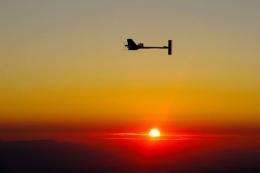
The experimental Solar Impulse aircraft with Swiss pilot Andre Borschberg onboard flies at sunrise above Payerne airbase, July 2010, during the first attempt to fly around the clock fuelled by the energy of the sun. Borschberg completed a 72-hour non-stop flight Friday -- but in a simulator for the new Solar Impulse aircraft planned for a 2014 world tour using only solar energy.
Swiss pilot Andre Borschberg completed a 72-hour non-stop flight Friday -- but in a simulator for the new Solar Impulse aircraft planned for a 2014 world tour using only solar energy.
Borschberg emerged red-eyed from lack of sleep to tell reporters how he had endured three days and three nights in a narrow cockpit, wired up to electrodes and filmed from all angles.
For he and his 80-strong support team have to ensure not just that they can build a solar-powered aircraft capable of completing the flight around the world, but also that they have a pilot strong enough to complete the mission.
Borschberg declared the experiment a success.
"This simulation was extremely important because it has shown the strategy for the 2014 flight is viable," he told reporters.
Borschberg founded the project with Bertrand Piccard, a famous explorer who made his name for travelling around the world in a hot-air balloon.
"This is the first time each section of the team worked simultaneously in one place, for a long time," said Piccard.
The projected tour of the world would be split up into five stages, said Borschberg.
"The longest flight segments will last up to five days and five nights and we had to make sure the pilot aboard the aircraft can survive" during these long periods, he added.
To this end, the team completely redesigned the cockpit from the previous model that last summer made a series of European flights to air shows in Brussels and Paris, making it more spacious.
The pilot's seat can be folded so he can relax or sleep very briefly after connecting the autopilot. A toilet is built into the seat.
He can be fed with freeze-dried meals that can be warmed up during the flight.
"We focused on gastronomic pleasure with real dishes, not tablets," said a spokeswoman.
The team had to contend with 20 simulated approach and landings a day during the simulation, with little respite for the pilot.
To avoid cramping up, the pilot devoted himself to yoga and pilates exercises.
The pilot had to get by on on snatches of microsleep lasting only about 20 minutes and come the real mission, he will also have to be able to withstand extreme temperature fluctuations.
The first prototype of Solar Impulse made aviation history in July 2010 providing the first uninterrupted flight of 24 hours powered only by its solar panels and batteries.
Its wings were covered with 12,000 solar cells and it had four electric motors.
Construction has already started on the new device, which will be larger, with new batteries and engines.
The aircraft must be ready for its first test flight in 2013.
(c) 2012 AFP
-
From lemons to lemonade: Reaction uses carbon dioxide to make carbon-based semiconductor,
33 comments
-
Thioridazine kills cancer stem cells in human while avoiding toxic side-effects of conventional cancer treatments,
3 comments
-
SpaceX private rocket blasts off for space station (Update),
42 comments
-
Landmark calculation clears the way to answering how matter is formed,
55 comments
-
Research team claims to have found evidence Lake Cheko is impact crater for Tunguska Event,
18 comments
-
Need a rigid insulation material???
May 26, 2012
-
magnets or EMF in car bumpers to protect from fender bender
May 26, 2012
-
length of wire in a coil of known dimensions?
May 25, 2012
-
India Engineering Powerhouse
May 25, 2012
-
electromagnet core dereference between hard and soft iron
May 25, 2012
-
Measuring water pressure in an open tank
May 24, 2012
- More from Physics Forums - General Engineering
More news stories
Browser wars flare in mobile space
The browser wars are heating up again, but this time the fight is for dominance of the mobile Internet.
20 hours ago |
4 / 5 (4) |
3
Probability of contamination from severe nuclear reactor accidents is higher than expected: study
Catastrophic nuclear accidents such as the core meltdowns in Chernobyl and Fukushima are more likely to happen than previously assumed. Based on the operating hours of all civil nuclear reactors and the number ...
Technology / Energy & Green Tech
May 22, 2012 |
3.6 / 5 (25) |
57
|
HyperSolar shows dirty water no barrier to power world
(Phys.org) -- The Santa Barbara, California, company, HyperSolar, is set to transparently share the ups and downs of its research experiences toward the companys ultimate vision, successfully producing ...
Tesla to launch electric sedan in US on June 22
Tesla Motors said Tuesday it would begin deliveries of "the world's first premium electric sedan" on June 22, slightly ahead of schedule.
Technology / Energy & Green Tech
May 22, 2012 |
4.5 / 5 (12) |
18
SpotterRF debuts Radar Backpack Kit (w/ Video)
(Phys.org) -- SpotterRF has announced a special radar backpack kit designed to enhance situational awareness for soldiers on the ground. The company says its special radar is designed for warfighters as part ...
Stunning image of smallest possible five-ringed structure
Scientists have created and imaged the smallest possible five-ringed structure about 100,000 times thinner than a human hair and you'll probably recognise its shape.
'Unzipped' carbon nanotubes could help energize fuel cells, batteries
Multi-walled carbon nanotubes riddled with defects and impurities on the outside could replace some of the expensive platinum catalysts used in fuel cells and metal-air batteries, according to scientists at ...
Change in developmental timing was crucial in the evolutionary shift from dinosaurs to birds: study
At first glance, it's hard to see how a common house sparrow and a Tyrannosaurus Rex might have anything in common. After all, one is a bird that weighs less than an ounce, and the other is a dinosaur that ...
Computer model used to pinpoint prime materials for efficient carbon capture
When power plants begin capturing their carbon emissions to reduce greenhouse gases and to most in the electric power industry, it's a question of when, not if it will be an expensive undertaking.
T cells 'hunt' parasites like animal predators seek prey, study shows
By pairing an intimate knowledge of immune-system function with a deep understanding of statistical physics, a cross-disciplinary team at the University of Pennsylvania has arrived at a surprising finding: T cells use a movement ...
Yale study concludes public apathy over climate change unrelated to science literacy
Are members of the public divided about climate change because they don't understand the science behind it? If Americans knew more basic science and were more proficient in technical reasoning, would public consensus match ...
Feb 24, 2012
Rank: 5 / 5 (1)
Feb 25, 2012
Rank: 3 / 5 (2)
Feb 25, 2012
Rank: not rated yet
Feb 25, 2012
Rank: 5 / 5 (3)
Why? If your plane's cruising altitude is above the clouds the sun always shines (assuming you plan your trips during daytime)
Just need some power reserves for takeoff to get above the clouds (for landings you could probably recharge your reserves along the way)
Think 'slow travel'. Travelling as an experience. Solar powered blimps or largish gliders could do the trick. Humans will (hopefully) not have to keep running around like hamsters on treadmills to make a living forever.
Feb 25, 2012
Rank: 5 / 5 (1)
By the way, the article mention the craft has autopilot, but the pilot can only snatches 20 min of sleep at a time. Why? With telemetry monitoring from the ground, I suppose they can let the pilot sleep for at least an hour or more as sop, only wake him up if the plane starts to misbehaving? As if flying from a toilet seat is not bad enough :-)
Feb 25, 2012
Rank: not rated yet
If it can't handle the extra weight of 1 more person, then isn't it a slightly pointless endeavour?