Gamers on 3-D mission to save world, just don't tell them they are learning cell biology
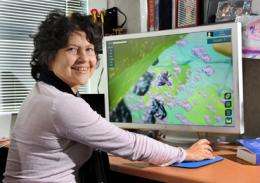
After growing up on an entertainment diet of X-Men and Xbox, high school and college-age students may find a textbook on cell biology to be a little, well, bland.
Eve Syrkin Wurtele decided the best way to get the attention of the science-deprived, gamer generation is to take the information out of a text book and put it in a medium that kids crave - video games.
So her team developed Meta!Blast, which won honorable mention in the 2011 International Science and Engineering Visualization Challenge sponsored by the American Association for the Advancement of Science and is featured in the Feb. 3 issue of the journal Science.
The game takes place in the year 2052. Plants are dying, and there is a developing ecological crisis. At the same time, an expert team of plant scientists has disappeared. The player, represented by a novice undergraduate student in the research lab, must shrink to microscopic size, enter the plant cell, rescue the lost scientists, discover what is killing the plants, and save the world - all in the game's virtual, 3-D environment. Along the way, players must solve problems and answer questions about the cell and metabolic biology.
Let's see a textbook do that.
It has been more than a decade since Wurtele, a professor in the Department of Genetics, Development and Cell Biology, had the idea for the game as a way to reach students in an understandable, "cool" and exciting way.
"It was a combination of teaching the freshman core biology class and teaching my own children about photosynthesis and respiration that sparked the idea of the game. I found that these concepts are really hard to get across," said Wurtele. "One reason understanding biology is so difficult is that life is driven by events that take place across a huge variation in temporal and spatial scale. And most biological terms are really boring to the uninitiated. Words like acetyl-Coenzyme put kids to sleep."
Wurtele, who researches how metabolism is regulated, would love to see her students use the game to find a love for science.
"Developing a game in which students interact with the subject makes them partners in learning. And playing video games, kids are willing to learn lots of crazy words just because they are involved in the game. So my idea was to develop something interactive that moved through time and space. As opposed to students gagging every time they read the word 'mitochondria.' In Meta!Blast, students realize the mitochondria are a place to pick up extra energy."
More than 50 undergraduate students, high school students and researchers in biology, art, computer science, education and game design have contributed to creating different aspects of the virtual game, which accurately represents the interior of a plant cell. Most of that effort was in the last three years as funding for the project started to increase.
Wurtele says the delay may have been a blessing as the technology to make the game as it is now didn't exist when "we first had the idea."
"Year by year the software for making models and program game elements became more powerful and sophisticated," she said.
Game design was important to Wurtele, who also insisted from the start that the game provide an accurate, 3-D representation of a photosynthetic cell.
Diane Bassham, associate professor in the Department of Genetics, Development and Cell Biology, worked with Wurtele on the project, and says that the game is up to date and accurate.
"We incorporate recent research on cell structure and behavior into the Meta!Blast cell models," she said.
"We wanted it to be visually beautiful," Wurtele said. "And we wanted it to represent a real cell. It is very hard to understand the three dimensionality of the cell from drawings or text. And (in our game) cellular content can move, and the players interact with it. It's like walking into a forest where you can see parts of the forest, touch the trees and moss, and explore. Looking at a sketch of forest doesn't enable the same understanding."
The game is designed to be used in schools and the learning principles and content are based on content standards of the National Academy of Sciences for life science, grades 9-12. Teachers who use the game will soon be able to gauge students' progress by monitoring the game's assessment tools.
Several teachers in Iowa and Mississippi are currently using Meta!Blast in their classrooms and giving feedback to the design team.
In the future, Wurtele thinks applications such as Meta!Blast will be important teaching tools for science education.
"I think education will become much more interactive," she said. "We can integrate new concepts of science and engineering technologies. Further, students will have the opportunity to learn on their own, by exploring in the real world. This game provides a means of computationally exploring the cell interior, down to the nano-scale."
Wurtele stressed that she is not trying to replace books in the classroom, just complement them.
"Good books and electronic or e-books have a wonderful place in education," she said. "I don't think Meta!Blast takes away from the books. Rather, I anticipate that by playing this game, students will be able to read science texts more easily, and teachers will have a new tool to involve students in science."
But she adds one caution.
"When I started the thinking about the idea of a video game for cell and metabolic biology, I had no idea how hard it would be," she said.
Meta!Blast has been developed with support from the Science Education Partnership at the National Institute of Health, and the National Science Foundation. Iowa State University's Plant Sciences Institute, Center for Biorenewable Chemicals, College of Liberal Arts and Sciences, and the Department of Genetics, Development and Cell Biology all contributed.
Provided by Iowa State University


