First ever direct measurement of the Earth's rotation
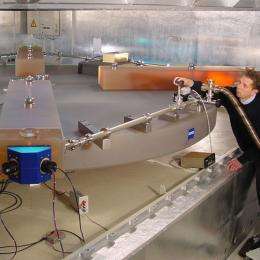
© Geodätische Observatorium Wettzell
A group with researchers of the Technical University of Munich, Germany, are the first to plot changes in the Earth's axis through laboratory measurements. To do this, they constructed the world's most stable ring laser. Previously, scientists were only able to track shifts in the axis indirectly by monitoring fixed objects in space. Capturing these shifts is crucial for navigation systems.
The Earth wobbles. Like a spinning top touched in mid-spin, its rotational axis fluctuates in relation to space. This is partly caused by gravitation from the sun and the moon. At the same time, the Earth's rotational axis constantly changes relative to the Earth's surface. On the one hand, this is caused by variation in atmospheric pressure, ocean loading and wind. These elements combine in an effect known as the Chandler wobble to create polar motion. Named after the scientist who discovered it, this phenomenon has a period of around 435 days. On the other hand, an event known as the "annual wobble" causes the rotational axis to move over a period of a year. This is due to the Earth's elliptical orbit around the sun. These two effects cause the Earth's axis to migrate irregularly along a circular path with a radius of up to six meters.
Capturing these movements is crucial to create a reliable coordinate system that can feed navigation systems or project trajectory paths in space travel. "Locating a point to the exact centimeter for global positioning is an extremely dynamic process after all, at our latitude, we are moving at around 350 meters to the east per second," explains Prof. Karl Ulrich Schreiber who directed the project in TUM's Research Section Satellite Geodesy. The orientation of the Earth's axis relative to space and its rotational velocity are currently established in a complicated process that involves 30 radio telescopes around the globe. Every Monday and Thursday, eight to twelve of these telescopes alternately measure the direction between Earth and specific quasars. Scientists assume that these galaxy nuclei never change their position and can therefore be used as reference points. The geodetic observatory Wettzell, which is run by TUM and Germany's Federal Agency for Cartography (BKG), is also part of this process.
In the mid-1990s, scientists of TUM and BKG joined forces with researchers at New Zealand's University of Canterbury to develop a simpler method that would be capable of continuously tracking the Chandler wobble and annual wobble. "We also wanted to develop an alternative that would enable us to eliminate any systematic errors," continues Schreiber. "After all, there was always a possibility that the reference points in space were not actually stationary." The scientists had the idea of building a ring laser similar to ones used in aircraft guidance systems only millions of times more exact. "At the time, we were almost laughed off. Hardly anyone thought that our project was feasible," says Schreiber.
Yet at the end of the 1990s, work on the world's most stable ring laser got underway at the Wettzell observatory. The installation comprises two counter-rotating laser beams that travel around a square path with mirrors in the corners, which form a closed beam path (hence the name ring laser). When the assembly rotates, the co-rotating light has farther to travel than the counter-rotating light. The beams adjust their wavelengths, causing the optical frequency to change. The scientists can use this difference to calculate the rotational velocity the instrumentation experiences. In Wettzell, it is the Earth that rotates, not the ring laser. To ensure that only the Earth's rotation influences the laser beams, the four-by-four-meter assembly is anchored in a solid concrete pillar, which extends six meters down into the solid rock of the Earth's crust.
The Earth's rotation affects light in different ways, depending on the laser's location. "If we were at one of the poles, the Earth and the laser's rotational axes would be in complete synch and their rotational velocity would map 1:1," details Schreiber. "At the equator, however, the light beam wouldn't even notice that the Earth is turning." The scientists therefore have to factor in the position of the Wettzell laser at the 49th degree of latitude. Any change in the Earth's rotational axis is reflected in the indicators for rotational velocity. The light's behavior therefore reveals shifts in the Earth's axis.
"The principle is simple," adds Schreiber. "The biggest challenge was ensuring that the laser remains stable enough for us to measure the weak geophysical signal without interference especially over a period of several months." In other words, the scientists had to eliminate any changes in frequency that do not come from the Earth's rotation. These include environmental factors such as atmospheric pressure and temperature. They relied predominantly on a ceramic glass plate and a pressurized cabin to achieve this. The researchers mounted the ring laser on a nine-ton Zerodur base plate, also using Zerodur for the supporting beams. They chose Zerodur as it is extremely resistant to changes in temperature. The installation is housed in a pressurized cabin, which registers changes in atmospheric pressure and temperature (12 degrees) and automatically compensates for these. The scientists sunk the lab five meters below ground level to keep these kinds of ambient influences to a minimum. It is insulated from above with layers of Styrodur and clay, and topped by a four-meter high mound of Earth. Scientists have to pass through a twenty-meter tunnel with five cold storage doors and a lock to get to the laser.
Under these conditions, the researchers have succeeded in corroborating the Chandler and annual wobble measurements based on the data captured by radio telescopes. They now aim to make the apparatus more accurate, enabling them to determine changes in the Earth's rotational axis over a single day. The scientists also plan to make the ring laser capable of continuous operation so that it can run for a period of years without any deviations. "In simple terms," concludes Schreiber, "in future, we want to be able to just pop down into the basement and find out how fast the Earth is accurately turning right now."
More information: Schreiber, K. U.; Klügel, T.; Wells, J.-P. R.; Hurst, R. B.; Gebauer, A.: How to detect the Chandler and the annual wobble of the Earth with a large ring laser gyroscope; Physical Review Letters, Vol. 107, Nr. 17, EID 173904, American Physical Society, ISSN 0031-9007, DOI: 10.1103/PhysRevLett.107.173904 , 2011
Spotlight by the American Physical Society: http://physics.aps … t.107.173904
Journal reference:
Physical Review Letters
Provided by Technische Universitaet Muenchen
-
From lemons to lemonade: Reaction uses carbon dioxide to make carbon-based semiconductor,
32 comments
-
Thioridazine kills cancer stem cells in human while avoiding toxic side-effects of conventional cancer treatments,
3 comments
-
SpaceX private rocket blasts off for space station (Update),
42 comments
-
Climate scientists say they have solved riddle of rising sea,
31 comments
-
SpaceX capsule has 'new car' smell, astronauts say (Update),
4 comments
-
Why does a boiled egg rotates while a raw egg doesn't?
2 hours ago
-
Lightning strike in mindair
3 hours ago
-
Why does light move?
4 hours ago
-
How to calculate the repulsion force between a permanent and an electromagnet?
6 hours ago
-
Why does light allow us to see things?
6 hours ago
-
Room temperature superconductivity
6 hours ago
- More from Physics Forums - General Physics
More news stories
Is a classical electrodynamics law incompatible with special relativity?
(Phys.org) -- The laws of classical electromagnetism that were developed in the 19th century are the same laws that scientists use today. They include Maxwell’s four equations along with the Lorentz la ...
Landmark calculation clears the way to answering how matter is formed
(Phys.org) -- An international collaboration of scientists, including Thomas Blum, associate professor of physics, is reporting in landmark detail the decay process of a subatomic particle called a kaon ...
May 25, 2012 |
4.3 / 5 (22) |
52
|
Lying in wait for WIMPs: Researchers seek to dramatically increase sensitivity of Large Underground Xenon detector
Although it's invisible, dark matter accounts for at least 80 percent of the matter in the universe. No one knows what it is, but most scientists would bet on weakly interacting massive particles, or WIMPs.
May 23, 2012 |
4 / 5 (7) |
18
|
Hawaii lab turns laser-powered bubbles into microrobots
(Phys.org) -- A team of scientists from the University of Hawaii are working on microrobots created from bubbles of air in a saline solution. The bubbles take on their title of robots as a laser ...
Sound increases the efficiency of boiling
Scientists at the Georgia Institute of Technology achieved a 17-percent increase in boiling efficiency by using an acoustic field to enhance heat transfer. The acoustic field does this by efficiently removing vapor bubbles ...
May 24, 2012 |
5 / 5 (2) |
2
Stunning image of smallest possible five-ringed structure
Scientists have created and imaged the smallest possible five-ringed structure about 100,000 times thinner than a human hair and you'll probably recognise its shape.
'Unzipped' carbon nanotubes could help energize fuel cells, batteries
Multi-walled carbon nanotubes riddled with defects and impurities on the outside could replace some of the expensive platinum catalysts used in fuel cells and metal-air batteries, according to scientists at ...
Change in developmental timing was crucial in the evolutionary shift from dinosaurs to birds: study
At first glance, it's hard to see how a common house sparrow and a Tyrannosaurus Rex might have anything in common. After all, one is a bird that weighs less than an ounce, and the other is a dinosaur that ...
Computer model used to pinpoint prime materials for efficient carbon capture
When power plants begin capturing their carbon emissions to reduce greenhouse gases and to most in the electric power industry, it's a question of when, not if it will be an expensive undertaking.
T cells 'hunt' parasites like animal predators seek prey, study shows
By pairing an intimate knowledge of immune-system function with a deep understanding of statistical physics, a cross-disciplinary team at the University of Pennsylvania has arrived at a surprising finding: T cells use a movement ...
Land and sea species differ in climate change response: study
(Phys.org) -- Marine and terrestrial species will likely differ in their responses to climate warming, new research by Simon Fraser University and Australia’s University of Tasmania has found.
Dec 22, 2011
Rank: 1 / 5 (6)
Since light is not a wave but is a series of photons traveling in single file, the increase in frequency is actually an increase in photons passing a given 'stationary' point in a given amount of time. The light speed up or slows down depending on the direction. Relativity is wrong. The speed of the medium is added to the speed of the light. They are detecting a measurable change in light caused by an almost immeasurable change in speed of the medium(mirrors and atmosphere). Hardly what relativity predicts.
Dec 22, 2011
Rank: 4 / 5 (4)
Dec 22, 2011
Rank: 1 / 5 (5)
Dec 22, 2011
Rank: 4 / 5 (3)
Dec 22, 2011
Rank: 1 / 5 (6)
Dec 22, 2011
Rank: 4.4 / 5 (7)
Again, light propagates as a wave. An individual photon, when it moves, moves as a wave. It can be combined with another photon and the amplitude of the wave is the addition of the two. It can also be destroyed in much the same way. This is constructive/destructive interference and has been proven in experiment for about 100 years.
Dec 22, 2011
Rank: 4.9 / 5 (31)
It is possible to release a single photon and see that it interferes with it self (although it requires many trials to see the interference).
A single photon can impart a momentum like a particle.
A prism does not spread a single photon into many colours,.. it's sorts light based on it's frequency into bands of colours (frequencies).
[FrankHerbert, the mental child rates me 1's no matter what I post .]
Dec 22, 2011
Rank: 1.2 / 5 (5)
Dec 22, 2011
Rank: 1 / 5 (4)
1, This was just plain foolish, since it was allegedly established by Eistein that absolute rest doesn't exist.
2, Because of the Hubble constant, there is no reference frame in which two galaxies are permanently at rest relative to one another, therefore someone was making an error either in measurement or in logic from the beginning.
Dec 22, 2011
Rank: 2 / 5 (4)
The particle theory of light doesn't work for explaining cosmic red shift.
In order for cosmic red shift to occur, NEW SPACE is produced between every point between individual troughs and crests in the wave form, thus "stretching out" the wave in space.
The way you have to do this is convert the Hubble Constant to the scale of the wavelength of light, and you'll find that it works.
This would NOT WORK if light propagated as a particle.
In fact, no form of doppler shift would work.
The only reason doppler shift would work is if light propagates as a wave, since that's the whole point: The wave crests and troughs are closer together than the "should be" when the object is moving towards you, and farther apart when it is moving away, etc.
Dec 22, 2011
Rank: 4.9 / 5 (28)
Well I don't know other wise.
Dec 22, 2011
Rank: 5 / 5 (3)
That is correct, however when you take extreme distance into account and a given amount of required accuracy, averaged over multiple reference objects, then it's quite valid to assume that these objects are 'stationary' for the purposes of the measurement.