Expanding dead zones shrinking tropical blue marlin habitat
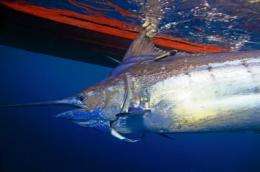
The science behind counting fish in the ocean to measure their abundance has never been simple. A new scientific paper authored by NOAA Fisheries biologist Eric Prince, Ph.D., and eight other scientists shows that expanding ocean dead zones – driven by climate change – have added a new wrinkle to that science.
In the December 4 paper published in the scientific journal Nature Climate Change, these scientists sound an alarm that expanding ocean dead zones are shrinking the habitat for high value fish such as marlins in the tropical northeast Atlantic Ocean. As dead zones expand, marlins, other billfish and tunas move into surface waters where they are more vulnerable to fishing. Dead zones are areas in the ocean where oxygen levels are so low that creatures cannot survive over the long term.
"By combining the disciplines of oceanography and fishery biology, we are getting a much clearer picture of how climate driven dead zones are shrinking the habitat for some of the world's most valuable fish to commercial and recreational fishermen," Prince said. "With a clearer picture, we will be able to make better management decisions for the long-term health of these species and their ecosystems."
In the past, Prince has studied the movement of marlins and other billfish in ocean waters off Florida and the Caribbean as well as in the tropical waters of the eastern Pacific. The new paper combines Prince's research on marlins in the northeast tropical Atlantic Ocean off Africa with oceanographic research in the same waters by Lothar Stramma and his colleagues at the Leibniz Institute of Marine Science in Kiel, Germany, as well as scientists at the University of Miami Rosensteil School of Marine and Atmospheric Science.
Prince tagged blue marlin, one of the most valuable recreational species on the planet, with pop up satellite tracking devices to record their horizontal and vertical movement. He compared this information on fish movement with detailed oceanographic maps developed by Stramma and his colleagues on the same ocean areas showing the location of zones with low dissolved oxygen. Prince, Stramma and Sunke Schmidtko, who was at NOAA's Pacific Marine Environmental Laboratory in Seattle at the time of the research, are the three equally contributing first authors of the paper.
Blue marlins and many other billfish are high energy fish that need large amounts of dissolved oxygen. By comparing the movement of the blue marlins and the location of low-oxygen areas, the scientists show that blue marlins venture deeper when dissolved oxygen levels are higher and remain in shallower surface waters when low dissolved oxygen areas encroach on their habitat from below.
"The shrinking of habitat due to expanding dead zones needs to be taken into account in scientific stock assessments and management decisions for tropical pelagic billfish and tuna," said Prince. "Without taking it into account, stock assessments could be providing false signals that stocks are healthy, when in fact they are not, thus allowing overfishing that further depletes these fish stocks and threatens the sustainability of our fisheries."
While the new paper focuses on the tropical northeast Atlantic Ocean off Africa, the expansion of low-oxygen zones is occurring in all tropical ocean basins and throughout the subarctic Pacific, making the compression of habitat a global issue. The problem for pelagic fishes in the tropical Atlantic is particularly acute, the authors note, because many of these fish species and the unintended catch, called bycatch, are already fully exploited or overfished.
The new paper follows earlier research by Prince published in 2010 in Fisheries Oceanography based on tagging of marlins and sailfish in the waters off Florida and the Caribbean, which also showed these billfish prefer oxygen-rich waters close to the surface and move away from waters low in dissolved oxygen.
More information: To read the new paper, "Expansion of oxygen minimum zones may reduce available habitat for tropical pelagic fish," visit the"Nature Climate Change" website www.nature.com/nclimate/journa … ll/nclimate1304.html
Journal information: Nature Climate Change
Provided by NOAA


