Whales off Calif. coast draw crowds, warning
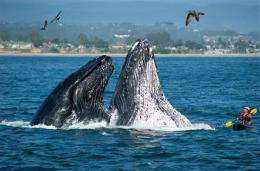
In this Oct. 25, 2011 photo provided by the Santa Cruz Conference and Visitors Council, kayaker Alan Brady is surprised by two breaching humpback whales while kayaking off the coast of Seabright State Beach in Santa Cruz, Calif. The U.S. Coast Guard is warning people to stay away from a pod of whales that has settled unusually close to the shore off Santa Cruz or face fines for whale harassment of at least $2,500. The agency plans to monitor the waters on Wednesday, Nov. 2, 2011. (AP Photo/Santa Cruz Conference and Visitors Council , Paul Schraub, file)
(AP) -- The U.S. Coast Guard on Wednesday monitored the waters off Santa Cruz, where a pod of whales has settled unusually close to shore drawing crowds and threatening the safety of kayakers and other boaters trying to get a look at the creatures.
The humpback whales, each measuring about the length of a school bus, have come about a mile from land in search of food.
The Monterey Bay National Marine Sanctuary said no one has been hurt so far but at least one sailboat was damaged this week when it struck a whale.
"The sheer number of folks crowding around the whales is not only an issue for the whales themselves, but also public safety," Paul Michel, the sanctuary's superintendent, told The San Francisco Chronicle. He estimated that 100 people took to the ocean on paddleboards and in kayaks last weekend to get a look.
He worried that the gawkers might disrupt the whales as they eat and leave them without enough energy to make their migratory journey to Mexico.
On Tuesday, the sanctuary and Coast Guard issued warnings for people to stay at least 100 yards away from the whales or face fines of at least $2,500 for whale harassment.
Don Croll, a professor in ecology and evolutionary biology at UC Santa Cruz, said whales are good at avoiding people while feeding but getting too close could pose safety risks. He said the whales are "lunge feeding," which involves dropping their jaw and swimming just below the surface capturing everything in their path.
Croll said watching such a spectacle - from a safe distance - is a thrill.
"Lunge feeding is probably one of the largest biomechanical events on the planet. It's a really, really great thing for people to see," he said.
Feeding grounds for the humpbacks are usually farther offshore, but scientists said this year weather conditions have brought anchovies closer to land, and the whales have followed.
The whales are likely to stick around Santa Cruz for another few weeks before continuing south.
©2011 The Associated Press. All rights reserved. This material may not be published, broadcast, rewritten or redistributed.
-
From lemons to lemonade: Reaction uses carbon dioxide to make carbon-based semiconductor,
32 comments
-
Thioridazine kills cancer stem cells in human while avoiding toxic side-effects of conventional cancer treatments,
3 comments
-
SpaceX private rocket blasts off for space station (Update),
42 comments
-
Climate scientists say they have solved riddle of rising sea,
31 comments
-
SpaceX capsule has 'new car' smell, astronauts say (Update),
4 comments
-
What would stain as translucent on light-coloured fabric?
May 26, 2012
-
How do I identify different bacteria on culture plates?
May 26, 2012
-
Why Do Dogs do Strange things...
May 25, 2012
-
What does exophillic and endophillic mean in terms of mosquito and their control?
May 24, 2012
-
Semen stains glows under black lights (uv light)?
May 23, 2012
-
Question on Human Chromosome 2
May 23, 2012
- More from Physics Forums - Biology
More news stories
Manufacturing genes to attack flu virus
An international research team has manufactured a new protein that can combat deadly flu epidemics.
6 hours ago |
not rated yet |
0
|
Scientist: Evolution debate will soon be history
(AP) -- Richard Leakey predicts skepticism over evolution will soon be history. Not that the avowed atheist has any doubts himself.
May 26, 2012 |
3.5 / 5 (20) |
89
More plant species responding to global warming than previously thought
(Phys.org) -- Far more wild plant species may be responding to global warming than previous large-scale estimates have suggested.
May 22, 2012 |
4.6 / 5 (14) |
18
|
For monogamous sparrows, it doesn't pay to stray (but they do it anyway)
It's quite common for a female song sparrow to stray from her breeding partner and mate with the male next door, but a new study shows that sleeping around can be costly.
May 22, 2012 |
5 / 5 (2) |
8
|
Thousands of shellfish found dead in Peru
Thousands of crustaceans were found dead off the coast of Lima following the mystery mass death of dolphins and pelicans, the Peruvian Navy said Friday.
May 26, 2012 |
4.7 / 5 (7) |
7
Stunning image of smallest possible five-ringed structure
Scientists have created and imaged the smallest possible five-ringed structure about 100,000 times thinner than a human hair and you'll probably recognise its shape.
'Unzipped' carbon nanotubes could help energize fuel cells, batteries
Multi-walled carbon nanotubes riddled with defects and impurities on the outside could replace some of the expensive platinum catalysts used in fuel cells and metal-air batteries, according to scientists at ...
Change in developmental timing was crucial in the evolutionary shift from dinosaurs to birds: study
At first glance, it's hard to see how a common house sparrow and a Tyrannosaurus Rex might have anything in common. After all, one is a bird that weighs less than an ounce, and the other is a dinosaur that ...
Computer model used to pinpoint prime materials for efficient carbon capture
When power plants begin capturing their carbon emissions to reduce greenhouse gases and to most in the electric power industry, it's a question of when, not if it will be an expensive undertaking.
T cells 'hunt' parasites like animal predators seek prey, study shows
By pairing an intimate knowledge of immune-system function with a deep understanding of statistical physics, a cross-disciplinary team at the University of Pennsylvania has arrived at a surprising finding: T cells use a movement ...
Land and sea species differ in climate change response: study
(Phys.org) -- Marine and terrestrial species will likely differ in their responses to climate warming, new research by Simon Fraser University and Australia’s University of Tasmania has found.