Welsh mudstones reveal ancient sponge ecosystem
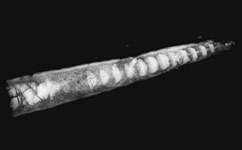
A remarkably complete record of a prehistoric seabed ecosystem of a kind never discovered before has been revealed with X-ray scanning.
A paper in Geology gives the first account of the plentiful and exceptionally well-preserved organisms from the Ordovician period that have been found in the Llanfawr Mudstones near Llandrindod Wells in central Wales. More than 20 species have turned up so far, and it's almost certain that many more remain to be uncovered.
The fossils include sponges, priapulid worms and arthropods, and shed new light on how living things colonised the deep oceans. Among the most exciting are beautiful specimens of a type of animals known as solitary hydroids – the earliest known examples of the group.
The rocks, which are about 460 million years old, provide a unique new perspective on life in the Ordovician, which stretched between about 488 and 444 million years ago and saw an explosion in the variety of living things on Earth. By the end of the period, the planet's total count of species is thought to have quadrupled, and whole new kinds of ecosystem had appeared, including the first coral reefs.
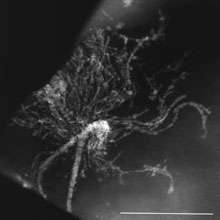
This area of mid-Wales is known for its fossils. But this particular assemblage of living things was only found in 2004; since then, the researchers have returned repeatedly to gather more specimens, using hi-tech scanning equipment to find out what's in the rocks without physically having to delve inside them.
The three palaeontologists who made the find – Dr. Joe Botting, Dr. Lucy Muir and Talfan Barnie - are among the paper's authors. Recent finds of fossil sponges made them suspect the area might have more to offer to fossil-hunters. 'We were on a field trip to the area, and decided to spend a day in the quarry looking for more sponges,' says Muir. 'Talfan hammered a large fresh block, found something, and said, "Is this interesting?" It was.'
The team took rock samples back to the Natural History Museum, where a colleague suggested X-raying them to find out what was inside. "We tried one or two slabs, just to see if the technique worked, and this spectacular hydroid turned up in the very first slab," Muir explains. "It's not visible on the surface of the rock, so we had no idea that it was there."
Unlike the few other exceptionally preserved Ordovician faunas we know of, this habitat was dominated by sponges, which account for three quarters of the inhabitants. There were few mobile animals – not unlike the sponge-based communities still common on modern deep ocean seabeds. Most of these animals had delicate skeletons or were completely soft-bodied, so it's very rare to find them preserved – creatures with hard skeletons are far more likely to become fossilized.
Ordovician ecologies
This means our knowledge of the Ordovician is skewed towards hard-bodied animals. "We just don't know what the less well-preservable animals were doing," says Muir. "They may have been diversifying in the same way as the ones we know about, but they might have been doing something completely different. The significance of this particular community is that it's rather different from the others described from this age, even the ones that do preserve soft-bodied animals. The fact that all the sites with soft-bodied preservation have different communities from each other indicates that the Ordovician diversification of species and communities applied to soft-bodied animals as well as those that fossilised easily."
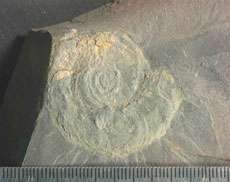
"This community is very unusual from an ecological perspective," adds Dr. Mark Sutton of Imperial College London, another of the paper's authors. "It's dominated by fixed filter-feeders, with relatively few arthropods and other mobile organisms. If you found this in the modern world you'd certainly assume it came from the deep ocean beds, but we know that this was found in relatively shallow shelf-sea waters."
These organisms' traces survive in the Welsh mudstones largely because of the unusual way they've been fossilized. Their shapes are preserved as patterns of iron pyrite, also known as fool's gold. The pyrite blocks X-rays much better than the rock around it does, so the fossil shapes show up well under scanning. But since they aren't usually visible from outside, it's a hit-and-miss process - the team brings blocks back for scanning; sometimes they contain a hitherto-undiscovered species, while at other times there's nothing at all.
It wouldn't be practical to investigate these fossils using more traditional methods – they're so small – often only a few millimetres long - and so delicate that trying to dig them out of the mudstone using even very precise tools would be time-consuming and would probably still end up destroying many of the fossils' finer details.
So as well using X-ray imaging to find and categorise fossils within the stone, the researchers used a CT scanner to see them in partial 3D, rather than simply as flattened smears. This makes it far easier to reconstruct a living, functioning organism from its fossilised form.
The findings shed light on how living things colonised the deep oceans. 'There's been a school of thought for a long time that the ecosystems that are now found on the deep seabed were once found in shallower waters and moved out, perhaps because they were displaced by new organisms that evolved to live in the shelf seas,' Sutton explains. 'We have a good idea this happened with hard-bodied organisms, but our findings are some of the first evidence that it's true of soft-bodied organisms too.'
The finds suggest that even areas that have been extensively explored by fossil hunters may have much more to tell us, particularly now that affordable X-ray and CT scanning means that exciting new fossils can be found even in seemingly dull blocks of stone. The team are now preparing formal descriptions of some of the new organisms they've identified, while continuing to visit the site in search of more specimens.
The researchers also believe that collections of organisms like this may be much more common than previously thought. The reason the fossils were overlooked for so long is probably that the pyrite quickly decays to almost nothing in the Welsh weather. The fossils are only visible when you examine fresh rock surfaces – so other black mudstones may be hiding unexpected surprises as well.
This story is republished courtesy of Planet Earth online, a free, companion website to the award-winning magazine Planet Earth published and funded by the Natural Environment Research Council (NERC).
More information: Welsh gold: A new exceptionally preserved pyritized Ordovician biota. Geology 1 v. 39 no. 9 p. 879-882 (September 2011). DOI: 10.1130/G32143
Journal information: Geology
Provided by PlanetEarth Online


