Nanowires could be solution for high performance solar cells
November 9, 2011

Nanowires could be solution for high performance solar cells

Enlarge

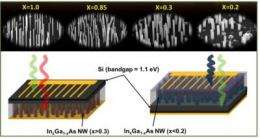
Solar cells (bottom) made with arrays of nanowires. Engineers can tune the performance by using nanowires of differing composition and thickness (top). Credit: Xiuling Li. University of Illinois

Tiny wires could help engineers realize high-performance solar cells and other electronics, according to University of Illinois researchers.

The research group, led by electrical and computer engineering professor Xiuling Li, developed a technique to integrate compound semiconductor nanowires on , overcoming key challenges in device production. The team published its results in the journal .

Semiconductors in the III-V (pronounced three-five) group are promising for devices that change light to electricity and vice-versa, such as high-end or lasers. However, they don't integrate with seamlessly, which is a problem since silicon is the most ubiquitous . Each material has a specific distance between the atoms in the crystal, known as the lattice constant.

"The biggest challenge has been that III-V semiconductors and silicon do not have the same lattice constants," Li said. "They cannot be stacked on top of each other in a straightforward way without generating dislocations, which can be thought of as atomic scale cracks."

When the crystal lattices don't line up, there is a mismatch between the materials. Researchers usually deposit III-V materials on top of silicon wafers in a thin film that covers the wafer, but the mismatch causes strain and introduces defects, degrading the device performance.

Instead of a thin film, the Illinois team grew a densely packed array of nanowires, tiny strands of III-V semiconductor that grow up vertically from the silicon wafer.

"The nanowire geometry offers a lot more freedom from lattice-matching restrictions by dissipating the mismatch strain energy laterally through the sidewalls," Li said.

The researchers found conditions for growing of various compositions of the III-V semiconductor . Their methodology has the advantages of using a common growth technique without the need for any special treatments or patterning on the silicon wafer or the metal catalysts that are often needed for such reactions.

The nanowire geometry provides the additional benefit of enhancing solar cell performance through greater light absorption and carrier collection efficiency. The nanowire approach also uses less material than thin films, reducing the cost.

"This work represents the first report on ternary semiconductor nanowire arrays grown on silicon substrates, that are truly epitaxial, controllable in size and doping, high aspect ratio, non-tapered, and broadly tunable in energy for practical device integration," said Li, who is affiliated with the Micro and Nanotechnology Laboratory, the Frederick Seitz Materials Research Laboratory and the Beckman Institute for Advanced Science and Technology at the U. of I.

Li believes the nanowire approach could be applied broadly to other semiconductors, enabling other applications that have been deterred by mismatch concerns. Next, Li and her group hope soon to demonstrate nanowire-based multi-junction tandem solar cells with high quality and efficiency.

More information: The paper, "InxGa1-xAs Nanowires on Silicon: One-Dimensional Heterogeneous Epitaxy, Bandgap Engineering, and Photovoltaics," is available online at http://pubs.acs.or … 21/nl202676b

Provided by University of Illinois at Urbana-Champaign search and more info website


Rank 5 /5 (3 votes)
Relevant PhysicsForums posts
  • Why does light move?
    created2 hours ago
  • How to calculate the repulsion force between a permanent and an electromagnet?
    created3 hours ago
  • Why does light allow us to see things?
    created3 hours ago
  • Room temperature superconductivity
    created3 hours ago
  • Water flow question
    created7 hours ago
  • 16 year old solves 300 year old problem set by Isaac Newton
    created8 hours ago
  • More from Physics Forums - General Physics

More news stories

'Unzipped' carbon nanotubes could help energize fuel cells, batteries

Multi-walled carbon nanotubes riddled with defects and impurities on the outside could replace some of the expensive platinum catalysts used in fuel cells and metal-air batteries, according to scientists at ...

Nanotechnology / Nanomaterials

created 4 hours ago | popularity not rated yet | comments 0 | with audio podcast

Dopant gives graphene solar cells highest efficiency yet

(Phys.org) -- By taking advantage of graphene’s favorable electrical and optical properties, and then adding an organic dopant, researchers have achieved the highest power conversion efficiency yet for ...

Nanotechnology / Nanophysics

created May 21, 2012 | popularity 5 / 5 (10) | comments 14 | with audio podcast feature

In nanorod crystal growth, nanoparticles seen as artificial atoms

In the growth of crystals, do nanoparticles act as "artificial atoms" forming molecular-type building blocks that can assemble into complex structures? This is the contention of a major but controversial theory ...

Nanotechnology / Nanophysics

created May 24, 2012 | popularity 4.8 / 5 (6) | comments 0 | with audio podcast

First direct observation of oriented attachment in nanocrystal growth

Berkeley Lab researchers have reported the first direct observation of nanoparticles undergoing oriented attachment, the critical step in biomineralization and the growth of nanocrystals. A better understanding ...

Nanotechnology / Nanophysics

created May 24, 2012 | popularity 4.7 / 5 (3) | comments 0 | with audio podcast

Synthetic nano-waste does not disappear

(Phys.org) -- Tiny particles of cerium oxide do not burn or change in the heat of a waste incineration plant. They remain intact on combustion residues or in the incineration system, as a new study by Swiss ...

Nanotechnology / Bio & Medicine

created May 25, 2012 | popularity 5 / 5 (2) | comments 1 | with audio podcast


Nvidia trumpets Tegra 3 phone design wins for 2012

(Phys.org) -- Nvidia’s competitive war paint has a name, Tegra 3. On the heels of Nvidia announcements about lowering costs of its Tegra 3 processors and Nvidia-enabled tablets running Android Ice Cream ...

T cells 'hunt' parasites like animal predators seek prey, study shows

By pairing an intimate knowledge of immune-system function with a deep understanding of statistical physics, a cross-disciplinary team at the University of Pennsylvania has arrived at a surprising finding: T cells use a movement ...

Computer model used to pinpoint prime materials for efficient carbon capture

When power plants begin capturing their carbon emissions to reduce greenhouse gases – and to most in the electric power industry, it's a question of when, not if – it will be an expensive undertaking.

Change in developmental timing was crucial in the evolutionary shift from dinosaurs to birds: study

At first glance, it's hard to see how a common house sparrow and a Tyrannosaurus Rex might have anything in common. After all, one is a bird that weighs less than an ounce, and the other is a dinosaur that ...

Land and sea species differ in climate change response: study

(Phys.org) -- Marine and terrestrial species will likely differ in their responses to climate warming, new research by Simon Fraser University and Australia’s University of Tasmania has found.

Scientist: Evolution debate will soon be history

(AP) -- Richard Leakey predicts skepticism over evolution will soon be history. Not that the avowed atheist has any doubts himself.