Individual CO2 emissions decline in old age
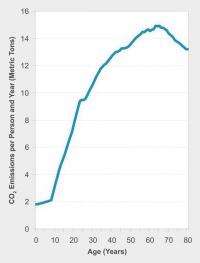
For the first time, demographer Emilio Zagheni of the Max Planck Institute for Demographic Research in Rostock (MPIDR) has calculated a profile that illustrates the relationship between age and average per capita CO2 emissions. This profile applies to U.S. citizens, as data for this group were easily accessible. But the demographic-economic model developed for the analysis is universally valid, and can be applied to other countries.
Carbon dioxide projections, like those of the Intergovernmental Panel on Climate Change (IPCC), depend greatly on future population developments. Most projection models only take into account the anticipated size of populations, but not their age composition, which will change considerably as life expectancy increases. According to the United Nations, the worldwide share of people aged 65 and older will grow from around eight percent currently to around 13 percent by 2030.
Zagheni's profile suggests that societies with a growing share of elderly people will tend to produce lower CO2 emissions -- at least in developed countries with consumption patterns similar to those of the U.S.A. This is because people appear to do less damage to the climate after the age of 65. As they enter retirement, Americans are producing more carbon dioxide emissions than at any other point in their lives: i.e., around 14.9 metric tons per person annually. Thereafter, the amount produced decreases continuously, falling to 13.1 metric tons by age 80. No data are available for higher ages, but it is expected that emissions fall further. The impact of this age group on climate projections will be significant. This is because, while life expectancy in the U.S. is currently (2010) 78.3 years, it is projected to rise to 83.1 years by 2050, according to the U.S. Census Bureau. Moreover, life expectancy is expected to be even higher in other developed countries.
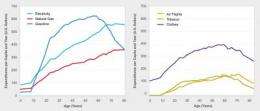
In order to calculate the per capita emissions profile, Zagheni compiled figures on how many dollars an average U.S. residents spend at different ages on nine energy-intensive -- and thus CO2-intensive -- products and services, including electricity, gasoline, and air travel. By assigning carbon dioxide emissions weights to the consumption of these goods, he combined the nine consumption profiles to produce a single CO2 profile.
The per person expenditures in the nine areas change considerably over the course of life (see Figure 2). First they increase with age, along with income: middle-aged adults fly and drive cars more frequently than young people, and they use more electricity. But as people grow older, this trend often changes. The elderly spend more on average than younger adults, but a growing share of their consumption is devoted to their health. Thus, a double effect can be observed: health care services generally produce low levels of greenhouse gas emissions; and, as less money is available for energy-intensive goods, older people tend to spend less in these areas. Clothing expenditures start to decline at age 58, and gasoline consumption decreases from age 60 onwards -- a sign that older people start to reduce their driving relatively early. However, because they spend more time at home, the consumption of electricity and natural gas rises among the elderly until they reach age 80. Only then does home energy usage appear to reach a plateau.
Electricity and natural gas have the greatest impact on the per capita emissions profile, as CO2 emissions are the highest per U.S. dollar spent for these types of energy. Electricity produces 8.7 kilograms of carbon dioxide per dollar (kg CO2/$), and thus tops Zagheni's list of climate-killers. This is followed by natural gas, which generates 7.5 kg CO2/$; and gasoline, which produces 6 kg CO2/$. Other types of energy usage have relatively small effects. One flight generates around 2.3 kg CO2/$, while one dollar spent on tobacco produces only around 0.5 kg of CO2.
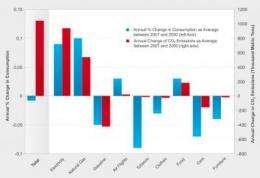
Will the reductions in CO2 emissions among the elderly alter the effects on climate of the population as a whole? To investigate this question, Zagheni projected future carbon dioxide emissions for the U.S. by creating a model in which the population of around 300 million grew older, but did not increase in size. Results showed that, on average, about one million metric ton of additional CO2 emissions would be produced in each of the years between 2007 and 2050 (see Figure 3). Thus, the effect of age is comparatively small. Total CO2 emissions in the U.S. in recent years have amounted to around 5.9 billion metric tons per year. Moreover, rising life expectancy is likely to lead to higher greenhouse gas emissions in the medium term, despite the declining per capita profile among the elderly. Why is this the case?
It is likely that the ageing of the population will not lead to a decrease in CO2 emissions between 2007 and 2050 because the process is not yet sufficiently advanced. This is despite the fact that the changing age structure will lead to a reduction in consumption of certain energy-intensive goods. For example, on the one hand, the shares of carbon dioxide emissions that come from burning gasoline (around 400,000 fewer metric tons) and wear-and-tear on cars (around 150,000 fewer metric tons) will tend to decrease, because cars are being used less (on average, around -0.05 to -0.7 percent; see Figure 3). On the other hand, this trend will be more than counteracted by increasing consumption of electricity and natural gas (by 0.09 or 0.1 percent per year), that will lead to significant additional emissions (estimates range from around 900,000 or 500,000 additional metric tons).
Overall, the balance in the medium term is expected to be positive. One reason for this is that the baby boomer cohorts, who will turn age 65 in the years to come, are also the age groups with the highest emissions values. This will not change until after 2030, when large numbers of baby boomers will have reached age 80, and reductions in CO2 emissions will outweigh increases. This shift cannot be discerned from Zagheni's results due to the method used: it produces only a single average value for each of the years from 2007 to 2050. The averaging conceals the possibility that emissions could decline at the end of the simulation period.
Also, Zagheni's study isolates the effect of ageing but does not account for potential improvements in technology. However, if it turns out that new technologies will be more carbon-efficient in the future, that might even leverage age structure effects for the good of the climate. This could be the case, for instance, if electricity, of which the old use a lot, could be generated and distributed with fewer emissions. The economic models of other researchers show that a reduction in carbon dioxide through changes in the age structure can only be seen after 2050. Then, however, reductions of up to 20 percent could occur.
Provided by Max-Planck-Gesellschaft


