Blooming ocean fronts
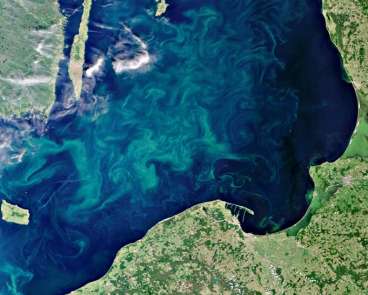
Each spring, huge patches of phytoplankton bloom in the oceans, turning cold, blue waters into teeming green pools of microbial life. This ocean “greening,” which can be seen from space, mirrors the springtime thaw on land. But while spring arrives gradually on land, with a few blades here and some buds there, the oceans bloom seemingly overnight.
“If you go and look in the ocean and try to sample in deep winter, there’s little phytoplankton,” says Raffaele Ferrari, the Breene M. Kerr Professor of Oceanography in MIT’s Department of Earth, Atmospheric and Planetary Sciences. “It’s like going into a desert. And then all of a sudden you have this bloom explosion, and it’s like a jungle. There is an ongoing debate as to what triggers the bloom onset.”
Ferrari and John Taylor, a former postdoc at MIT and now a lecturer in oceanography at the University of Cambridge in the U.K., have identified where blooms are most likely to start. The team found that phytoplankton grow up along ocean fronts, at the boundaries between cold and warm currents. This explains why the ocean does not turn green everywhere at once, but rather develops green streaks that track fronts.
Through numerical simulations, Ferrari and Taylor found that at these fronts, warm water slides over cold, denser water, creating a hospitable environment for microorganisms. The findings, published online last week in Geophysical Research Letters, may help scientists predict where blooms will spring up.
Knowing how and where blooms occur may help scientists gauge an ocean’s productivity from year to year. The tiny microorganisms collectively known as phytoplankton are the foundation of the marine food web and account for half of the world’s photosynthetic activity, consuming carbon dioxide and sunlight to produce energy.
Eric D’Asaro, a professor of oceanography at the University of Washington, says predicting phytoplankton blooms may help determine the amount of carbon dioxide taken up and stored by the oceans.
“Phytoplankton … take carbon dioxide out of the atmosphere, including the extra carbon dioxide that we have put there,” says D’Asaro, who was not involved in the research. “A fraction of this organic carbon then sinks to deeper depths in the ocean, thereby removing it from the atmosphere and reducing the amount of greenhouse warming.”
Ferrari and Taylor say their findings suggest that ocean fronts are hotspots for phytoplankton growth and may be “crucial players” in the global carbon cycle.
Seeing the light
Since phytoplankton depend on sunlight to grow, they need to stay within 10 to 100 meters of the surface, in the euphotic layer where sunlight can easily penetrate. However, in winter, intense cooling by atmospheric storms causes the surface waters to increase in density and sink. The sinking waters suck organisms down deep into the ocean, away from sustaining light.
Within this “mixed layer” churned by cooling, organisms die off and eventually sink into the ocean abyss. In the winter, the ocean’s mixed layer runs deep, creating a “desert” with very little signs of life. “Life on earth depends on light,” Ferrari says, “and phytoplankton do not see much light in winter.”
Ferrari and Taylor recently published a paper in Limnology and Oceanography where they identified a physical explanation for the onset of biological blooms. The team found that in late winter, when harsh atmospheric cooling gives way to springtime warming, mixing in the ocean subsides. Using numerical simulations, the researchers showed that decreased cooling turns the ocean’s mixed layer into a quiet environment, the top of which has sufficient light to host microbial growth.
The team then proposed that phytoplankton blooms start at fronts, because fronts substantially reduce mixing in the upper ocean. Hence, they reasoned, phytoplankton find hospitable conditions at fronts — even in winter, when cooling has not yet subsided. They reasoned that the overall warming of the ocean in spring encourages phytoplankton to grow beyond a front’s boundaries, into large, sprawling blooms.
D’Asaro says the team’s findings present a compelling mechanism for ocean blooms. However, he adds that to fully understand the causes of ocean greening, one has to consider biology along with physics.
“In particular, [blooms depend on] the presence or absence of planktonic animals that could rapidly eat the phytoplankton as they grow,” D’Asaro says. “It’s like a meadow — the grass will not grow tall in the spring if there are a lot of cows in the meadow.”
Ferrari plans to test the theory next year off the coast of Ireland. He hopes to deploy gliders, autonomous vehicles that will go up and down a water column for a year, monitoring temperature, salinity, chlorophyll and light penetration. He also plans to deploy a meteorological buoy to track surface fluxes of heat and winds.
“We’re going to be able to predict according to this argument where the blooms occur, and the gliders will tell us whether our prediction is right,” Ferrari says. “We think it’s a pretty general principle that must hold.”
Provided by Massachusetts Institute of Technology
This story is republished courtesy of MIT News (web.mit.edu/newsoffice/), a popular site that covers news about MIT research, innovation and teaching.


