Wearable depth-sensing projection system makes any surface capable of multitouch interaction (w/ video)
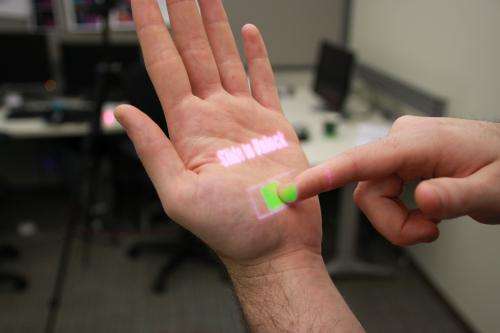
(PhysOrg.com) -- OmniTouch, a wearable projection system developed by researchers at Microsoft Research and Carnegie Mellon University, enables users to turn pads of paper, walls or even their own hands, arms and legs into graphical, interactive surfaces.
OmniTouch employs a depth-sensing camera, similar to the Microsoft Kinect, to track the user's fingers on everyday surfaces. This allows users to control interactive applications by tapping or dragging their fingers, much as they would with touchscreens found on smartphones or tablet computers. The projector can superimpose keyboards, keypads and other controls onto any surface, automatically adjusting for the surface's shape and orientation to minimize distortion of the projected images.
This video is not supported by your browser at this time.
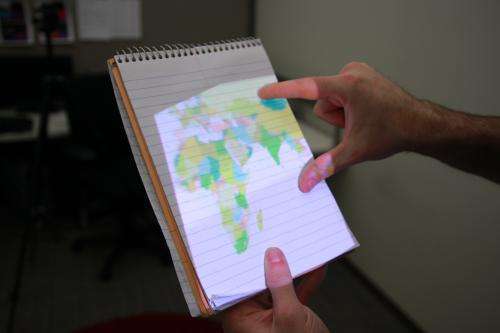
"It's conceivable that anything you can do on today's mobile devices, you will be able to do on your hand using OmniTouch," said Chris Harrison, a Ph.D. student in Carnegie Mellon's Human-Computer Interaction Institute. The palm of the hand could be used as a phone keypad, or as a tablet for jotting down brief notes. Maps projected onto a wall could be panned and zoomed with the same finger motions that work with a conventional multitouch screen.
This video is not supported by your browser at this time.
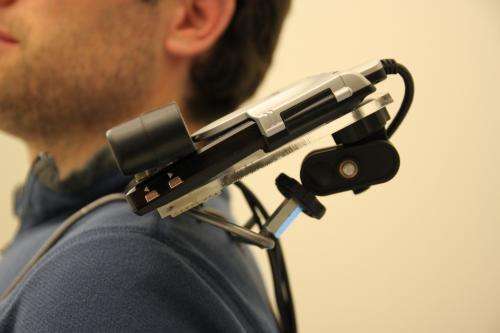
Harrison was an intern at Microsoft Research when he developed OmniTouch in collaboration with Microsoft Research's Hrvoje Benko and Andrew D. Wilson. Harrison will describe the technology on Wednesday (Oct. 19) at the Association for Computing Machinery's Symposium on User Interface Software and Technology (UIST) in Santa Barbara, Calif.The OmniTouch device includes a short-range depth camera and laser pico-projector and is mounted on a user's shoulder. But Harrison said the device ultimately could be the size of a deck of cards, or even a matchbox, so that it could fit in a pocket, be easily wearable, or be integrated into future handheld devices.
"With OmniTouch, we wanted to capitalize on the tremendous surface area the real world provides," said Benko, a researcher in Microsoft Research's Adaptive Systems and Interaction group. "We see this work as an evolutionary step in a larger effort at Microsoft Research to investigate the unconventional use of touch and gesture in devices to extend our vision of ubiquitous computing even further. Being able to collaborate openly with academics and researchers like Chris on such work is critical to our organization's ability to do great research and to advancing the state of the art of computer user interfaces in general."
Harrison previously worked with Microsoft Research to develop Skinput, a technology that used bioacoustic sensors to detect finger taps on a person's hands or forearm. Skinput thus enabled users to control smartphones or other compact computing devices.
The optical sensing used in OmniTouch, by contrast, allows a wide range of interactions, similar to the capabilities of a computer mouse or touchscreen. It can track three-dimensional motion on the hand or other commonplace surfaces, and can sense whether fingers are "clicked" or hovering. What's more, OmniTouch does not require calibration users can simply wear the device and immediately use its features. No instrumentation of the environment is needed; only the wearable device is needed.
More information: http://www.chrisha … ch/OmniTouch
(Videos and images: Chris Harison)
Provided by
Carnegie Mellon University
-
From lemons to lemonade: Reaction uses carbon dioxide to make carbon-based semiconductor,
32 comments
-
Thioridazine kills cancer stem cells in human while avoiding toxic side-effects of conventional cancer treatments,
3 comments
-
SpaceX private rocket blasts off for space station (Update),
42 comments
-
Climate scientists say they have solved riddle of rising sea,
31 comments
-
SpaceX capsule has 'new car' smell, astronauts say (Update),
4 comments
-
Need a rigid insulation material???
17 hours ago
-
magnets or EMF in car bumpers to protect from fender bender
May 26, 2012
-
length of wire in a coil of known dimensions?
May 25, 2012
-
India Engineering Powerhouse
May 25, 2012
-
electromagnet core dereference between hard and soft iron
May 25, 2012
-
Measuring water pressure in an open tank
May 24, 2012
- More from Physics Forums - General Engineering
More news stories
Browser wars flare in mobile space
The browser wars are heating up again, but this time the fight is for dominance of the mobile Internet.
10 hours ago |
5 / 5 (1) |
3
Probability of contamination from severe nuclear reactor accidents is higher than expected: study
Catastrophic nuclear accidents such as the core meltdowns in Chernobyl and Fukushima are more likely to happen than previously assumed. Based on the operating hours of all civil nuclear reactors and the number ...
Technology / Energy & Green Tech
May 22, 2012 |
3.6 / 5 (22) |
56
|
SpotterRF debuts Radar Backpack Kit (w/ Video)
(Phys.org) -- SpotterRF has announced a special radar backpack kit designed to enhance situational awareness for soldiers on the ground. The company says its special radar is designed for warfighters as part ...
HyperSolar shows dirty water no barrier to power world
(Phys.org) -- The Santa Barbara, California, company, HyperSolar, is set to transparently share the ups and downs of its research experiences toward the companys ultimate vision, successfully producing ...
Tesla to launch electric sedan in US on June 22
Tesla Motors said Tuesday it would begin deliveries of "the world's first premium electric sedan" on June 22, slightly ahead of schedule.
Technology / Energy & Green Tech
May 22, 2012 |
4.5 / 5 (12) |
18
Land and sea species differ in climate change response: study
(Phys.org) -- Marine and terrestrial species will likely differ in their responses to climate warming, new research by Simon Fraser University and Australia’s University of Tasmania has found.
Almost half of new vets seek disability
(AP) -- America's newest veterans are filing for disability benefits at a historic rate, claiming to be the most medically and mentally troubled generation of former troops the nation has ever seen.
'Unzipped' carbon nanotubes could help energize fuel cells, batteries
Multi-walled carbon nanotubes riddled with defects and impurities on the outside could replace some of the expensive platinum catalysts used in fuel cells and metal-air batteries, according to scientists at ...
T cells 'hunt' parasites like animal predators seek prey, study shows
By pairing an intimate knowledge of immune-system function with a deep understanding of statistical physics, a cross-disciplinary team at the University of Pennsylvania has arrived at a surprising finding: T cells use a movement ...
Computer model used to pinpoint prime materials for efficient carbon capture
When power plants begin capturing their carbon emissions to reduce greenhouse gases and to most in the electric power industry, it's a question of when, not if it will be an expensive undertaking.
Change in developmental timing was crucial in the evolutionary shift from dinosaurs to birds: study
At first glance, it's hard to see how a common house sparrow and a Tyrannosaurus Rex might have anything in common. After all, one is a bird that weighs less than an ounce, and the other is a dinosaur that ...


Oct 17, 2011
Rank: 3 / 5 (2)
Oct 17, 2011
Rank: not rated yet
It seems to be very similar to the Sixth Sense system
http://www.youtub...=related
Oct 17, 2011
Rank: 4.5 / 5 (2)
Oct 17, 2011
Rank: not rated yet
Oct 17, 2011
Rank: not rated yet
Oct 17, 2011
Rank: not rated yet
Yes it has been done in trials but only short term. There still no convenient way to connect to the bodies nerves long term.
Oct 17, 2011
Rank: not rated yet
I'm sure people said similar things to/about the early generation of room sized computers, or giant Zack Morris cell phones.
Oct 17, 2011
Rank: not rated yet
I'm sure we could find some body modification freaks to volunteer for experiments..
Oct 17, 2011
Rank: 5 / 5 (1)
Nice to see Microsoft & Co is still "innovating"... :/
Oct 18, 2011
Rank: not rated yet
Oct 18, 2011
Rank: not rated yet
I agree, it is one of those solutions that is looking for the problem to solve. It might well find it, but the need to wear it about the upper body makes it an unlikely candidate for mainstream consumer devices.
Oct 18, 2011
Rank: 3 / 5 (1)
I can tell you we've been doing exactly that for decades now, with cochlear implants.
OK, I do know what you meant... the cochlear implants case isn't exactly qualifying as central nervous system example.
But I still think you are wrong. Of course, your "not close" is up to interpretation, but to me the various work that's been done with carbon nanotube electrodes, optical nerve stimulation, inductive (contact-less) reception of single-neuron signals and so on means "close". As in, quite likely to happen within my lifetime.
Oct 18, 2011
Rank: not rated yet
And this tech here might reach a critical roadblock that can't be overcome to make viable. We don't know, was really my only point.
Oct 19, 2011
Rank: not rated yet
@iPan. You do understand that this is a prototype and not a finished product, don't you? :-D