New study shows how trees clean the air in London
October 5, 2011

New study shows how trees clean the air in London

Enlarge

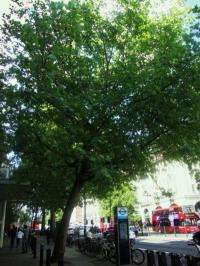
This is an urban tree in London. Credit: University of Southampton

New research by scientists at the University of Southampton has shown how London's trees can improve air quality by filtering out pollution particulates, which are damaging to human health.

A paper published this month in the journal Landscape and indicates that the urban trees of the Greater London Authority (GLA) area remove somewhere between 850 and 2000 tonnes of (PM10) from the air every year.

An important development in this research, carried out by Dr Matthew Tallis, is that the methodology allows the prediction of how much pollution will be removed in the future as the climate and pollution emissions change. This shows the real benefits of the planned increase in the number of street trees in London and throughout England, including the GLA's plan to increase the area of by 2050 and the current government's 'Big tree plant' initiative.
New study shows how trees clean the air in London
Enlarge

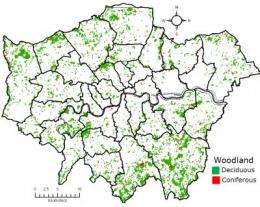
The Great London Authority (GLA) displaying the administrative boundaries of the 33 boroughs. Urban woodlands are shown (extracted from the Land Cover Map 2000). This woodland canopy comprises c. 8.6 percent of the whole GLA land area; the remaining c. 11.4 percent is made up from garden trees, street trees and undesignated individual trees. Credit: Fuller R, Smith GM, Sanderson JM, Hill RA, Thompson AG (2001). The UK Land Cover Map 2000: Construction of a parcel-based vector map from satellite images. Cartographic Journal, 39, 15-25.

The research found that the targeting of tree planting in the most polluted areas of the GLA area and particularly the use of a mixture of trees, including evergreens such as pines and evergreen oak, would have the greatest benefit to future air quality in terms of PM10 removal.

One of the paper's authors Professor Gail Taylor explains: "Trees have evolved to remove CO2 from the atmosphere, so it's not surprising that they are also good at removing pollutants. Trees which have leaves the whole year are exposed to more pollution and so they take up more. Using a number of different and modelling approaches, the effectiveness of the for clean air can be optimised."

This study presents predictions of particulate (PM10) uptake in future climate and for five tree planting scenarios in London. Using seasonal rather than hourly data was shown to have little impact on modelled annual deposition of pollution (PM10) to urban , suggesting that pollution uptake can be estimated in other cities and for the future where hourly data are not available.

Co-author Peter Freer-Smith, Chief Scientist for Forest Research (Forestry Commission) and visiting professor at the University of Southampton, says: "We know that can damage , for example exacerbating asthma and this reduction in exposure could have real benefits in some places, such as around the edge of school playgrounds. Urban greenspace and trees give a wide range of benefits and this study confirms that improving air quality is one of them and will also help us to get the most out of this benefit in future."

Provided by University of Southampton search and more info website


Rank 5 /5 (2 votes)
Relevant PhysicsForums posts

More news stories

Yale study concludes public apathy over climate change unrelated to science literacy

Are members of the public divided about climate change because they don't understand the science behind it? If Americans knew more basic science and were more proficient in technical reasoning, would public consensus match ...

Space & Earth / Environment

created 1 hour ago | popularity not rated yet | comments 8 | with audio podcast

10 million years needed to recover from mass extinction

It took some 10 million years for Earth to recover from the greatest mass extinction of all time, latest research has revealed.

Space & Earth / Earth Sciences

created 1 hour ago | popularity not rated yet | comments 1 | with audio podcast

Sophisticated simulations predict future warming

The chances of our planet being hit by a global warming of 3 degrees Celsius by 2050 is as likely as it being hit by an increase of 1.4 degrees, new research shows. Presented in the journal Nature Geoscience, the British study ...

Space & Earth / Earth Sciences

created May 22, 2012 | popularity 4.4 / 5 (9) | comments 51

Aliens don't want to eat us, says former SETI director

Alien life probably isn’t interested in having us for dinner, enslaving us or laying eggs in our bellies, according to a recent statement by former SETI director Jill Tarter.

Space & Earth / Space Exploration

created May 25, 2012 | popularity 4.4 / 5 (14) | comments 39

Kyoto Protocol architect 'frustrated' by climate dialogue

UN climate talks are going nowhere, as politicians dither or bicker while the pace of warming dangerously speeds up, one of the architects of the Kyoto Protocol told AFP.

Space & Earth / Environment

created May 23, 2012 | popularity 3.7 / 5 (7) | comments 39


'Unzipped' carbon nanotubes could help energize fuel cells, batteries

Multi-walled carbon nanotubes riddled with defects and impurities on the outside could replace some of the expensive platinum catalysts used in fuel cells and metal-air batteries, according to scientists at ...

T cells 'hunt' parasites like animal predators seek prey, study shows

By pairing an intimate knowledge of immune-system function with a deep understanding of statistical physics, a cross-disciplinary team at the University of Pennsylvania has arrived at a surprising finding: T cells use a movement ...

Computer model used to pinpoint prime materials for efficient carbon capture

When power plants begin capturing their carbon emissions to reduce greenhouse gases – and to most in the electric power industry, it's a question of when, not if – it will be an expensive undertaking.

Change in developmental timing was crucial in the evolutionary shift from dinosaurs to birds: study

At first glance, it's hard to see how a common house sparrow and a Tyrannosaurus Rex might have anything in common. After all, one is a bird that weighs less than an ounce, and the other is a dinosaur that ...

Same gene that stunts infants' growth also makes them grow too big: research

UCLA geneticists have identified the mutation responsible for IMAGe* syndrome, a rare disorder that stunts infants' growth. The twist? The mutation occurs on the same gene that causes Beckwith-Wiedemann syndrome, which makes ...

Scientists develop ultra-sensitive test that detects diseases in their earliest stages

Scientists have developed an ultra-sensitive test that should enable them to detect signs of a disease in its earliest stages, in research published today in the journal Nature Materials.