NASA studying ways to make 'tractor beams' a reality
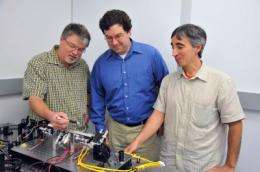
NASA Goddard laser experts (from left to right) Barry Coyle, Paul Stysley and Demetrios Poulios have won NASA funding to study advanced technologies for collecting extraterrestrial particle samples. Credit: NASA's Goddard Space Flight Center, Debora McCallum
Tractor beams -- the ability to trap and move objects using laser light -- are the stuff of science fiction, but a team of NASA scientists has won funding to study the concept for remotely capturing planetary or atmospheric particles and delivering them to a robotic rover or orbiting spacecraft for analysis.
The NASA Office of the Chief Technologist (OCT) has awarded Principal Investigator Paul Stysley and team members Demetrios Poulios and Barry Coyle at NASA's Goddard Space Flight Center in Greenbelt, Md., $100,000 to study three experimental methods for corralling particles and transporting them via laser light to an instrument -- akin to a vacuum using suction to collect and transport dirt to a canister or bag. Once delivered, an instrument would then characterize their composition.
"Though a mainstay in science fiction, and Star Trek in particular, laser-based trapping isn't fanciful or beyond current technological know-how," Stysley said. The team has identified three different approaches for transporting particles, as well as single molecules, viruses, ribonucleic acid, and fully functioning cells, using the power of light.
"The original thought was that we could use tractor beams for cleaning up orbital debris," Stysley said. "But to pull something that huge would be almost impossible -- at least now. That's when it bubbled up that perhaps we could use the same approach for sample collection."
With the Phase-1 funding from OCT's recently reestablished NASA Innovative Advanced Concepts (NIAC) program designed to spur the development of "revolutionary" space technologies, the team will study the state of the technology to determine which of the three techniques would apply best to sample collection. OCT received hundreds of proposals, ultimately selecting only 30 for initial funding.
Replace Current Sample-Collection Methods
Currently, NASA uses a variety of techniques to collect extraterrestrial samples. With Stardust, a space probe launched in 1999, the Agency used aerogel to gather samples as it flew through the coma of comet Wild 2. A capsule returned the samples in 2006. NASA's next rover to Mars, Curiosity, will drill and scoop samples from the Martian surface and then carry out detailed analyses of the materials with one of the rover's many onboard instruments, including the Goddard-built Sample Analysis at Mars instrument suite.
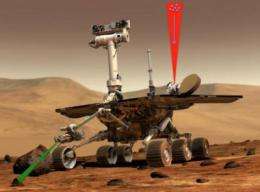
Goddard technologists are studying different techniques for corralling particles and transporting them via laser light to instruments on rovers and orbiting spacecraft. Credit: Concept image courtesy Dr. Paul Stysley
"These techniques have proven to be largely successful, but they are limited by high costs and limited range and sample rate," Stysley said. "An opticaltrapping system, on the other hand, could grab desired molecules from the upper atmosphere on an orbiting spacecraft or trap them from the ground or lower atmosphere from a lander. In other words, they could continuously and remotely capture particles over a longer period of time, which would enhance science goals and reduce mission risk."Team to Study Three Approaches
One experimental approach the team plans to study -- the optical vortex or "optical tweezers" method -- involves the use of two counter-propagating beams of light. The resulting ring-like geometry confines particles to the dark core of the overlapping beams. By alternately strengthening or weakening the intensity of one of the light beams -- in effect heating the air around the trapped particle -- researchers have shown in laboratory testing that they can move the particle along the ring's center. This technique, however, requires the presence of an atmosphere.
Another technique employs optical solenoid beams -- those whose intensity peaks spiral around the axis of propagation. Testing has shown that the approach can trap and exert a force that drives particles in the opposite direction of the light-beam source. In other words, the particulate matter is pulled back along the entire beam of light. Unlike the optical vortex method, this technique relies solely on electromagnetic effects and could operate in a space vacuum, making it ideal for studying the composition of materials on one of the airless planetary moons, for example.
The third technique exists only on paper and has never been demonstrated in the laboratory, Poulios said. It involves the use of a Bessel beam. Normal laser beams when shined against a wall appear as a small point. With Bessel beams, however, rings of light surround the central dot. In other words, when seen straight on, the Bessel beam looks like the ripples surrounding a pebble dropped in a pond. According to theory, the laser beam could induce electric and magnetic fields in the path of an object. The spray of light scattered forward by these fields could pull the object backward, against the movement of the beam itself.
"We want to make sure we thoroughly understand these methods. We have hope that one of these will work for our purposes," Coyle said. "Once we select a technique, we will be in position to then formulate a possible system" and compete for additional NIAC funding to advance the technology to the next level of development. "We're at the starting gate on this," Coyle added. "This is a new application that no one has claimed yet."
Provided by
NASA's Goddard Space Flight Center
-
From lemons to lemonade: Reaction uses carbon dioxide to make carbon-based semiconductor,
32 comments
-
Thioridazine kills cancer stem cells in human while avoiding toxic side-effects of conventional cancer treatments,
3 comments
-
SpaceX private rocket blasts off for space station (Update),
42 comments
-
Climate scientists say they have solved riddle of rising sea,
31 comments
-
SpaceX capsule has 'new car' smell, astronauts say (Update),
3 comments
-
Water flow question
3 hours ago
-
[Drift velocity] Factors affecting velocity
6 hours ago
-
does cold gasoline have less energy
7 hours ago
-
distribution of molecules throughout the atmosphere
9 hours ago
-
The Global Positioning System !
10 hours ago
-
A Question relating Power
11 hours ago
- More from Physics Forums - General Physics
More news stories
Is a classical electrodynamics law incompatible with special relativity?
(Phys.org) -- The laws of classical electromagnetism that were developed in the 19th century are the same laws that scientists use today. They include Maxwell’s four equations along with the Lorentz la ...
Landmark calculation clears the way to answering how matter is formed
(Phys.org) -- An international collaboration of scientists, including Thomas Blum, associate professor of physics, is reporting in landmark detail the decay process of a subatomic particle called a kaon ...
May 25, 2012 |
4.3 / 5 (22) |
51
|
Lying in wait for WIMPs: Researchers seek to dramatically increase sensitivity of Large Underground Xenon detector
Although it's invisible, dark matter accounts for at least 80 percent of the matter in the universe. No one knows what it is, but most scientists would bet on weakly interacting massive particles, or WIMPs.
May 23, 2012 |
4 / 5 (7) |
15
|
Hawaii lab turns laser-powered bubbles into microrobots
(Phys.org) -- A team of scientists from the University of Hawaii are working on microrobots created from bubbles of air in a saline solution. The bubbles take on their title of robots as a laser ...
Sound increases the efficiency of boiling
Scientists at the Georgia Institute of Technology achieved a 17-percent increase in boiling efficiency by using an acoustic field to enhance heat transfer. The acoustic field does this by efficiently removing vapor bubbles ...
May 24, 2012 |
5 / 5 (2) |
2
'Unzipped' carbon nanotubes could help energize fuel cells, batteries
Multi-walled carbon nanotubes riddled with defects and impurities on the outside could replace some of the expensive platinum catalysts used in fuel cells and metal-air batteries, according to scientists at ...
T cells 'hunt' parasites like animal predators seek prey, study shows
By pairing an intimate knowledge of immune-system function with a deep understanding of statistical physics, a cross-disciplinary team at the University of Pennsylvania has arrived at a surprising finding: T cells use a movement ...
Computer model used to pinpoint prime materials for efficient carbon capture
When power plants begin capturing their carbon emissions to reduce greenhouse gases and to most in the electric power industry, it's a question of when, not if it will be an expensive undertaking.
Change in developmental timing was crucial in the evolutionary shift from dinosaurs to birds: study
At first glance, it's hard to see how a common house sparrow and a Tyrannosaurus Rex might have anything in common. After all, one is a bird that weighs less than an ounce, and the other is a dinosaur that ...
Yale study concludes public apathy over climate change unrelated to science literacy
Are members of the public divided about climate change because they don't understand the science behind it? If Americans knew more basic science and were more proficient in technical reasoning, would public consensus match ...
Same gene that stunts infants' growth also makes them grow too big: research
UCLA geneticists have identified the mutation responsible for IMAGe* syndrome, a rare disorder that stunts infants' growth. The twist? The mutation occurs on the same gene that causes Beckwith-Wiedemann syndrome, which makes ...

Oct 31, 2011
Rank: not rated yet
Oct 31, 2011
Rank: 1 / 5 (1)
Oct 31, 2011
Rank: 2.3 / 5 (9)
http://www.youtub...pp_video
Oct 31, 2011
Rank: 5 / 5 (2)
Nov 01, 2011
Rank: not rated yet
Nov 01, 2011
Rank: not rated yet
A solar powered motor could launch the little pellets etc.
Nov 01, 2011
Rank: 2.3 / 5 (9)
What a wonderful way to clear all the debris from all the orbitals. What a wonderful way to fulfill any and all Design for Demise requirements.
What a wonderful way to dupe the public with faux science and still place anything to your heart's desire in orbit without a single successful plan to deal with the demise.
What a wonderful way to appease to buy time until the 'project' is declared not doable. Duping a la NASA.
Nov 01, 2011
Rank: 1.6 / 5 (7)
Nov 01, 2011
Rank: 3 / 5 (6)
It is impossible to give you a reply to whatever you stated.
You have to make sense first.
Nov 01, 2011
Rank: 3 / 5 (2)
Nov 01, 2011
Rank: 5 / 5 (6)
Nov 01, 2011
Rank: 1 / 5 (4)
I never owned or had a video recorder or TV.
I will conjecture that is why you don't understand.
Anything.
:P
Nov 01, 2011
Rank: 5 / 5 (8)
Nov 01, 2011
Rank: 3.5 / 5 (15)
Nov 01, 2011
Rank: 3.4 / 5 (5)
Nov 01, 2011
Rank: 2.3 / 5 (3)
Curves or bust for me.
Although someone had the initiative to correct me:
Curves and bust.
At that point, I ask for a draw and we were drew in agreement.
Nov 01, 2011
Rank: not rated yet
It's chess (chest?) talk - for the uninitiated.
Nov 01, 2011
Rank: 3 / 5 (4)
'Use a narrow directed curvature intensity beam (or give the curve potential a twist) and stuff comes to you. All this mucking about with photons, how quaint.'
'.. and the Unicorn wants a word with Ethelred about God'.
I plead with it to stop confusing me.
The FSM grunts and tells me 'don't doubt just because you don't understand, after all you still believe the Universe can be quantified'.
'Who moved my cheese'.
Nov 01, 2011
Rank: 4.2 / 5 (5)
Why ask a question when already know the answer.
We aren't. And such a law would have no effect in the US. The Supreme Court would knock it down as it has done many times already.
Sorry I am presently unable to produce a worthy insult. Perhaps if you were to make a much stupider post I would be inspired. This is the best I can do:
For a first post that was mediocre. No passion, only a boring rant coupled with an unneeded question. First posts should have some passion. Many first posts have been directed at me for savaging deserving Cranks so I know passion when I see it. There was no spittle, no self-contradictory statements, no bizarre non-sequitors just one silly question which contained the answer.
Ethelred
Nov 01, 2011
Rank: 4.8 / 5 (6)
Now that post had non-sequitors anyway. I wasn't even on this thread when it was written.
I think that Hush is causing brain damage.
Ethelred
Nov 01, 2011
Rank: 5 / 5 (1)
Nov 01, 2011
Rank: 5 / 5 (1)
An overreaching conclusion. It pains me to read some comments. I take pains to understand. Painstaking are the attempts to understand you all. The attempts harm me not. I remain unscathed. No self damaged done. Besides, in an imperfect world, healing makes sense.
lol Bluehigh.
Nov 01, 2011
Rank: 5 / 5 (1)
Just because you can demonstrate some effect at a quantum level doesn't mean it will scale up to a real life level.
Nov 01, 2011
Rank: 5 / 5 (5)
However the engineer in me would like to see a cost/benefit analysis. The article makes the point that a system like this could be used continuously, the 'infinite ammo' argument. But is it really better than say, a scoop, on the Martian surface? Or for instance an aerogel trap in the vacuum of space? Perhaps the specific targeting of individual dust particles is desirable. But it feels unnecessarily complex.
Nov 01, 2011
Rank: 4 / 5 (4)
Exactly which laws would those be? And, btw, I agree with everything else you said.
Nov 01, 2011
Rank: 5 / 5 (4)
While it's true that one could just go about reading the articles and ignoring the comments, arri_guy's comment isn't completely without merit as the comment section does, in theory, have the *potential* to provive readers with additional, useful insights into the content of the articles. However, as the % of posts of dubious value increases in any forum, it becomes harder and harder to justify spending time to fish out interesting posts, leading a lot of worthwhile contributors to drop out, in turn leading to a network effect where the signal to noise ratio goes to almost all noise.
Nov 01, 2011
Rank: 5 / 5 (6)
Of course, contenting ourselves with just reading the articles remains an option, but what a pity that someone 'reasonable' might avoid interations with other readers because the forum has become so acidic in tone.
Nov 01, 2011
Rank: 5 / 5 (2)
You misconstrue.
As an engineer, my objection is to making a jump from a small advance in technology to these Star Trek technologies as being very presumptuous.
I will admit that there have been some advances that are not beyond possibility, like the personal communicator (cellphone), medical scanner (MRI, CATSCAN, et al), data tablet (i pad), etc. All these are were advances that logically would seem to be predictable in some form or other.
Occasionally, you get a surprise - like transparent aluminum.
However, there is a great difference between gathering space dust and locking on to a 2 ton defunct satellite.
Much as many of us like Star Trek, what I object to are huge editorial jumps from lab parlor tricks to hard technology, very early in the game.
Nov 01, 2011
Rank: not rated yet
Nov 03, 2011
Rank: not rated yet
It sucks in money and and resources and extrudes crap.
Nov 04, 2011
Rank: 5 / 5 (1)
If you didn't have this combination, you would draw the object you were manipulating right into the tractor beam projector.
So even if you could come up with a tractor beam to use on a macro level, it would also be necessary to develop a "pressor" beam to use the tractor beam properly.
It would be the "negative feedback" required for a stable system.
This would be mandatory for "towing" an object instead of merely drawing in (or collecting) objects.
Nov 05, 2011
Rank: 3 / 5 (2)
Nov 05, 2011
Rank: not rated yet
Nov 05, 2011
Rank: 5 / 5 (1)
Nov 05, 2011
Rank: 2.1 / 5 (11)
In the real world decent people don't act like you because they would never be taken seriously by anyone or in any line of work and would end up in poverty due to their inability to productively correspond with others of differing opinion.
Nov 05, 2011
Rank: 3.7 / 5 (12)
Again you choose to be negatively combative. Among my many failings is that I can hold a grudge indefinitely.
Perhaps if you stop framing your opinions as fact and ceased just being contradictory then you might acquire some social skills in your sad lonely little life.
As for poverty and inability to be productive - once again, these are things of which you would be familiar.
Nov 05, 2011
Rank: 2.1 / 5 (11)
I was merely pointing out how juvenile your behavior is and that it was ironically a perfect example of what the poster you were replying to was talking about in the first place.
You've demonstrated my point yet again, and for that I thank you.
Nov 07, 2011
Rank: 5 / 5 (2)
Personally I'd also prefer to see a bit more civility on open forums. But as we are only accountable for our own actions not those of another the ability to ignore some posts can be useful.