Research finds gallium nitride is non-toxic, biocompatible - holds promise for implants
October 24, 2011

Research finds gallium nitride is non-toxic, biocompatible - holds promise for implants

Enlarge

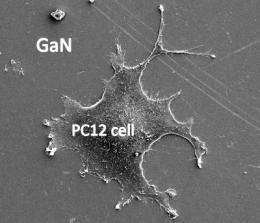
This is a scanning electron microscope image of cell growth on GaN that has been coated with peptides. Credit: Albena Ivanisevic, North Carolina State University

Researchers from North Carolina State University and Purdue University have shown that the semiconductor material gallium nitride (GaN) is non-toxic and is compatible with human cells – opening the door to the material's use in a variety of biomedical implant technologies.

GaN is currently used in a host of technologies, from LED lighting to optic sensors, but it is not in widespread use in biomedical implants. However, the new findings from NC State and Purdue mean that GaN holds promise for an array of implantable technologies – from electrodes used in neurostimulation therapies for Alzheimer's to transistors used to monitor blood chemistry.

"The first finding is that GaN, unlike other semiconductor materials that have been considered for biomedical implants, is not toxic. That minimizes risk to both the environment and to patients," says Dr. Albena Ivanisevic, who co-authored a paper describing the research. Ivanisevic is an associate professor of materials science and engineering at NC State and associate professor of the joint biomedical engineering program at NC State and the University of North Carolina at Chapel Hill.

Researchers used a mass spectrometry technique to see how much gallium is released from GaN when the material is exposed to various environments that mimic conditions in the human body. This is important because gallium oxides are toxic. But the researchers found that GaN is very stable in these environments – releasing such a tiny amount of gallium that it is non-toxic.

The researchers also wanted to determine GaN's potential biocompatibility. To do this they bonded peptides – the building blocks that make up proteins – to the GaN material. Researchers then placed peptide-coated GaN and uncoated GaN into cell cultures to see how the material and the interacted.

Researchers found that the peptide-coated GaN bonded more effectively with the cells. Specifically, more cells bonded to the material and those cells spread over a larger area.

"This matters because we want that give us some control over cell behavior," Ivanisevic says. "For example, being able to make cells adhere to a material or to avoid it.

"One problem facing many , such as sensors, is that they can become coated with biological material in the body. We've shown that we can coat GaN with peptides that attract and bond with cells. That suggests that we may also be able to coat GaN with peptides that would help prevent cell growth – and keep the implant 'clean.' Our next step will be to explore the use of such 'anti-fouling' peptides with GaN."

More information: "Gallium Nitride is Biocompatible and Non-Toxic Before and After Functionalization with Peptides," forthcoming paper in Acta Biomaterialia.

Provided by North Carolina State University search and more info website

Filter


Move the slider to adjust rank threshold, so that you can hide some of the comments.


Display comments: newest first

Standing Bear
Oct 24, 2011

Rank: not rated yet
Ahhh, the zombie creation mechanism to create remote controlled people....bond to brain cells. Make insectlike soldiers. Soul-less police. Totalitarian governments will LOVE this! May God have mercy on us all!
Mabus
Oct 24, 2011

Rank: 1 / 5 (3)
So in the future we might see people covered entirely in LED implants that light red when get angry?
Cave_Man
Oct 24, 2011

Rank: 1 / 5 (1)
I prefer to imagine a super cooled boot made of gallium nitride that would allow me to use earths intense magnetic field to fly.
Rank 5 /5 (2 votes)
Relevant PhysicsForums posts
  • Gibbs Free Energy Change/Entropy
    created8 hours ago
  • What's the rule to covalent character
    created9 hours ago
  • Schwartz reagent-- NMR/MS/IR
    createdMay 26, 2012
  • High school chemistry EEI
    createdMay 25, 2012
  • oxidation of I- by KMnO4
    createdMay 25, 2012
  • Inversion temp
    createdMay 25, 2012
  • More from Physics Forums - Chemistry

More news stories

Computer model used to pinpoint prime materials for efficient carbon capture

When power plants begin capturing their carbon emissions to reduce greenhouse gases – and to most in the electric power industry, it's a question of when, not if – it will be an expensive undertaking.

Chemistry / Materials Science

created 1 hour ago | popularity not rated yet | comments 0 | with audio podcast

Scientists develop ultra-sensitive test that detects diseases in their earliest stages

Scientists have developed an ultra-sensitive test that should enable them to detect signs of a disease in its earliest stages, in research published today in the journal Nature Materials.

Chemistry / Analytical Chemistry

created 1 hour ago | popularity not rated yet | comments 0 | with audio podcast

New CO2-removing catalyst can take the heat

(Phys.org) -- The current method of removing the greenhouse gas carbon dioxide (CO2) from the flues of coal-fired power plants uses so much energy that no one bothers to use it. So says Roger Aines, principal ...

Chemistry / Materials Science

created May 24, 2012 | popularity 5 / 5 (9) | comments 10 | with audio podcast

High-speed method to aid search for solar energy storage catalysts

Eons ago, nature solved the problem of converting solar energy to fuels by inventing the process of photosynthesis.

Chemistry / Materials Science

created May 25, 2012 | popularity 5 / 5 (3) | comments 4 | with audio podcast

Researchers demonstrate possible primitive mechanism of chemical info self-replication

(Phys.org) -- When scientists think about the replication of information in chemistry, they usually have in mind something akin to what happens in living organisms when DNA gets copied: a double-stranded molecule ...

Chemistry / Materials Science

created May 25, 2012 | popularity 5 / 5 (4) | comments 2 | with audio podcast


'Unzipped' carbon nanotubes could help energize fuel cells, batteries

Multi-walled carbon nanotubes riddled with defects and impurities on the outside could replace some of the expensive platinum catalysts used in fuel cells and metal-air batteries, according to scientists at ...

T cells 'hunt' parasites like animal predators seek prey, study shows

By pairing an intimate knowledge of immune-system function with a deep understanding of statistical physics, a cross-disciplinary team at the University of Pennsylvania has arrived at a surprising finding: T cells use a movement ...

Yale study concludes public apathy over climate change unrelated to science literacy

Are members of the public divided about climate change because they don't understand the science behind it? If Americans knew more basic science and were more proficient in technical reasoning, would public consensus match ...

Same gene that stunts infants' growth also makes them grow too big: research

UCLA geneticists have identified the mutation responsible for IMAGe* syndrome, a rare disorder that stunts infants' growth. The twist? The mutation occurs on the same gene that causes Beckwith-Wiedemann syndrome, which makes ...

Change in developmental timing was crucial in the evolutionary shift from dinosaurs to birds: study

At first glance, it's hard to see how a common house sparrow and a Tyrannosaurus Rex might have anything in common. After all, one is a bird that weighs less than an ounce, and the other is a dinosaur that ...

Manufacturing genes to attack flu virus

An international research team has manufactured a new protein that can combat deadly flu epidemics.