Extreme ultraviolet movies reveal inside story of complex materials
October 21, 2011

Extreme ultraviolet movies reveal inside story of complex materials

Enlarge

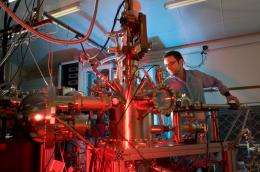
Dr Jesse Petersen from the University of Oxford using the Artemis materials science beamline (Credit: STFC)

(PhysOrg.com) -- A new X-ray movie technique using extreme ultraviolet (XUV) pulses from Artemis (link opens in a new window), one of the world's most advanced lasers, could help unravel the mysteries of phenomena such as magnetism or high-temperature superconductivity. The results are published in the latest edition of Physical Review Letters.

The science beamline at Artemis has succeeded in making movies of electronic and structural changes in a complex material using XUV pulses produced through high , a technique where a laser is fired into a gas jet and just one part in a million is converted into XUV pulses.

Members of the international collaboration from the STFC Central Laser Facility, Diamond Light Source and the universities of Hamburg, Lausanne, Oxford and Padua used these XUV pulses to study a layered crystal of Disulphide. The resulting movies – whose frames captured slices of time lasting less than a millionth of a millionth of a second – revealed that electrical conductivity in this material is governed by strong interactions between the electrons themselves.

Understanding this type of ‘correlated-electron’ behaviour is of crucial importance, since it underlies effects such as high-temperature superconductivity. is the phenomenon where electric current can travel through a material with no loss, because the material is a perfect conductor with zero resistance. Although superconductors are widely used, how they work is less well understood. Even high temperature superconductors need to be kept at -170°C, requiring sophisticated cryogenics systems. The world has ever increasing energy requirements and the search is on to find superconductors that work at room temperature. Understanding the complex physics that underlies this phenomenon is the key.

Dr Jesse Petersen of the University of Oxford said, “This is the only technique that enables us to separate several different processes that are taking place within the material at the same time. The result is particularly interesting because it tells us there must be much more new physics in this material than we had originally thought.”

Professor John Collier, Director of STFC Central Laser Facility said: “These excellent results complement work by other research groups who are using the Artemis laser to probe how laser pulses can be used to switch magnetism on and off by looking at electron spin dynamics. If these phenomena can be understood and controlled, it opens the way for new devices and technologies - such as ultra high speed data storage.”
Extreme ultraviolet movies reveal inside story of complex materials
Enlarge

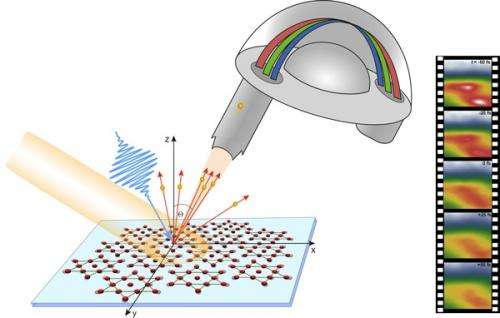
Schematic of tr-ARPES, and a sequence of snapshots from the X-ray movie (Credit: J. Harms, University of Hamburg)

The technique used on Artemis is time and angle resolved photoemission spectroscopy (tr-ARPES) , which enables the electronic structure of a material to be monitored as it responds to excitation by a laser pulse. The target material is irradiated by a short laser pulse, which induces structural changes and excitations. It is then probed at a series of time delays by a short wavelength pulse which generates photoelectrons that are then collected and analysed.

Until recently, tr-ARPES measurements with lasers have typically used only near UV radiation (<7 eV) and pulses of 100 fs or longer. The low photon energy meant that only a small subset of electrons, with certain energies and travelling in certain directions, could be ejected from the material and detected. The long pulselength meant that it was impossible to see the fastest changes to the material.

The Artemis beamline is one of the first in the world to overcome these limitations by using XUV pulses from high-order laser harmonics, with 20 eV photon energy and 30 fs time resolution. XUV pulses are created through the technique of high harmonic generation. A short pulse laser is focused into a gas-jet and interacts with the gas, producing even shorter pulses of coherent radiation in the 10-100 nm wavelength range. The higher photon energy enables electrons with a much wider range of energy and momentum space to be detected, meaning that each snapshot of electronic structure has a much wider field of view.

ARPES is also widely used on synchrotrons, using similar photon energies, to make high resolution static maps of electronic structure. A new ARPES beamline is now in construction at Diamond , meaning that scientists will be able to use these two very complementary techniques located on one site.

These experiments focussed on the layered material tantalum disulphide (TaS2). A short infrared pulse induced a phase transition from a Mott insulator to a metal, and then XUV pulses recorded a sequence of snapshots of the electronic structure on a very short timescale. TaS2 exhibits a ‘charge density wave’ – a regular variation in electron density across the layers of atoms – which makes the atoms settle into star-shaped patterns.

Charge density waves are normally related to interactions between electrons and the crystal structure, while Mott insulators are instead produced by interactions between the electrons themselves. The experiment found that, contrary to expectations, the charge density wave and Mott-insulating states ‘melted’ simultaneously, suggesting a novel mechanism for charge density waves in this material.

The X-ray movies also revealed a structural relaxation which followed the electronic phase transition, but moving slightly more slowly.. This was only possible because of the improved time resolution and higher photon energy in the beamline. The technique looks to be a promising route to disentangling the complex behaviour of exotic materials.

More information: http://prl.aps.org … /i17/e177402

Provided by Science and Technology Facilities Council search and more info website

Filter


Move the slider to adjust rank threshold, so that you can hide some of the comments.


Display comments: newest first

Callippo
Oct 21, 2011

Rank: not rated yet
XUV pulses produced through high harmonic generation, a technique where a laser is fired into a gas jet and just one part in a million is converted into XUV pulses
This technique is interesting by itself, as it represents the "acessible" way of how to generate pulses of very short wavelength radiation with common pulsed lasers. We can imagine it like combination of low energy experiments with mechanically accelerated particles in particles collider, which are colliding like balls of famous Astroblaster toy. During mutual collisions of heavy atoms with electrons excited a tiny portion of electrons get ejected with much higher speed than it corresponds the mutual speed of atoms on the principle of energy and momentum conservation (you can check the Java applet here).

http://www.phy.nt...ic=579.0
vidyunmaya
Oct 21, 2011

Rank: 1 / 5 (1)
Sub:Ano-Raneeyan-Mahato Maheeyaan
Plasma regulated Electromagnetic Interface helps Knowledge base to expand through Dimensional Vortex mode- call Dual Magnetic vortex-DMVT process
see books-Plasma Vision of the Universe-1993 and PREM Universe concepts in http://vidyardhic...pot.com/
Rank 5 /5 (4 votes)
Relevant PhysicsForums posts
  • Laser noise spectrum
    created1 hour ago
  • Transparency of molten substances?
    createdMay 25, 2012
  • saturated paramagnetic and ferromagnetic
    createdMay 24, 2012
  • How to calculate the bandstructure of Twisted Bilayer Graphene
    createdMay 23, 2012
  • vast computational richness from swapping one proton
    createdMay 22, 2012
  • Oscillator strength of mixed LH- and HH-excitons
    createdMay 22, 2012
  • More from Physics Forums - Atomic, Solid State, Comp. Physics

More news stories

Is a classical electrodynamics law incompatible with special relativity?

(Phys.org) -- The laws of classical electromagnetism that were developed in the 19th century are the same laws that scientists use today. They include Maxwell’s four equations along with the Lorentz la ...

Physics / General Physics

created May 24, 2012 | popularity 4.7 / 5 (17) | comments 43 | with audio podcast feature

Landmark calculation clears the way to answering how matter is formed

(Phys.org) -- An international collaboration of scientists, including Thomas Blum, associate professor of physics, is reporting in landmark detail the decay process of a subatomic particle called a kaon – ...

Physics / General Physics

created May 25, 2012 | popularity 4.3 / 5 (22) | comments 50 | with audio podcast

Lying in wait for WIMPs: Researchers seek to dramatically increase sensitivity of Large Underground Xenon detector

Although it's invisible, dark matter accounts for at least 80 percent of the matter in the universe. No one knows what it is, but most scientists would bet on weakly interacting massive particles, or WIMPs.

Physics / General Physics

created May 23, 2012 | popularity 4 / 5 (7) | comments 15 | with audio podcast

Hawaii lab turns laser-powered bubbles into microrobots

(Phys.org) -- A team of scientists from the University of Hawaii are working on microrobots created from bubbles of air in a saline solution. The bubbles take on their title of “robots” as a laser ...

Physics / General Physics

created May 23, 2012 | popularity 5 / 5 (4) | comments 2 | with audio podcast weblog

Sound increases the efficiency of boiling

Scientists at the Georgia Institute of Technology achieved a 17-percent increase in boiling efficiency by using an acoustic field to enhance heat transfer. The acoustic field does this by efficiently removing vapor bubbles ...

Physics / Soft Matter

created May 24, 2012 | popularity 5 / 5 (2) | comments 2


Computer model used to pinpoint prime materials for efficient carbon capture

When power plants begin capturing their carbon emissions to reduce greenhouse gases – and to most in the electric power industry, it's a question of when, not if – it will be an expensive undertaking.

'Unzipped' carbon nanotubes could help energize fuel cells, batteries

Multi-walled carbon nanotubes riddled with defects and impurities on the outside could replace some of the expensive platinum catalysts used in fuel cells and metal-air batteries, according to scientists at ...

T cells 'hunt' parasites like animal predators seek prey, study shows

By pairing an intimate knowledge of immune-system function with a deep understanding of statistical physics, a cross-disciplinary team at the University of Pennsylvania has arrived at a surprising finding: T cells use a movement ...

Yale study concludes public apathy over climate change unrelated to science literacy

Are members of the public divided about climate change because they don't understand the science behind it? If Americans knew more basic science and were more proficient in technical reasoning, would public consensus match ...

Same gene that stunts infants' growth also makes them grow too big: research

UCLA geneticists have identified the mutation responsible for IMAGe* syndrome, a rare disorder that stunts infants' growth. The twist? The mutation occurs on the same gene that causes Beckwith-Wiedemann syndrome, which makes ...

Change in developmental timing was crucial in the evolutionary shift from dinosaurs to birds: study

At first glance, it's hard to see how a common house sparrow and a Tyrannosaurus Rex might have anything in common. After all, one is a bird that weighs less than an ounce, and the other is a dinosaur that ...