How green are green roofs?
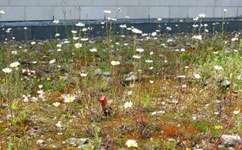
Covered with a growing medium and plants, green roofs can benefit a building's insulation, control storm-water drainage and remove pollution from the air, as well as provide wildlife habitats.
Extensive green roofs might even be able to compensate for urban habitat lost at ground level, but there isn't much information about how well they match ground-based habitats.
Researchers from the University of Birmingham looked at just one of the factors that distinguish green roofs from habitats on the ground – the depth of the growing medium, known as substrate. Their results showed that having restricted access to substrate – and therefore to water and nutrients – significantly affects plants' growth rates and chances of survival.
'You cannot make an exact copy of a ground-based habitat on a roof,' says Dr. Adam Bates, co-author of the research report published in Urban Forestry & Urban Greening.
"Green roofs' limited substrate depth and their different micro-climate will always make them different from the ground. Careful design might make it possible to create habitats of equal wildlife value on a roof, and it is definitely possible to make green-roof habitats that are more valuable than a traditional non-greened roof; but green roofs will always be different."
To find out exactly what effect the shallower substrate would have, the researchers planted a mix of 25 different wild flowers in 1m2 wooden frames. Each frame contained either 100mm or 150mm substrate over filter and drainage layers and a PVC membrane, or 150mm substrate laid directly over bare earth. The frames were not watered or fertilized during the experiment.
At three months and five months after seeding, the researchers measured the total number of plants, total number of species, the number of species in flower and seed, and the maximum height.
While they found some differences in results between the two depths of green-roof substrate, there was a much more marked variation between both green-roof treatments and the frames where substrate was laid over bare earth. In particular they found an increase in species richness. Though this study examined only the first growing season, earlier research has shown that deeper substrate can reduce the number of colonising plant species – in other words, it helps preserve the intended habitat and reduce the risk it will be taken over by self-seeded species, which could be a good thing if your intention is to reproduce a particular ground habitat.
The experiment was carried out at ground level to rule out other variables of the green-roof environment. But of course green roofs are up high, which means plants face different conditions to their companions on the ground. Higher temperatures and stronger wind, among other things, make them more vulnerable to drought. And, no matter how deep their growing medium is, it is unlikely they can be made totally resilient to these conditions.
The researchers point out that, while mulch and moisture-retaining materials can help alleviate this effect, their use will change the habitat from that on the ground. They write that green roofs are a distinct habitat in their own right and cannot be used as like-for-like substitutes for habitats on the ground without great care.
"It is worth considering whether other, cheaper, wildlife friendly alternatives can offer the same or greater benefits to wildlife," Bates points out. "For example, instead of planting a green roof to try to replicate the lost habitat, changing the mowing regime of nearby amenity grassland might have a similar or greater environmental benefit."
However, the researchers note that dry conditions on extensive green roofs can keep habitats at an early stage of development; a stage at which biodiversity and numbers of rare species are often at their highest. A good example of such highly disturbed habitats on the ground are wastelands or brownfield sites, which often represent some of the most important urban habitats in terms of their conservation value. .
Green roofs are expensive to fit to existing buildings and, even when incorporated into a building's original design, the financial and environmental costs of manufacturing and transporting construction materials, membranes, filters and substrates are high. So we need to be confident of the environmental benefits of the completed roof.
'The concept of using green roofs as habitats in the sky is a great idea. But we need more research to make sure that, on balance, they have a positive environmental effect and still meet people's expectations,' Bates concludes.
More information: Luke M Olly, et al. An initial experimental assessment of the influence of substrate depth on floral assemblage for extensive green roofs. Urban Forestry & Urban Greening, 2011, doi: 10.1016/j.ufug.2011.07.005
Provided by PlanetEarth Online


