NIST finds that ethanol-loving bacteria accelerate cracking of pipeline steels
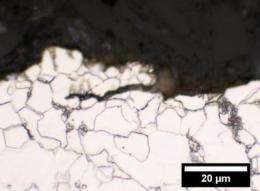
Micrograph of crack in X52 steel after the sample was subjected to mechanical forces for several days in an ethanol solution containing acid-producing bacteria, Acetobacter aceti. Researchers at NIST's biofuels testing facility found that the bacteria increased fatigue crack growth rates at least 25-fold compared to what would occur in air. Credit: Sowards/NIST
U.S. production of ethanol for fuel has been rising quickly, topping 13 billion gallons in 2010. With the usual rail, truck and barge transport methods under potential strain, existing gas pipelines might be an efficient alternative for moving this renewable fuel around the country. But researchers at the National Institute of Standards and Technology (NIST) caution that ethanol, and especially the bacteria sometimes found in it, can dramatically degrade pipelines.
At a conference this week,* NIST researchers presented new experimental evidence that bacteria that feed on ethanol and produce acid boosted fatigue crack growth rates by at least 25 times the levels occuring in air alone.
The NIST team used a new biofuels test facility to evaluate fatigue-related cracking in two common pipeline steels immersed in ethanol mixtures, including simulated fuel-grade ethanol and an ethanol-water solution containing common bacteria, Acetobacter aceti. Ethanol and bacteria are known to cause corrosion, but this is the first study of their effects on fatigue cracking of pipeline steels.
"We have shown that ethanol fuel can increase the rate of fatigue crack growth in pipelines," NIST postdoctoral researcher Jeffrey Sowards says. "Substantial increases in crack growth rates were caused by the microbes. These are important data for pipeline engineers who want to safely and reliably transport ethanol fuel in repurposed oil and gas pipelines."
Ethanol, an alcohol that can be made from corn, is widely used as a gasoline additive due to its oxygen content and octane rating. Ethanol also can be used as fuel by itself in modified engines. The NIST tests focused on fuel-grade ethanol.
The tests were performed on X52 and X70 pipeline steels, which are alloys of more than a dozen metals. Simulated fuel-grade ethanol significantly increased crack growth at stress intensity levels found in typical pipeline operating conditions, but not at low stress levels. The cracking is related to corrosion. The X70 steel, which is finer-grained than X52, had lower rates of crack growth at all stress levels. This was expected because larger grain size generally reduces resistance to fatigue. In the bacteria-laden solutions, acid promoted crack growth at stress intensity levels found in typical pipeline operating conditions.
Preliminary tests also suggested that glutaraldehyde, a biocide used in oil and gas operations, may help control bacterial growth during ethanol transport.
The findings are the first from NIST's biofuels test facility, where material samples are installed in hydraulic test frames and subjected to load cycles while immersed in fuel inside a transparent polymer tank. Fatigue crack growth and other properties are observed over a period of up to 10 days. NIST staff expect to continue and possibly expand the research to other potential biofuels such as butanol or biodiesel.
Collaborators at the Colorado School of Mines provided the bacteria, which were isolated from industrial ethanol storage tanks. The research was supported by the U.S. Department of Transportation.
Provided by National Institute of Standards and Technology (NIST)
-
From lemons to lemonade: Reaction uses carbon dioxide to make carbon-based semiconductor,
32 comments
-
Thioridazine kills cancer stem cells in human while avoiding toxic side-effects of conventional cancer treatments,
3 comments
-
SpaceX private rocket blasts off for space station (Update),
42 comments
-
Climate scientists say they have solved riddle of rising sea,
31 comments
-
SpaceX capsule has 'new car' smell, astronauts say (Update),
3 comments
-
Need a rigid insulation material???
15 hours ago
-
magnets or EMF in car bumpers to protect from fender bender
May 26, 2012
-
length of wire in a coil of known dimensions?
May 25, 2012
-
India Engineering Powerhouse
May 25, 2012
-
electromagnet core dereference between hard and soft iron
May 25, 2012
-
Measuring water pressure in an open tank
May 24, 2012
- More from Physics Forums - General Engineering
More news stories
Browser wars flare in mobile space
The browser wars are heating up again, but this time the fight is for dominance of the mobile Internet.
8 hours ago |
5 / 5 (1) |
3
Probability of contamination from severe nuclear reactor accidents is higher than expected: study
Catastrophic nuclear accidents such as the core meltdowns in Chernobyl and Fukushima are more likely to happen than previously assumed. Based on the operating hours of all civil nuclear reactors and the number ...
Technology / Energy & Green Tech
May 22, 2012 |
3.6 / 5 (22) |
56
|
SpotterRF debuts Radar Backpack Kit (w/ Video)
(Phys.org) -- SpotterRF has announced a special radar backpack kit designed to enhance situational awareness for soldiers on the ground. The company says its special radar is designed for warfighters as part ...
HyperSolar shows dirty water no barrier to power world
(Phys.org) -- The Santa Barbara, California, company, HyperSolar, is set to transparently share the ups and downs of its research experiences toward the companys ultimate vision, successfully producing ...
Tesla to launch electric sedan in US on June 22
Tesla Motors said Tuesday it would begin deliveries of "the world's first premium electric sedan" on June 22, slightly ahead of schedule.
Technology / Energy & Green Tech
May 22, 2012 |
4.5 / 5 (12) |
18
Computer model used to pinpoint prime materials for efficient carbon capture
When power plants begin capturing their carbon emissions to reduce greenhouse gases and to most in the electric power industry, it's a question of when, not if it will be an expensive undertaking.
'Unzipped' carbon nanotubes could help energize fuel cells, batteries
Multi-walled carbon nanotubes riddled with defects and impurities on the outside could replace some of the expensive platinum catalysts used in fuel cells and metal-air batteries, according to scientists at ...
T cells 'hunt' parasites like animal predators seek prey, study shows
By pairing an intimate knowledge of immune-system function with a deep understanding of statistical physics, a cross-disciplinary team at the University of Pennsylvania has arrived at a surprising finding: T cells use a movement ...
Yale study concludes public apathy over climate change unrelated to science literacy
Are members of the public divided about climate change because they don't understand the science behind it? If Americans knew more basic science and were more proficient in technical reasoning, would public consensus match ...
Same gene that stunts infants' growth also makes them grow too big: research
UCLA geneticists have identified the mutation responsible for IMAGe* syndrome, a rare disorder that stunts infants' growth. The twist? The mutation occurs on the same gene that causes Beckwith-Wiedemann syndrome, which makes ...
Change in developmental timing was crucial in the evolutionary shift from dinosaurs to birds: study
At first glance, it's hard to see how a common house sparrow and a Tyrannosaurus Rex might have anything in common. After all, one is a bird that weighs less than an ounce, and the other is a dinosaur that ...
Aug 03, 2011
Rank: not rated yet
http://en.wikiped..._current
http://en.wikiped...ttlement
Interesting that microbial populations take advantage of solar storm effects.