Genetically engineered spider silk for gene therapy
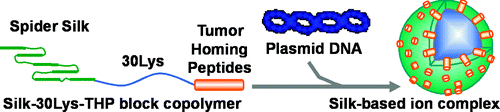
Genetically engineered spider silk could help overcome a major barrier to the use of gene therapy in everyday medicine, according to a new study that reported development and successful initial laboratory tests of such a material. It appears in ACS' journal Bioconjugate Chemistry.
David Kaplan and colleagues note that gene therapy the use of beneficial genes to prevent or treat disease requires safe and efficient carriers or "vectors." Those carriers are the counterparts to pills and capsules, transporting therapeutic genes into cells in the body. Safety and other concerns surround the experimental use of viruses to insert genes. The lack of good gene delivery systems is a main reason why there are no FDA-approved gene therapies, despite almost 1,500 clinical trials since 1989. The new study focused on one promising prospect, silk proteins, which are biocompatible and have been used in everyday medicine and medical research for decades.
The scientists describe modifying spider silk proteins so that they attach to diseased cells and not healthy cells. They also engineered the spider silk to contain a gene that codes for the protein that makes fireflies glow in order to provide a visual signal (seen using special equipment) that the gene has reached its intended target. In lab studies using mice containing human breast cancer cells, the spider-silk proteins attached to the cancer cells and injected the DNA material into the cells without harming the mice. The results suggest that the genetically-engineered spider-silk proteins represent "a versatile and useful new platform polymer for nonviral gene delivery," the article notes.
More information: Spider Silk-Based Gene Carriers for Tumor Cell-Specific Delivery Bioconjugate Chem., Article ASAP. DOI: 10.1021/bc200170u
Abstract
The present study demonstrates pDNA complexes of recombinant silk proteins containing poly(l-lysine) and tumor-homing peptides (THPs), which are globular and approximately 150250 nm in diameter, show significant enhancement of target specificity to tumor cells by additions of F3 and CGKRK THPs. We report herein the preparation and study of novel nanoscale silk-based ionic complexes containing pDNA able to home specifically to tumor cells. Particular focus was on how the THP, F3 (KDEPQRRSARLSAKPAPPKPEPKPKKAPAKK), and CGKRK, enhanced transfection specificity to tumor cells. Genetically engineered silk proteins containing both poly(l-lysine) domains to interact with pDNA and the THP to bind to specific tumor cells for target-specific pDNA delivery were prepared using Escherichia coli, followed by in vitro and in vivo transfection experiments into MDA-MB-435 melanoma cells and highly metastatic human breast tumor MDA-MB-231 cells. Non-tumorigenic MCF-10A breast epithelial cells were used as a control cell line for in vitro tumor-specific delivery studies. These results demonstrate that combination of the bioengineered silk delivery systems and THP can serve as a versatile and useful new platform for nonviral gene delivery.
Provided by
American Chemical Society
-
From lemons to lemonade: Reaction uses carbon dioxide to make carbon-based semiconductor,
32 comments
-
Thioridazine kills cancer stem cells in human while avoiding toxic side-effects of conventional cancer treatments,
3 comments
-
SpaceX private rocket blasts off for space station (Update),
42 comments
-
Climate scientists say they have solved riddle of rising sea,
31 comments
-
SpaceX capsule has 'new car' smell, astronauts say (Update),
2 comments
-
Gibbs Free Energy Change/Entropy
5 hours ago
-
What's the rule to covalent character
6 hours ago
-
Schwartz reagent-- NMR/MS/IR
May 26, 2012
-
High school chemistry EEI
May 25, 2012
-
oxidation of I- by KMnO4
May 25, 2012
-
Inversion temp
May 25, 2012
- More from Physics Forums - Chemistry
More news stories
New CO2-removing catalyst can take the heat
(Phys.org) -- The current method of removing the greenhouse gas carbon dioxide (CO2) from the flues of coal-fired power plants uses so much energy that no one bothers to use it. So says Roger Aines, principal ...
May 24, 2012 |
5 / 5 (9) |
9
|
High-speed method to aid search for solar energy storage catalysts
Eons ago, nature solved the problem of converting solar energy to fuels by inventing the process of photosynthesis.
May 25, 2012 |
5 / 5 (3) |
4
|
Researchers demonstrate possible primitive mechanism of chemical info self-replication
(Phys.org) -- When scientists think about the replication of information in chemistry, they usually have in mind something akin to what happens in living organisms when DNA gets copied: a double-stranded molecule ...
May 25, 2012 |
5 / 5 (4) |
2
|
Building a better solar panel -- one molecule at a time
(Phys.org) -- One of the fundamental building blocks in modern chemistry, an organometallic chemical compound called ferrocene, has never been structurally defined - until now.
May 25, 2012 |
5 / 5 (3) |
0
|
Discarded data may hold the key to a sharper view of molecules
(Phys.org) -- There's nothing like a new pair of eyeglasses to bring fine details into sharp relief. For scientists who study the large molecules of life from proteins to DNA, the equivalent of new lenses have come in the ...
May 24, 2012 |
4.7 / 5 (3) |
0
|
Nvidia trumpets Tegra 3 phone design wins for 2012
(Phys.org) -- Nvidias competitive war paint has a name, Tegra 3. On the heels of Nvidia announcements about lowering costs of its Tegra 3 processors and Nvidia-enabled tablets running Android Ice Cream ...
Browser wars flare in mobile space
The browser wars are heating up again, but this time the fight is for dominance of the mobile Internet.
Scientist: Evolution debate will soon be history
(AP) -- Richard Leakey predicts skepticism over evolution will soon be history. Not that the avowed atheist has any doubts himself.
Dell tablet leak: 10.1-inch display, two-battery choice
(Phys.org) -- Headline after headline talks about vendors tablets in the wings as likely number-one contenders for the iPad. Such claims have justifiably been taken with a grain of salt, considering ...
Keep food safety in mind this memorial day weekend
(HealthDay) -- Picnics, parades and cookouts are as much a part of Memorial Day weekend as tributes to the United States' war veterans.
Social welfare cuts ultimately come with heavy price, researchers say
(Phys.org) -- Slashing government funding for Medicaid, food stamps and other programs that serve the poor while politically popular with some lawmakers and many conservatives may do more harm ...