'Bifocals' in mangrove fish species discovered
July 20, 2011

Cheaper and cleaner electricity from wave-powered ships

Enlarge

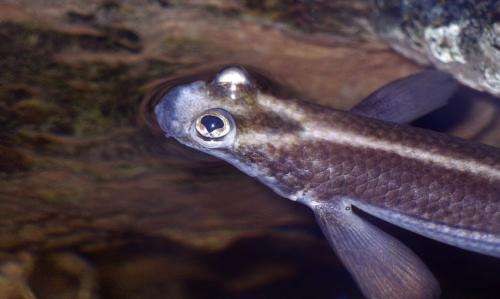
Anableps anableps ("four-eyed fish"). Photo credit: Alan Wolf

(PhysOrg.com) -- A "four-eyed" fish that sees simultaneously above and below the water line has offered up a dramatic example of how gene expression allows organisms to adapt to their environment.

Gregory L. Owens, a University of British Columbia graduate student, found a sharp divide between the upper and lower sections of the eyes of Anableps anableps, a six- to 12-inch fish closely related to guppies. The findings were published today online in Biology Letters.

The four-eyed fish spends most of its life at the water surface, feeding on as well as algae, in the mangrove swamps of central America and northern South America. The upper half of its eyes penetrate the water line, while the lower half of its eyes are submerged.

Its opsin genes, which code for in the eye, closely resemble those of other that don't see above water, so it was unknown if the four-eyed fish's eyes were adapted to both aerial and aquatic light.

Owens, while conducting research for a master's degree at the University of Victoria, sought an answer in how the opsin genes were expressed. He made several molecular probes that, when applied to the retina, would bind to specific opsin gene (mRNA), the molecules that translate DNA into .

By determining the type and distribution of mRNA in the retina, Owens discovered that the eye was clearly divided in sensitivity. One part of the retina, exposed to aerial light, has cones (neurons that convert light into ) that are sensitive to the green wavelengths that predominate in the air. The other part of the retina, exposed to aquatic light, has cones more attuned to the yellow wavelengths of muddy water. The whole eye, meanwhile, is sensitive to other wavelengths, from ultraviolet to blue.

"We expected some difference between different parts of the eye, but not as dramatic as this," says Owens, who is now earning his PhD in UBC's Department of Botany.

John Taylor, an associate professor of biology at the University of Victoria who supervised Owens' work, said the study is part of a larger fish opsin research program that examines gene duplication. Usually, duplicated genes are rendered non-functional by mutations – but not in this case.

"Greg's study illuminates how gene duplication can lead to innovation – in this case each half of the eye gets its own duplicate, tailored to its particular needs," Taylor says.

Provided by University of British Columbia search and more info website

Filter


Move the slider to adjust rank threshold, so that you can hide some of the comments.


Display comments: newest first

FrankHerbert
Jul 20, 2011

Rank: 0.8 / 5 (49)
Looks like nature had Ben Franklin beat.
jsa09
Jul 21, 2011

Rank: 4 / 5 (1)
This fish is greatly superior to man.
The other part of the retina, exposed to aquatic light, has cones more attuned to the yellow wavelengths of muddy water. The whole eye, meanwhile, is sensitive to other wavelengths, from ultraviolet to blue.


This fish sure can see. I wonder how many names of colours we would have to come up with, with eyes like that.
Telekinetic
Jul 21, 2011

Rank: not rated yet
Jeepers, creepers, where'd you get those peepers?
Rank 5 /5 (3 votes)
Relevant PhysicsForums posts

More news stories

Scientist: Evolution debate will soon be history

(AP) -- Richard Leakey predicts skepticism over evolution will soon be history. Not that the avowed atheist has any doubts himself.

Biology / Evolution

created 14 hours ago | popularity 3.5 / 5 (14) | comments 33

More plant species responding to global warming than previously thought

(Phys.org) -- Far more wild plant species may be responding to global warming than previous large-scale estimates have suggested.

Biology / Ecology

created May 22, 2012 | popularity 4.6 / 5 (14) | comments 18 | with audio podcast

Thousands of shellfish found dead in Peru

Thousands of crustaceans were found dead off the coast of Lima following the mystery mass death of dolphins and pelicans, the Peruvian Navy said Friday.

Biology / Ecology

created May 26, 2012 | popularity 4.8 / 5 (4) | comments 7

For monogamous sparrows, it doesn't pay to stray (but they do it anyway)

It's quite common for a female song sparrow to stray from her breeding partner and mate with the male next door, but a new study shows that sleeping around can be costly.

Biology / Plants & Animals

created May 22, 2012 | popularity 5 / 5 (1) | comments 7 | with audio podcast

Study uncovers secret to speedy burrowing by razor clams

(Phys.org) -- If you look at a razor burrowing clam sitting in a bucket, you’d never guess that it could burrow itself down into the soil, much less do it with any speed. Razor clams look like fat straws, ...

Biology / Plants & Animals

created May 25, 2012 | popularity 1 / 5 (1) | comments 3 | with audio podcast report


Nvidia trumpets Tegra 3 phone design wins for 2012

(Phys.org) -- Nvidia’s competitive war paint has a name, Tegra 3. On the heels of Nvidia announcements about lowering costs of its Tegra 3 processors and Nvidia-enabled tablets running Android Ice Cream ...

Browser wars flare in mobile space

The browser wars are heating up again, but this time the fight is for dominance of the mobile Internet.

Dell tablet leak: 10.1-inch display, two-battery choice

(Phys.org) -- Headline after headline talks about vendors’ tablets in the wings as likely number-one contenders for the iPad. Such claims have justifiably been taken with a grain of salt, considering ...

Keep food safety in mind this memorial day weekend

(HealthDay) -- Picnics, parades and cookouts are as much a part of Memorial Day weekend as tributes to the United States' war veterans.

Family history of Alzheimer's affects functional connectivity

(HealthDay) -- Cognitively normal individuals with a family history of late-onset Alzheimer's disease (AD) may display lower resting state functional connectivity in the default mode network (DMN) of the brain, ...

Social welfare cuts ultimately come with heavy price, researchers say

(Phys.org) -- Slashing government funding for Medicaid, food stamps and other programs that serve the poor – while politically popular with some lawmakers and many conservatives – may do more harm ...