Belgium's highways shine into space - but for how long?
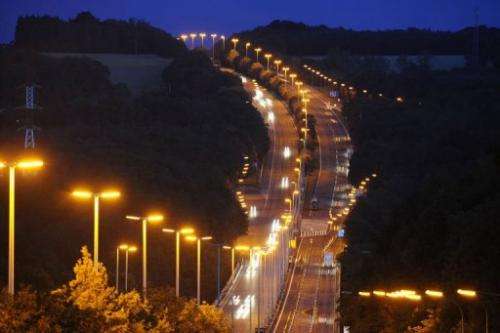
When Belgian astronaut Frank De Winne feels homesick when in space, all he needs to do, provided it's night, is look down for the bright spot for even nowadays, Belgium keeps its highways switched on.
The almost 100 percent illumination of the country's highways can indeed be seen from space with a telescopic lens, said European Space Agency (ESA) spokesman in the German city of Cologne.
But down on earth, the mood is changing and Belgium soon may not shine so brightly.
Almost no other country on earth can currently afford such a luxury, and as energy-saving and cost-cutting measures bite, even Belgium is beginning to consider a switch-off. Another exception is its tiny but wealthy neighbour, Luxembourg, which too offers almost 100-percent lighting on its 150 kilometres (93 miles) of highways.
Belgium currently turns on 335,000 lights fitted to 150,000 lampposts on its motorways and main roads every evening.
In the economically struggling southern French-speaking region of Wallonia, 750 kilometres of the 860-kilometre grid are lit up at night. In the wealthier Dutch-speaking north, Flanders, the roads are 100 percent illuminated, according to transport ministries from both regions.
But officials are beginning to look at the cost.
Cash-strapped Wallonia last year paid out 9.5 million euros for 105 gigawatt-hours of electricity for road lighting -- to produce that amount of electricity a standard nuclear reactor would need to run for about four days.
The kingdom's affection for road lights dates to concerns some 60 years back -- the post-World War II period when more and more families were buying cars -- over spiralling fatalities on roads at night.
In the 1950s, the Wallonia transport ministry said, while only a quarter of road traffic took place after nightfall, more than half of fatal casualties occurred during the night.
Lamps were therefore introduced "mainly for safety reasons, all the more since energy costs seemed reasonable at that time," a recent ministry report said.
Twenty years later, exits and drive-ups were illuminated too as planners sought to spare drivers the constant change from darkness to light.
But the apparent benefits for road safety have come under question. The Belgium Institute for Road Security (IBSR) offers mixed conclusions in a recent report.
While lighting was installed "with the best of intentions", it presents "a certain number of more or less important inconveniences", it says. While lighting undoubtedly increases visibility, it can also give those at the wheel "a (false) sense of safety", the experts add.
And lampposts in many cases have turned out to be "extremely rigid and dangerous obstacles" responsible for more than 18 percent of fatalities involving obstacles, the report added.
It said that a driver who loses control of his vehicle faces double the risk of being killed against a lamppost than against a highway railing.
Conservative European parliamentarian Peter Liesse, a member of Germany's Christian Democratic Union (CDU) -- Chancellor Angela Merkel's party -- who works on the implementation of European energy efficiency targets, says the European Union cannot force Belgium to switch off the highway lighting.
But the new energy efficiency regulations which have already led to the abolition of old-style light bulbs in households also apply to street lighting, he said.
Old bulbs are indeed being replaced by more efficient models over time on the roads.
And already, the lights on the highways are dimming.
In 2008, southern Wallonia reduced the number of hours lights were turned on from 4,050 a year to 2,350. In northern Flanders, a report is due for release any time soon that is expected to question the overall idea.
Should the switch-off begin, Belgian astronauts will lose a beacon.
(c) 2011 AFP


