Team reports scalable fabrication of self-aligned graphene transistors, circuits
June 17, 2011 By Mike Rodewald

Team reports scalable fabrication of self-aligned graphene transistors, circuits

Enlarge

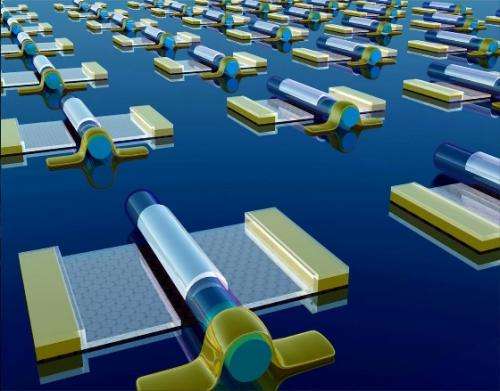
Self-aligned graphene transistor array

(PhysOrg.com) -- Graphene, a one-atom-thick layer of graphitic carbon, has the potential to make consumer electronic devices faster and smaller. But its unique properties, and the shrinking scale of electronics, also make graphene difficult to fabricate and to produce on a large scale.

In September 2010, a UCLA research team reported that they had overcome some of these difficulties and were able to fabricate transistors with unparalleled speed. These transistors used a nanowire as the self-aligned gate — the element that switches the transistor between various states. But the scalability of this approach remained an open question.

Now the researchers, using equipment from the Nanoelectronics Research Facility and the Center for High Frequency Electronics at UCLA, report that they have developed a scalable approach to fabricating these high-speed graphene transistors.

The team used a dielectrophoresis assembly approach to precisely place nanowire gate arrays on large-area chemical vapor deposition–growth graphene — as opposed to mechanically peeled graphene flakes — to enable the rational fabrication of high-speed transistor arrays. They were able to do this on a glass substrate, minimizing parasitic delay and enabling graphene transistors with extrinsic cut-off frequencies exceeding 50 GHz. Typical high-speed graphene transistors are fabricated on silicon or semi-insulating silicon carbide substrates that tend to bleed off electric charge, leading to extrinsic cut-off frequencies of around 10 GHz or less.

Taking an additional step, the UCLA team was able to use these graphene transistors to construct radio-frequency circuits functioning up to 10 GHz, a substantial improvement from previous reports of 20 MHz.

The research opens a rational pathway to scalable fabrication of high-speed, self-aligned graphene and functional circuits and it demonstrates for the first time a graphene transistor with a practical (extrinsic) cutoff frequency beyond 50 GHz.

This represents a significant advance toward graphene-based, radio-frequency circuits that could be used in a variety of devices, including radios, computers and mobile phones. The technology might also be used in wireless communication, imaging and radar technologies.

The research was recently published in the peer-reviewed journal Nano Letters.

The UCLA research team included Xiangfeng Duan, professor of chemistry and biochemistry; Yu Huang, assistant professor of materials science and engineering at the Henry Samueli School of Engineering and Applied Science; Lei Liao; Jingwei Bai; Rui Cheng; Hailong Zhou; Lixin Liu; and Yuan Liu. Duan and Huang are also researchers at the California NanoSystems Institute at UCLA.

More information: Scalable Fabrication of Self-Aligned Graphene Transistors and Circuits on Glass, Nano Lett., Article ASAP, DOI: 10.1021/nl201922c

Abstract
Graphene transistors are of considerable interest for radio frequency (rf) applications. High-frequency graphene transistors with the intrinsic cutoff frequency up to 300 GHz have been demonstrated. However, the graphene transistors reported to date only exhibit a limited extrinsic cutoff frequency up to about 10 GHz, and functional graphene circuits demonstrated so far can merely operate in the tens of megahertz regime, far from the potential the graphene transistors could offer. Here we report a scalable approach to fabricate self-aligned graphene transistors with the extrinsic cutoff frequency exceeding 50 GHz and graphene circuits that can operate in the 1–10 GHz regime. The devices are fabricated on a glass substrate through a self-aligned process by using chemical vapor deposition (CVD) grown graphene and a dielectrophoretic assembled nanowire gate array. The self-aligned process allows the achievement of unprecedented performance in CVD graphene transistors with a highest transconductance of 0.36 mS/μm. The use of an insulating substrate minimizes the parasitic capacitance and has therefore enabled graphene transistors with a record-high extrinsic cutoff frequency (> 50 GHz) achieved to date. The excellent extrinsic cutoff frequency readily allows configuring the graphene transistors into frequency doubling or mixing circuits functioning in the 1–10 GHz regime, a significant advancement over previous reports (20 MHz). The studies open a pathway to scalable fabrication of high-speed graphene transistors and functional circuits and represent a significant step forward to graphene based radio frequency devices.

Provided by University of California Los Angeles search and more info website

Filter


Move the slider to adjust rank threshold, so that you can hide some of the comments.


Display comments: newest first

Pharago
Jun 17, 2011

Rank: 5 / 5 (3)
welcome to the future
travisr
Jun 17, 2011

Rank: 5 / 5 (2)
It doesn't say what the feature size is though. If its self assembling I would suppose its small, but how small?

I think either way, this is a monumental break through though. If a semiconductor company takes serious interest in this you could see the graphene races in just a few years that you currently see in semiconductors. It would be easy to spot on a flop/t graph. A straight-line up and down showing desktop computers soaring upwards in capability at 90 degrees compared to the moore line.
El_Nose
Jun 17, 2011

Rank: 3.3 / 5 (4)
there will be no graphene race of any type --

silicon is the most understood material on the planet. Until the amount of research hours that have been put into graphene get close to the hours put into silicon there will be no change.

Semiconductor manufacturers are ready to go 7 more years with silicon and have developed research goals that go for the next 10 - 12 years with silicon -- until graphene becomes more well known it will be a decade probably before we see a graphene based microprocessor.
Vendicar_Decarian
Jun 17, 2011

Rank: 4 / 5 (3)
There will be some high end applications for graphene devices, probably military, satellite communications, and perhaps the 2020 iFad from Apple.
SemiNerd
Jun 17, 2011

Rank: 5 / 5 (4)
there will be no graphene race of any type --

silicon is the most understood material on the planet. Until the amount of research hours that have been put into graphene get close to the hours put into silicon there will be no change.

Semiconductor manufacturers are ready to go 7 more years with silicon and ... until graphene becomes more well known it will be a decade probably before we see a graphene based microprocessor.

Hmmm... not necessarily. Many thousands of research man-hours were spent decreasing the feature size and increasing the scale of current devices. Since current graphene transistors and other devices are already smaller than any existing silicon device and have other speed and current advantages, all that's really necessary at this point is to develop large scale manufacturing processes for these devices.

At this point, I estimate we are 4-6 years out before we see amazing graphene devices on the market.
Intensero
Jun 18, 2011

Rank: not rated yet
Sweetness. Someone invest a couple hundred billion in graphene please and save the world by advancing things like this. I can't wait until they learn to deal with the entropy issues with 3D computing, still at a lost here. Can anyone say nano neural net processing with speeds 50,000-100,000 times faster than today?
Rank 5 /5 (10 votes)
Relevant PhysicsForums posts
  • microstructure of titanium
    created16 hours ago
  • Steam in My Espresso Machine
    created22 hours ago
  • Density question
    createdMay 24, 2012
  • Mass transport originating from a point source at a solid gas interface
    createdMay 22, 2012
  • Ammonia dispersion in Air
    createdMay 22, 2012
  • Multi Choice Help
    createdMay 21, 2012
  • More from Physics Forums - Materials & Chemical Engineering

More news stories

In nanorod crystal growth, nanoparticles seen as artificial atoms

In the growth of crystals, do nanoparticles act as "artificial atoms" forming molecular-type building blocks that can assemble into complex structures? This is the contention of a major but controversial theory ...

Nanotechnology / Nanophysics

created May 24, 2012 | popularity 4.8 / 5 (6) | comments 0 | with audio podcast

First direct observation of oriented attachment in nanocrystal growth

Berkeley Lab researchers have reported the first direct observation of nanoparticles undergoing oriented attachment, the critical step in biomineralization and the growth of nanocrystals. A better understanding ...

Nanotechnology / Nanophysics

created May 24, 2012 | popularity 4.7 / 5 (3) | comments 0 | with audio podcast

Dopant gives graphene solar cells highest efficiency yet

(Phys.org) -- By taking advantage of graphene’s favorable electrical and optical properties, and then adding an organic dopant, researchers have achieved the highest power conversion efficiency yet for ...

Nanotechnology / Nanophysics

created May 21, 2012 | popularity 5 / 5 (10) | comments 14 | with audio podcast feature

Synthetic nano-waste does not disappear

(Phys.org) -- Tiny particles of cerium oxide do not burn or change in the heat of a waste incineration plant. They remain intact on combustion residues or in the incineration system, as a new study by Swiss ...

Nanotechnology / Bio & Medicine

created May 25, 2012 | popularity 5 / 5 (2) | comments 1 | with audio podcast

'Metamaterials,' quantum dots show promise for new technologies

(Phys.org) -- Researchers are edging toward the creation of new optical technologies using "nanostructured metamaterials" capable of ultra-efficient transmission of light, with potential applications including ...

Nanotechnology / Nanophysics

created May 24, 2012 | popularity 5 / 5 (7) | comments 1 | with audio podcast


Nvidia trumpets Tegra 3 phone design wins for 2012

(Phys.org) -- Nvidia’s competitive war paint has a name, Tegra 3. On the heels of Nvidia announcements about lowering costs of its Tegra 3 processors and Nvidia-enabled tablets running Android Ice Cream ...

Browser wars flare in mobile space

The browser wars are heating up again, but this time the fight is for dominance of the mobile Internet.

Scientist: Evolution debate will soon be history

(AP) -- Richard Leakey predicts skepticism over evolution will soon be history. Not that the avowed atheist has any doubts himself.

Dell tablet leak: 10.1-inch display, two-battery choice

(Phys.org) -- Headline after headline talks about vendors’ tablets in the wings as likely number-one contenders for the iPad. Such claims have justifiably been taken with a grain of salt, considering ...

SpotterRF debuts Radar Backpack Kit (w/ Video)

(Phys.org) -- SpotterRF has announced a special radar backpack kit designed to enhance situational awareness for soldiers on the ground. The company says its special radar is designed for warfighters as part ...

SpaceX capsule has 'new car' smell, astronauts say (Update)

SpaceX's Dragon cargo vessel smells like a new car, said astronauts at the International Space Station after opening the hatches Saturday following the spacecraft's landmark mission to the orbiting lab.