At small scales, tug-of-war between electrons can lead to magnetism under surprising circumstances
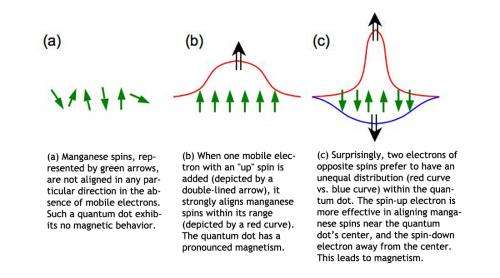
(PhysOrg.com) -- At the smallest scales, magnetism may not work quite the way scientists expected, according to a recent paper in Physical Review Letters by Rafal Oszwaldowski and Igor Zutic of the University at Buffalo and Andre Petukhov of the South Dakota School of Mines and Technology.
The three physicists have proposed that it would be possible to create a quantum dot -- a kind of nanoparticle -- that is magnetic under surprising circumstances.
Magnetism is determined by a property all electrons possess: spin. Individual spins are akin to tiny bar magnets, which have north and south poles. Electrons can have an "up" or "down" spin, and a material is magnetic when most of its electrons have the same spin.
Mobile electrons can act as "magnetic messengers," using their own spin to align the spins of nearby atoms. If two mobile electrons with opposite spins are in an area, conventional wisdom says that their influences should cancel out, leaving a material without magnetic properties.
But the UB-South Dakota team has proposed that at very small scales, magnetism may be more nuanced than that. It is possible, the physicists say, to observe a peculiar form of magnetism in quantum dots whose mobile electrons have opposing spins.
In their Physical Review Letters article, the researchers describe a theoretical scenario involving a quantum dot that contains two free-floating, mobile electrons with opposite spins, along with manganese atoms fixed at precise locations within the quantum dot.
The quantum dot's mobile electrons act as "magnetic messengers," using their own spins to align the spins of nearby manganese atoms.
Under these circumstances, conventional thinking would predict a stalemate: Each mobile electron exerts an equal influence over spins of manganese atoms, so neither is able to "win."
Through complex calculations, however, Oszwałdowski, Žutić and Petukhov show that the quantum dot's two mobile electrons will actually influence the manganese spins differently.
That's because while one mobile electron prefers to stay in the middle of the quantum dot, the other prefers to locate further toward the edges. As a result, manganese atoms in different parts of the quantum dot receive different messages about which way to align their spins.
In the "tug-of-war" that ensues, the mobile electron that interacts more intensely with the manganese atoms "wins," aligning more spins and causing the quantum dot, as a whole, to be magnetic. (For a visual representation of this tug-of-war, see Figure 1.)
This prediction, if proven, could "completely alter the basic notions that we have about magnetic interactions," Žutić says.
"When you have two mobile electrons with opposite spins, the assumption is that there is a nice balance of up and down spins, and therefore, there is no magnetic message, or nothing that could be sent to align nearby manganese spins," he says. "But what we are saying is that it is actually a tug of war. The building blocks of magnetism are still mysterious and hold many surprises."
Scientists including UB Professor Athos Petrou, UB College of Arts and Sciences Dean Bruce McCombe and UB Vice President for Research Alexander Cartwright have demonstrated experimentally that in a quantum dot with just one mobile electron, the mobile electron will act as a magnetic messenger, robustly aligning the spins of adjacent manganese atoms.
Now, Petrou and his collaborators are interested in taking their research a step further and testing the tug-of-war prediction for two-electron quantum dots, Žutić says.
Žutić adds that learning more about magnetism is important as society continues to find novel uses for magnets, which could advance technologies including lasers, medical imaging devices and, importantly, computers.
He explains the promise of magnet- or spin-based computing technology -- called "spintronics" -- by contrasting it with conventional electronics. Modern, electronic gadgets record and read data as a blueprint of ones and zeros that are represented, in circuits, by the presence or absence of electrons. Processing information requires moving electrons, which consumes energy and produces heat.
Spintronic gadgets, in contrast, store and process data by exploiting electrons' "up" and "down" spins, which can stand for the ones and zeros devices read. Future energy-saving improvements in data processing could include devices that process information by "flipping" spin instead of shuttling electrons around.
Studying how magnetism works on a small scale is particularly important, Žutić says, because "we would like to pack more information into less space."
And, of course, unraveling the mysteries of magnetism is satisfying for other, simpler reasons.
"Magnets have been fascinating people for thousands of years," Žutić says. "Some of this fascination was not always related to how you can make a better compass or a better computer hard drive. It was just peculiar that you have materials that attract one another, and you wanted to know why."
Provided by University at Buffalo


