Scientists pioneer nanoscale nuclear materials testing capability
Jun 26, 2011
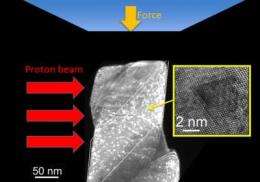
Scientists at Lawrence Berkeley National Laboratory and the University of California at Berkeley conducted compression tests of copper specimens irradiated with high-energy protons, designed to model how damage from radiation affects the mechanical properties of copper. By using a specialized in situ mechanical testing device in a transmission electron microscope at the National Center for Electron Microscopy, the team could examine -- with nanoscale resolution -- the localized nature of this deformation. (Scales in nanometers, millionths of a meter.) Credit: Minor et al, Lawrence Berkeley National Laboratory

Nuclear power is a major component of our nation's long-term clean-energy future, but the technology has come under increased scrutiny in the wake of Japan's recent Fukushima disaster. Indeed, many nations have called for checks and "stress tests" to ensure nuclear plants are operating safely.

In the United States, about 20 percent of our electricity and almost 70 percent of the electricity from emission-free sources, including renewable technologies and hydroelectric power plants, is supplied by nuclear power. Along with power generation, many of the world's nuclear facilities are used for research, materials testing, or the production of radioisotopes for the medical industry. The service life of structural and functional material components in these facilities is therefore crucial for ensuring reliable operation and safety.

Now scientists at Berkeley Lab, the University of California at Berkeley, and Los Alamos National Laboratory have devised a nanoscale testing technique for irradiated materials that provides macroscale materials-strength properties. This technique could help accelerate the development of new materials for nuclear applications and reduce the amount of material required for testing of facilities already in service.

"Nanoscale mechanical tests always give you higher strengths than the macroscale, bulk values for a material. This is a problem if you actually want use a nanoscale test to tell you something about the bulk-material properties," said Andrew Minor, a faculty scientist in the National Center for (NCEM) and an associate professor in the department at UC Berkeley. "We have shown you can actually get real properties from irradiated specimens as small as 400 nanometers in diameter, which really opens up the field of nuclear materials to take advantage of nanoscale testing."

In this study, Minor and his colleagues conducted compression tests of copper specimens irradiated with high-energy protons, designed to model how damage from radiation affects the mechanical properties of copper. By using a specialized in situ mechanical testing device in a transmission electron microscope at NCEM, the team could examine — with nanoscale resolution — the nature of the deformation and how it was localized to just a few atomic planes.

Three-dimensional defects within the copper created by radiation can block the motion of one-dimensional defects in the crystal structure, called dislocations. This interaction causes irradiated materials to become brittle, and alters the amount of force a material can withstand before it eventually breaks. By translating nanoscale strength values into bulk properties, this technique could help reactor designers find suitable materials for engineering components in .

"This small-scale testing technique could help extend the lifetime of a nuclear reactor," said co-author Peter Hosemann, an assistant professor in the nuclear engineering department at UC Berkeley. "By using a smaller specimen, we limit any safety issues related to the handling of the test material and could potentially measure the exact properties of a material already being used in a 40-year-old nuclear facility to make sure this structure lasts well into the future."

Minor adds, "Understanding how materials fail is a fundamental mechanistic question. This proof of principle study gives us a model system from which we can now start to explore real, practical materials applicable to nuclear energy. By understanding the role of defects on the mechanical properties of nuclear reactor materials, we can design that are more resistant to radiation damage, leading to more advanced and safer nuclear technologies."

Explore further: Hybrid material as gold-leaf substitute

More information: "In situ nanocompression testing of irradiated copper," Nature Materials (2011)

Related Stories

Beyond NYC: Other places adapting to climate, too

1 hour ago

From Bangkok to Miami, cities and coastal areas across the globe are already building or planning defenses to protect millions of people and key infrastructure from more powerful storm surges and other effects ...

China paper hits out at US surveillance programme

1 hour ago

China's official army newspaper on Sunday branded the United States Internet surveillance programme exposed by former spy Edward Snowden as "frightening", and accused the US of being a "habitual offender" ...

Russia fetes 50th anniversary of first woman in space

1 hour ago

Russia celebrated Sunday the 50th anniversary of the maiden flight of the first woman in space—a Soviet national hero who went by the call name "Seagull" and captured the imaginations of girls around the ...

Current, former officials back secret surveillance

1 hour ago

Current and former top U.S. officials on Sunday defended the government's collection of phone and Internet data following new revelations about the secret surveillance programs, saying the operations were ...

Recommended for you

Hybrid material as gold-leaf substitute

Jun 18, 2013

(Phys.org) —A team of researchers headed by Professor Raffaele Mezzenga has created a hybrid material out of gold and milk proteins that looks like a wafer-thin gold leaf. Thanks to its properties, it could ...

Antioxidant with a long shelf life

Jun 17, 2013

(Phys.org) —Scientists from ETH Zurich have developed a nanomaterial that protects other molecules from oxidation. Unlike many such active substances in the past, the ETH-Zurich researchers' antioxidant ...

Fast pollutant degradation by nanosheets

Jun 17, 2013

(Phys.org) —Waste from textile and paint industries often contains organic dyes such as methylene blue as pollutants. Photocatalysis is an efficient means of reducing such pollution, and molybdenum trioxide ...

Unzipped nanotubes unlock potential for batteries

Jun 13, 2013

(Phys.org) —Researchers at Rice University have come up with a new way to boost the efficiency of the ubiquitous lithium ion (LI) battery by employing ribbons of graphene that start as carbon nanotubes.

Nanoparticle opens the door to clean-energy alternatives

Jun 13, 2013

(Phys.org) —Cheaper clean-energy technologies could be made possible thanks to a new discovery. Research team members led by Raymond Schaak, a professor of chemistry at Penn State University, have found ...

User comments : 2

Adjust slider to filter visible comments by rank

Display comments: newest first

Telekinetic
1 / 5 (2) Jun 26, 2011
Is there also a way of testing whether the engineers involved in the nuclear plant's construction are immune to accepting payoffs to overlook defects that can have disastrous consequences?
"Mitsuhiko Tanaka says he helped conceal a manufacturing defect in the $250 million steel vessel installed at the Fukushima Dai-Ichi No. 4 reactor while working for a unit of Hitachi Ltd. (6501) in 1974."
tarheelchief
5 / 5 (3) Jun 26, 2011
I do hope the nanophysicists will attempt more research into Thorium.This might help modify reactor production systems around the globe.

More news stories

Sound waves precisely position nanowires

(Phys.org) —The smaller components become, the more difficult it is to create patterns in an economical and reproducible way, according to an interdisciplinary team of Penn State researchers who, using ...

Hybrid nanostructures: Getting to the core

Material scientists expect the new multifunctional properties of hybrid nanostructures will transform the development of high-performance devices, including batteries, high-sensitivity sensors and solar cells. ...