Researchers parse the origins of hematopoietic stem cells
Jun 08, 2011
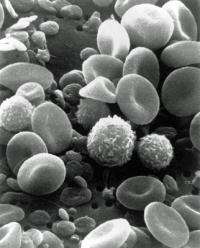
A scanning electron microscope image depicting normal circulating human blood, which includes round, dimpled red blood cells and several types of white blood cells, including lymphocytes, a monocyte and a neutrophil, and many small, disc-shaped platelets. Credit: Courtesy of the National Cancer Institute

Researchers at the University of California, San Diego School of Medicine have identified a gene and a novel signaling pathway, both critical for making the first hematopoietic stem cells (HSCs) in developing vertebrate embryos. The discovery has implications for developing stem cell-based therapies for diseases like leukemia and congenital blood disorders.

HSCs are that give rise to all blood cell types, including red blood and . Existing medical treatments using HSCs are hampered by cell shortages and finding compatible matches between donors and recipients. Currently, it is not possible to create HSCs from converted or induced – pluripotent cells artificially derived from non-pluripotent cells, such as skin cells.

"What we need is the ability to generate self-renewing HSCs from patients for treatments," said David Traver, PhD, an associate professor in UCSD's Department of Cellular and Molecular Medicine. "But accomplishing this goal means first understanding the mechanisms involved in creating HSCs during embryonic development."

One of those mechanisms is described for the first time in a paper published by Traver and colleagues in the June 9 issue of the journal Nature.

The researchers focused on a family of 19 known genes called Wnts, which had previously been recognized as important players in other aspects of embryogenesis. "Wnt signaling is involved in virtually all aspects of development," said Traver. The scientists eventually narrowed their efforts to a single, largely unstudied gene called Wnt16, which they found residing close to HSC precursors in the somites of vertebrate embryos. A somite is an early body segment in the developing embryo that gives rise to most of the adult body muscle and skeleton.

They determined that Wnt16 controls a novel genetic regulatory network necessary for HSC specification. The gene turns on key binding molecules, or ligands, that are required to definitively establish blood cell production. Knocking out Wnt16 in zebrafish, a powerful model of vertebrate development, resulted in embryos lacking HSCs.

Identifying Wnt16 as a vital factor in HSC production dramatically expands what's known about how HSCs are formed and provides new insight into what tissues talk to each other to achieve the end-goal of producing the adult blood system. "We're on the cusp of understanding something that people have been wondering about for decades," said Wilson K. Clements, first author of the study and a postdoctoral fellow in Traver's lab.

Explore further: Scientists offer first definitive proof of bacteria-feeding behavior in green algae

Related Stories

Tackling blood stem cell heterogeneity

Apr 26, 2010

Distinct populations of hematopoietic stem cells (HSCs) that preferentially generate specific types of blood cells can be identified based on abundance of a single surface protein, according to a study published online on ...

Researchers Unlock Molecular Origin of Blood Stem Cells

Jan 09, 2009

(PhysOrg.com) -- A research team led by Nancy Speck, PhD, Professor of Cell and Developmental Biology at the University of Pennsylvania School of Medicine, has identified the location and developmental timeline ...

Protein key to control, growth of blood cells

Aug 13, 2008

New research sheds light on the biological events by which stem cells in the bone marrow develop into the broad variety of cells that circulate in the blood. The findings may help improve the success of bone marrow transplants ...

Unappreciated dynamism of blood cell production

Feb 07, 2011

The bone marrow stem cells responsible for generating new blood cells are less fixed and more flexible than previously thought, according to a paper published online on February 7 in the Journal of Experimental Medicine.

Recommended for you

Scientists discover how rapamycin slows cell growth

21 minutes ago

University of Montreal researchers have discovered a novel molecular mechanism that can potentially slow the progression of some cancers and other diseases of abnormal growth. In the May 23 edition of the prestigious journal ...

Unlocking secrets of cell reproduction

8 hours ago

Research published in Open Biology today identifies, for the first time, nearly all the genes required for reproduction of a cell in a living organism.

What the smallest infectious agents reveal about evolution

20 hours ago

Radically different viruses share genes and are likely to share ancestry, according to research published in BioMed Central's open access journal Virology Journal this week. The comprehensive phylogenomic analysis compar ...

User comments : 0

More news stories

Scientists discover how rapamycin slows cell growth

University of Montreal researchers have discovered a novel molecular mechanism that can potentially slow the progression of some cancers and other diseases of abnormal growth. In the May 23 edition of the prestigious journal ...

White tiger mystery solved

White tigers today are only seen in zoos, but they belong in nature, say researchers reporting new evidence about what makes those tigers white. Their spectacular white coats are produced by a single change ...

Solar Kettle allows for boiling water off the grid

(Phys.org) —A company called Contemporary Energy has unveiled a new device it calls the Solar Kettle. It looks very much like a normal coffee thermos, but has flaps on one side that open to allow for collecting ...

Ferrets, pigs susceptible to H7N9 avian influenza virus

Chinese and U.S. scientists have used virus isolated from a person who died from H7N9 avian influenza infection to determine whether the virus could infect and be transmitted between ferrets. Ferrets are often used as a mammalian ...

Scientists develop cheaper, more efficient fuel cells

(Phys.org) —Using the Canadian Light Source (CLS) synchrotron, researchers have discovered a way to create cheaper fuel cells by dividing normally expensive platinum metal into nanoparticles (or even single ...