Icarus' revenge: Plane uses sun to power flight
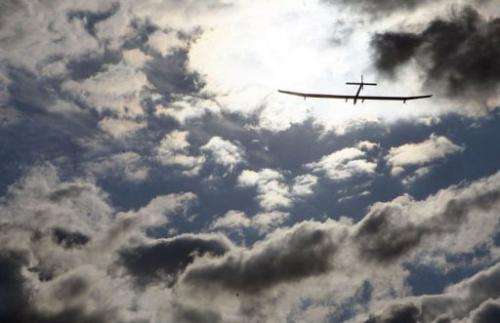
(AP) -- The plane making one of the biggest splashes at the Paris Air Show carries a grand total of one person and is often delayed because there's too much wind or too little sun.
Andre Borschberg pilots the Solar Impulse, a prototype aircraft powered exclusively by sunlight. While that has put him into the record books as the first pilot to fly 24 hours in an entirely solar-powered plane, it also causes aggravations that travelers anywhere could relate to.
Like the time it took him 16 hours to fly from Brussels to Paris - five hours to cover the distance and another 11 hours circling over the airport, waiting for wind conditions to settle down enough for him to land.
The plane has a slim dragonfly fuselage with a cockpit that fits just one pilot. Its enormous wing is entirely covered with energy-capturing solar cells similar to the ones used in some homes.
The Solar Impulse's 63-meter (207-foot) wingspan is equivalent to those on Airbus' long-range A340s, and the lightweight carbon fiber material used throughout the plane means it weighs no more than a standard passenger car.
Its 10,000 solar cells generate about 40 horsepower, "the same as a small motor scooter," Borschberg said in an interview in the plane's temporary hanger at Bourget airport, where the world's aviation industry is gathered for the biennial Paris Air Show.
That doesn't sound like a lot, but it's enough to power the featherweight plane up to its cruising altitude of 10,000 meters (32,800 feet), where it maintains an average speed of 70 kph (44 mph).
The Swiss pilot says the goal of the Solar Impulse "is to show what is possible with existing technology to maintain the same quality of life but using much less energy."
Borschberg and his partner, Swiss adventurer Bertrand Piccard, have been working on the Solar Impulse since 2003. The project is entirely privately financed and has a budget of euro90 million ($129 million), with the goal of building a second plane by 2013 to take on the next challenge: an around-the-world solar powered flight.
The plane was developed by a team of about 70 designers and engineers based in the Swiss city of Zurich. Sponsors include Swiss watchmaker Omega, which designed a unique lightweight flight instrument to precisely gauge the plane's banking angle, which is strictly limited.
Visitors to this year's rainy Paris Air Show may yet get a chance to see the Solar Impulse take to the air before the week is over - weather permitting.
©2011 The Associated Press. All rights reserved. This material may not be published, broadcast, rewritten or redistributed.


