Perfect welds for car bodies
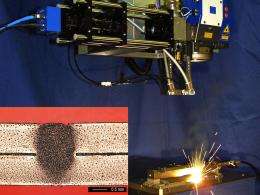
Surface welding instead of penetration welding, allows a laser to produce a weld that is only visible on one side. But how do you control the laser power to prevent it burning a hole through the sheets of metal? A new camera system analyzes thermal images in real time – and ensures a perfect weld.
As if controlled by an invisible hand, the welding head on the robot’s arm races along the sheet metal parts. Where the laser hits, sparks fly and the metal glows red hot. The process lasts just a few seconds. The outer door panel and the door frame are now welded together perfectly. A thin weld seam extends along the join, but it can only be seen on one side. From the other side of the welded car door the join is invisible. This is a perfect weld – the kind every car manufacturer dreams of, because it could be used anywhere on the car body. Expensive work to hide the seam, such as folding the sheet metal or covering with trim would no longer be necessary.
Research scientists at the Fraunhofer Institute for Physical Measurement Techniques IPM in Freiburg have turned this car makers’ dream into reality. ‘Controlled partial penetration welding’ is how experts refer to the process in which the laser does not burn right through all the sheets of metal – in contrast to full penetration welding, where a hole briefly forms in the melt pool. Instead, the weld seam is controlled to penetrate the lower sheet without damaging the bottom surface. Up to now, however, it was not possible to precisely control this type of welding and produce a seam that meets the requirements in respect of strength.
“As we do not weld through the sheet, basically we cannot see what we are doing,” states Andreas Blug, project manager at Fraunhofer IPM, outlining the problem. But they found the solution using an innovative camera that generates temperature images. This enables the system to recognize how deep the laser has penetrated into the sheets. Where it burns into the metal, causing it to melt, the images show a hot region. If the bottom of the melt pool reaches the gap between the upper and lower sheets, the conduction of heat is interrupted and a cooler point can be seen. This is referred to as the full penetration hole. From the relative frequency of this full penetration hole the system calculates the penetration depth into the lower sheet. A software program then adapts the output of the laser to the specific requirements. “The process is closed loop controlled in real time,” Blug explains. An extremely rapid camera system is needed for this – which is the key to Fraunhofer IPM’s innovation. The system is based on cellular neural networks (CNN). A tiny processor is integrated in each pixel. They all work simultaneously and speed up the analysis of the individual images enormously, whereas in conventional image processing systems a few processors process the data consecutively. “In this way the system analyzes up to 14,000 images per second,” says Blug. This compares with the usual rate of only 1,000 to 2,000 images per second.
Together with colleagues from the IFSW Institut für Strahlwerkzeuge at Stuttgart University and the Institut für Grundlagen der Elektrotechnik und Elektronik (IEE) at Dresden University of Technology, the Fraunhofer IPM research scientists have now developed a prototype which perfectly controls the surface welding process, offering car makers a further great benefit in comparison with full penetration welding: zinc does not vaporize on the bottom side of the weld. The corrosion problems encountered on galvanized car bodies are therefore a thing of the past.
Provided by Fraunhofer-Gesellschaft


